Quick Answer
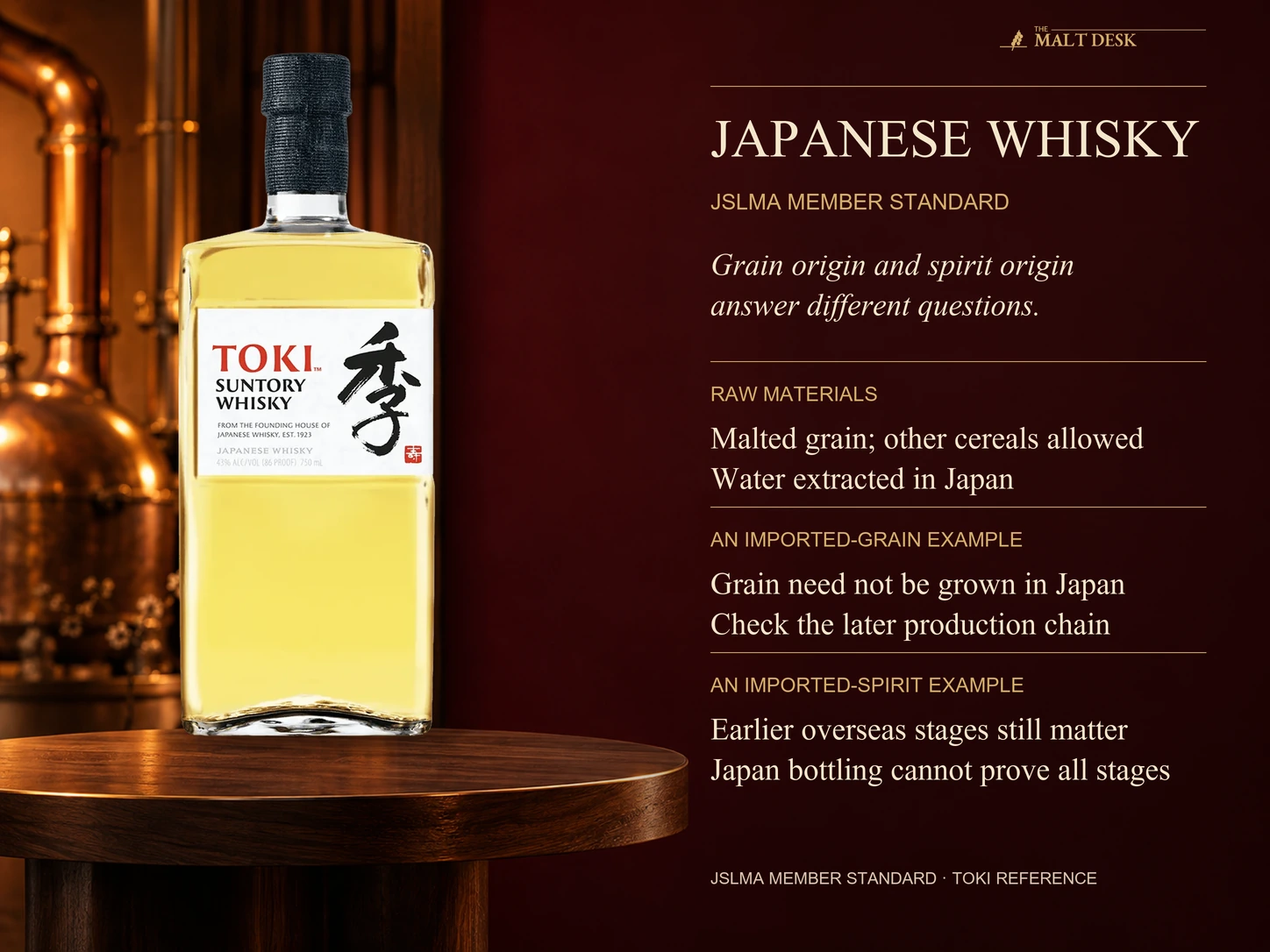
Japanese whisky under the JSLMA member standard does not require every cereal grain to have been grown in Japan. The raw-material wording permits malted and other cereal grains and specifically requires water extracted in Japan. The domestic conditions then attach to the production, maturation and bottling chain. Grain origin and spirit provenance are related questions, but they are not interchangeable.
That distinction gives a practical answer to two superficially similar import stories. Importing barley for processing in Japan is not the same event as importing distillate made elsewhere. A grain’s foreign origin does not itself fail the standard, while Japanese bottling or further distillation cannot be assumed to erase an earlier foreign production stage.
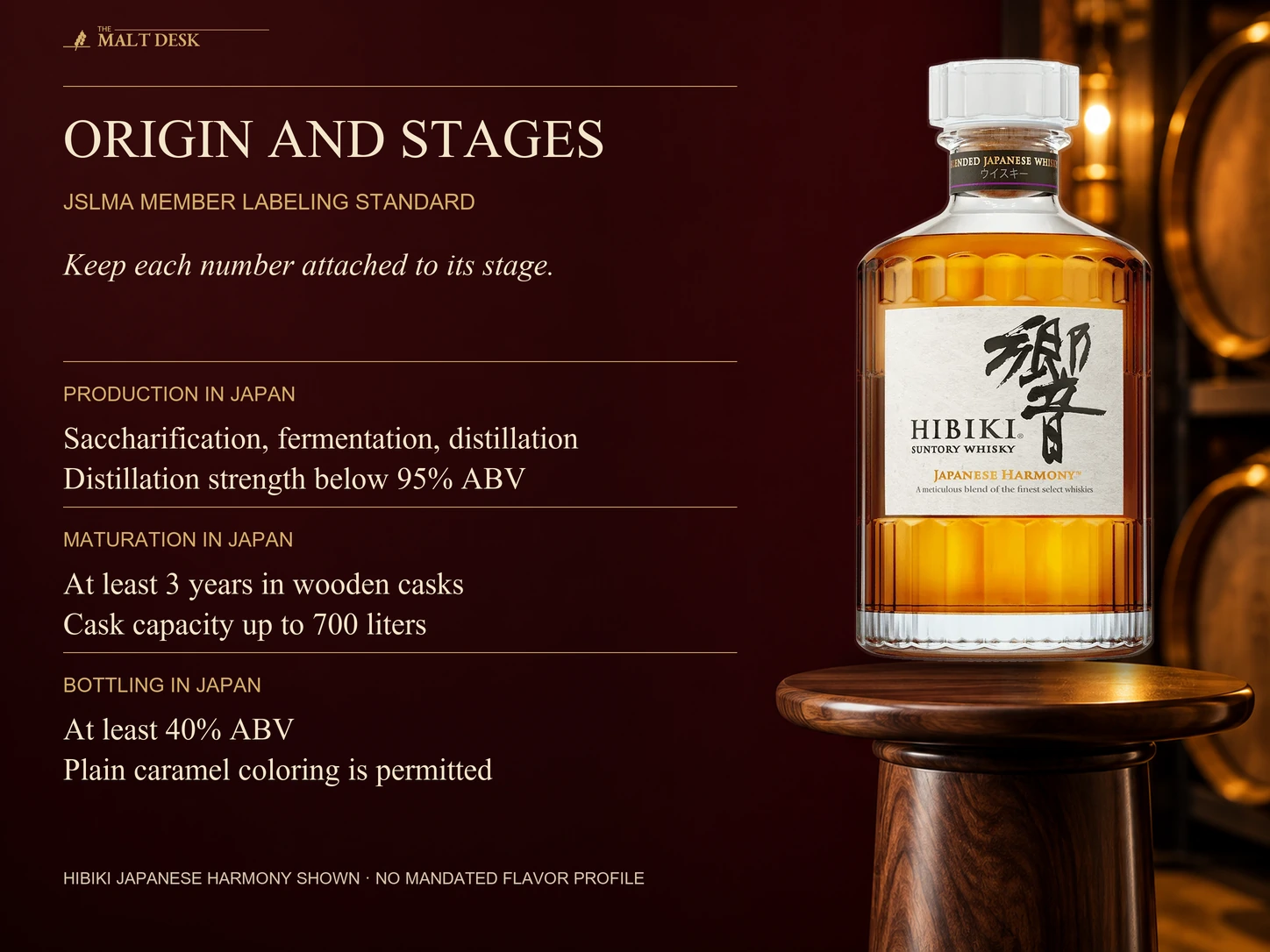
Japanese whisky is whisky that meets the Japan Spirits & Liqueurs Makers Association labeling standard: malted grain must be used; production water must come from Japan; saccharification, fermentation and distillation must occur at a Japanese distillery; the spirit must be distilled below 95% ABV; it must mature in Japan for at least three years in wooden casks no larger than 700 liters; and it must be bottled in Japan at 40% ABV or higher. Other cereal grains and plain caramel coloring are permitted.
The crucial nuance is legal scope. The JSLMA standard is an industry rule followed by association members, not a national geographical indication that automatically binds every producer. It took effect in 2021, with the transition completed for member products labeled and bottled after April 1, 2024.
For a buyer, the safest sequence is simple: look for an explicit Japanese Whisky statement, verify the producer or distillery page, then compare style, age, ABV, casks and price. Japanese imagery or a Japanese brand name alone does not prove Japanese-whisky provenance.
Key Takeaways
- Japanese water and Japanese distillery production are required.
- Distillation must remain below 95% ABV.
- Maturation must last at least three years in Japan in wooden casks up to 700 L.
- Bottling must take place in Japan at a minimum of 40% ABV.
- Malted grain is mandatory, but other cereal grains are allowed.
- Plain caramel coloring is permitted, so Japanese Whisky does not automatically mean natural color.
- The JSLMA rule binds its members; it is not the same legal structure as the Scotch Whisky Regulations or the Irish Whiskey geographical indication.
- The Japanese Whisky logo can help identification, but the label and producer confirmation matter more than the presence or absence of one mark.
- Blended, single malt and grain Japanese whiskies can all qualify when the full origin standard is met.
- A Japanese company’s name identifies its owner; a Japanese-whisky designation concerns the specified production chain. Check those two fields separately.
What Is Japanese Whisky?
Japanese whisky is a provenance claim before it is a flavor claim. It tells you where the production chain happened and establishes a minimum maturation and bottling standard.
That distinction matters because the category developed before a shared industry definition existed. Japanese producers historically built varied stocks in-house, acquired foreign distilleries and sometimes used imported whisky in blends. As international demand grew, bottles with Japanese names or imagery could be mistaken for whisky distilled and matured entirely in Japan.
Is the JSLMA Standard a Law?
No. It is a voluntary industry labeling standard, although it is binding on members that have committed to it. Calling it a Japanese-whisky law or a national geographical indication would overstate its reach.
The practical result is still meaningful. Suntory, Nikka and other major member producers identify qualifying products and avoid Japanese provenance language on member products that do not meet every condition. The standard also restricts misleading references for non-qualifying member whisky, including Japanese place names, people, eras, flags or other imagery that could falsely imply Japanese origin.
The limit is that not every producer in Japan belongs to the association. A bottle from a non-member may be distilled and matured entirely in Japan, yet the JSLMA system alone cannot certify it. In that case, transparent production details from the distillery become especially important.
What Do the Rules Require?
| Stage | Current JSLMA requirement | What to check |
|---|---|---|
| Raw materials | Malted grain, other cereal grains and water extracted in Japan; malted grain is mandatory | Producer states Japanese water and a grain-based whisky mash |
| Saccharification | Must occur at a distillery in Japan | The mash is made in Japan, not imported as mature whisky |
| Fermentation | Must occur at a distillery in Japan | The fermented wash is produced in Japan |
| Distillation | Must occur in Japan below 95% ABV | The spirit is distilled in Japan rather than only blended there |
| Maturation | At least 3 years in Japan in wooden casks no larger than 700 L | Full qualifying maturation takes place in Japan |
| Bottling | Must occur in Japan at 40% ABV or higher | Exported bulk spirit bottled elsewhere cannot use the member designation |
| Coloring | Plain caramel coloring is permitted | Do not infer natural color without a separate statement |
The three-year minimum resembles the familiar Scotch and Irish floor, but the systems are not identical. The Japanese standard specifically combines the maturation location, 700-liter cask ceiling and domestic bottling requirement with the full Japanese production chain.
What Changed on April 1, 2024?
The standard itself became effective on April 1, 2021. Producers received a three-year transition period to adjust labels and product communication. That transition ended on March 31, 2024.
For JSLMA members, whisky labeled and bottled after April 1, 2024 must meet the standard to use the Japanese-whisky designation. This date is easy to misread as the day Japanese whisky was legally created. It was instead the point at which the association’s transition finished and full member compliance became visible to consumers.
Older bottles require more care. A pre-transition label may reflect the previous system even when a current version has clearer provenance. Check the specific bottling, market and producer statement rather than assuming every edition of a brand has identical status.
How Is Japanese Whisky Made?
1. Grain and Japanese water
Malted grain must be part of the recipe because its enzymes support conversion during mashing. Other cereals may also be used, which allows both malt and grain whisky production. The production water must be extracted in Japan.
2. Saccharification and fermentation in Japan
The grain is milled and mashed so enzymes convert starch into fermentable sugar. Yeast then creates alcohol and flavor precursors. Both steps must happen at a Japanese distillery; importing fermented wash would not satisfy the standard.
3. Distillation below 95% ABV
Distillation must occur in Japan and finish below 95% ABV. Pot stills can create weighty malt spirit, while continuous stills can produce lighter grain whisky. Still shape, cut points, reflux and distillation strength influence flavor more directly than nationality alone.
4. At least three years of maturation in Japan
The new make spirit enters wooden casks no larger than 700 liters and remains in Japan for at least three years. American oak, sherry-seasoned European oak, Japanese mizunara and wine casks can all shape flavor, but none is mandatory for the whole category.
5. Blending and domestic bottling
Mature stocks can be combined to create a single malt, grain whisky, blended malt or blended whisky. The finished whisky must be bottled in Japan at no less than 40% ABV. Plain caramel may be used for color consistency.
Why the Origin Standard Allows Different Styles
The labeling standard defines provenance and minimum production conditions. It does not mandate one still design, one grain recipe, one cask species or one flavor profile. Different compliant expressions can therefore have different production choices and published aroma descriptions.
Suntory’s descriptions of Toki and Hibiki Japanese Harmony illustrate different blending emphases within one producer. Nikka’s distinction between Coffey Grain and Coffey Malt also shows why raw material, distillation method and Japanese-whisky status need to be checked separately.
What Are the Main Types?
Blended Japanese whisky
Blended products have their own disclosed components and recipes. Suntory Toki is presented by Suntory as a malt-and-grain blend with a prominent highball role. Hibiki Japanese Harmony is a separate no-age-statement blend with a 43% reference and floral/honey-associated producer notes.
Blended whisky identifies a composition of malt and grain whiskies.
Single malt Japanese whisky
Single malt comes from malted barley at one distillery. Yamazaki, Hakushu, Yoichi and Miyagikyo show how broad that category can be. Distillery design, fermentation, stills, peat, casks and climate all remain visible.
Single does not mean one cask or one batch. A single malt can combine many casks and ages as long as the malt whisky comes from the named distillery and the full Japanese-whisky origin standard is met.
Grain Japanese whisky
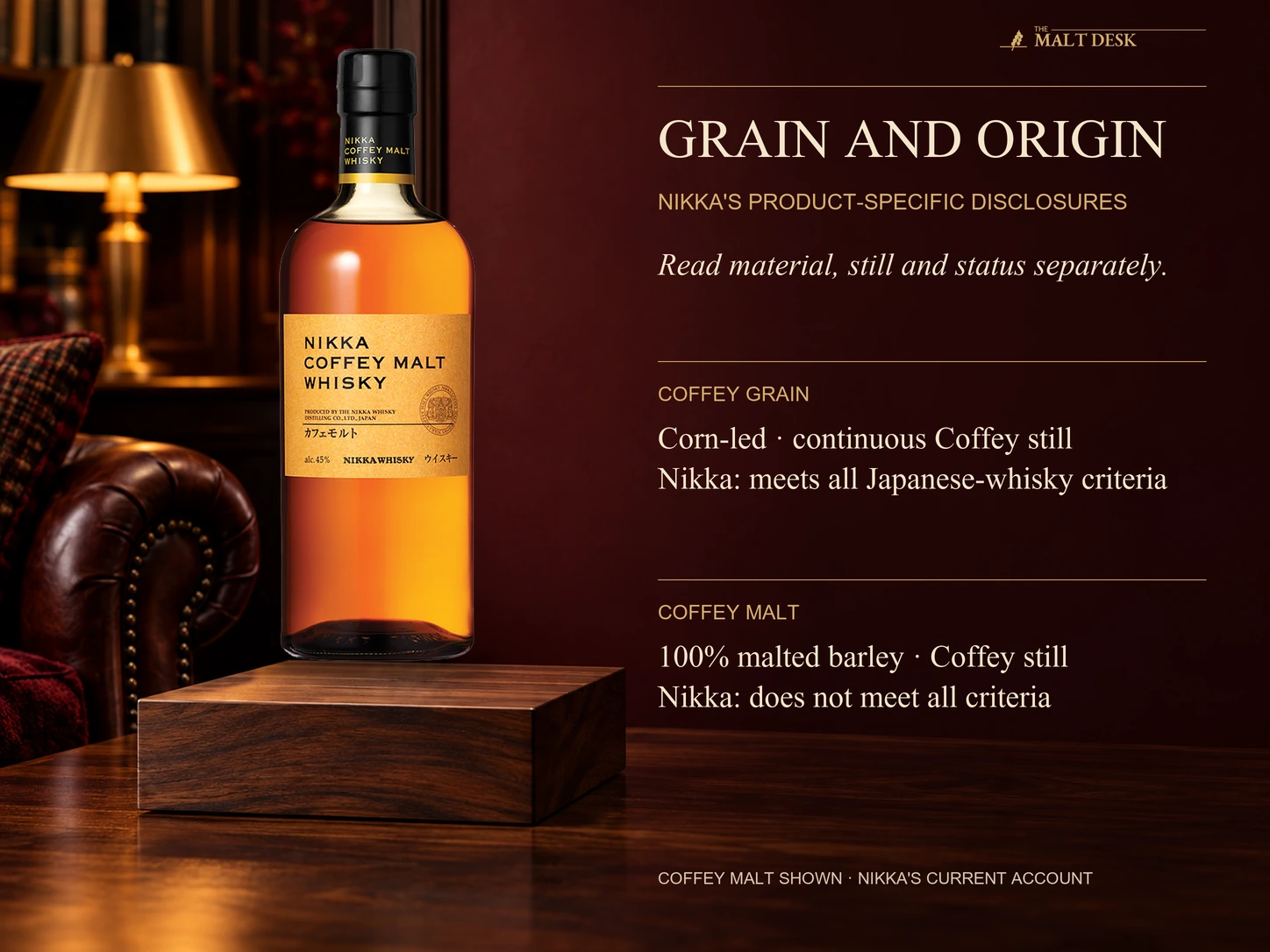
Nikka Coffey Grain is a concrete corn-led, continuous-still example.
Nikka’s current product page states that Coffey Grain meets the JSLMA Japanese-whisky criteria. Coffey Malt is made from 100% malted barley in Coffey stills and is categorized by Nikka as grain whisky. The producer says it does not meet all Japanese-whisky criteria because some old batches used imported Ben Nevis distillates that were then distilled in its Coffey stills. Grain choice, still method and origin status answer different questions.
Blended malt and pure malt
Blended malt combines malt whiskies from more than one distillery without grain whisky. Pure malt is an older or producer-preferred expression for a similar malt-only blend in some markets.
It can qualify as Japanese whisky if every component and every production stage meets the standard. If overseas malt is included, the product may remain a legitimate whisky but cannot be presented by a JSLMA member as Japanese whisky.
Does a Japanese Brand Name Prove Origin?
No. A Japanese company can make or sell whisky that includes imported stocks. That fact does not automatically make the whisky fake, poor or deceptive. It means the bottle should be judged under the provenance it actually claims.
Nikka’s product-specific compliance statement is a more useful check than assuming a whole brand has one status. The Coffey Grain and Coffey Malt page explicitly distinguishes the two current expressions; do not transfer that statement to another market version or unrelated Nikka product.
The buying mistake is not choosing a world blend. The mistake is paying a Japanese-whisky premium because packaging created an assumption the label never made.
What Does Japanese Whisky Taste Like?
There is no mandatory Japanese-whisky flavor. The standard controls provenance and minimum production conditions.
- Toki’s producer describes green fruit, herbs and honey associations.
- Hibiki Japanese Harmony has floral-fruit and honey/orange-associated producer notes.
- Nikka Coffey Grain is a corn-led continuous-still expression with a product-specific origin statement.
- Nikka Coffey Malt shows why 100% malted barley does not alone establish malt-whisky category or Japanese-whisky status.
- A Mizunara-associated producer note does not disclose an exclusive cask recipe.
Follow What Crossed the Border
Consider an illustrative grain shipment grown outside Japan. If saccharification, fermentation and qualifying distillation then occur at a Japanese distillery, followed by the required Japanese maturation and bottling, the foreign growing location alone is not a disqualifying condition in the member standard. This is a reading of its requirements, not a claim about the sourcing of every Japanese distillery.
Now consider a spirit already distilled overseas and shipped to Japan. Japanese ownership, local blending or local bottling does not by itself establish that the earlier saccharification, fermentation and distillation occurred in Japan. The chain must be checked; a final-stage Japanese location cannot substitute for all its earlier stages.
| Imported material in the illustrative case | Question to ask | What the import alone establishes |
|---|---|---|
| Cereal grain | Where were the required production stages carried out? | Foreign grain growing, not necessarily foreign spirit production |
| Fermented wash | Where did fermentation and saccharification occur? | A production-stage provenance question |
| Distillate or mature whisky | Where were the qualifying production and maturation stages completed? | Local bottling cannot establish the entire Japanese chain |
Nikka Gives a Concrete Distillate Example
Nikka says Coffey Malt includes part of older formula batches made from imported Ben Nevis distillates that were later distilled in its Coffey stills. It explicitly says the product does not meet every Japanese-whisky criterion. The second distillation’s local equipment does not justify replacing that product-specific status with an inference from the Japanese brand or the malted-barley recipe.
The example should remain attached to Coffey Malt. Nikka’s qualifying statement for Coffey Grain is separate, and the incomplete provenance of one product is not evidence against all products from the company. Nor is it a quality verdict. A reader can value a disclosed production experiment while retaining its actual origin status.
How Should You Read the Label?
- Look for the complete phrase Japanese Whisky, not only a Japanese brand name.
- Check the producer’s current product page for a clear compliance statement.
- Treat the JSLMA Japanese Whisky logo as useful evidence, not the only possible evidence. The association created it to make qualifying bottles easier to identify, but logo use is not the definition itself.
- Read single malt, grain, blended malt or blended as style information after provenance is established.
- Check age separately. A no-age-statement bottle can qualify fully.
- Check natural color and chill filtration separately. The standard permits plain caramel and does not make a universal non-chill-filtration promise.
- Check cask claims carefully. Mizunara is distinctive but not a requirement for Japanese whisky.
- Match the exact bottle and market. Formulas, sizes and labels can vary.
How to Compare Japanese Whisky Styles
First establish the exact expression and its production provenance. Then compare category, stated age, ABV and disclosed casks. Keep producer flavor descriptions separate from those measurable label facts.
Toki and Hibiki Japanese Harmony offer two blended-whisky references, while compliant single malts and grain whiskies provide other production categories. The highball guide explains serving variables; it does not change whether a whisky meets the origin standard.
What Are the Most Common Myths?
Japanese whisky must use Japanese oak
False. Mizunara is famous, but bourbon, sherry-seasoned European oak and other wooden casks are widely used. The standard does not require mizunara.
Japanese whisky must have an age statement
False. The spirit must be at least three years old, but a bottle can omit an age statement. Toki and Hibiki Japanese Harmony are compliant NAS products.
Japanese whisky is always light and smooth
False. Some blends are deliberately light, while Yoichi and other malt whiskies can be smoky, oily or robust.
Every whisky made by a Japanese company is Japanese whisky
False. Company nationality and spirit provenance are different questions.
A non-qualifying whisky is automatically bad
False. The standard answers where and how was it made? Transparent world blends can be excellent; they should simply be labeled and priced honestly.
Final Answer
Japanese whisky now has a much clearer meaning for JSLMA members. Malted grain and Japanese water begin the chain; mashing, fermentation and sub-95% distillation happen at a Japanese distillery; maturation lasts at least three years in Japan in wooden casks up to 700 liters; and bottling occurs in Japan at 40% ABV or higher.
The phrase still needs context. It is an industry labeling standard rather than a national geographical indication, and non-members sit outside its direct reach. That is why an explicit label statement and current producer confirmation remain more reliable than a Japanese name, calligraphy or landscape.
After checking JSLMA member-standard provenance, compare the individual expression’s category, age statement, ABV and producer descriptions. The member-origin standard does not dictate one flavor, texture or serving method.
The Malt Desk conclusion: verify the exact Japanese Whisky claim and producer statement, then compare the individual product specifications.
Trace Japanese Whisky Through the Production Chain
For a Japanese-whisky provenance question, check the stated standard and the location requirements for production, maturation and bottling. Ask about grain origin separately if agricultural sourcing matters to you. This lets the reader evaluate the specific claim on a label while keeping the spirit’s production chain and its raw-material sourcing clearly recorded.
Frequently Asked Questions
Is Japanese whisky made entirely in Japan?
Under the JSLMA standard, qualifying whisky uses Japanese production water and is saccharified, fermented, distilled, matured and bottled in Japan.
How long must Japanese whisky age?
At least three years in Japan in wooden casks no larger than 700 liters.
Is the Japanese whisky standard a law?
No. It is a voluntary labeling standard established by the JSLMA and followed by its members.
Can Japanese whisky use caramel coloring?
Yes. Plain caramel coloring is permitted, so natural color must be confirmed separately.
Does Japanese whisky have to use mizunara oak?
No. Mizunara is optional. Bourbon, sherry-seasoned and other wooden casks are also used.
Are Suntory Toki and Hibiki Japanese Harmony real Japanese whisky?
Yes. Their current official product pages state that they meet the JSLMA labeling standard.
Is Nikka From the Barrel Japanese whisky?
Do not infer status from the Japanese producer or packaging. Check the current product page for the exact market and bottling; Nikka distinguishes qualifying and non-qualifying products individually.
What should a beginner buy first?
Start by understanding category and provenance, then compare published product descriptions and serving methods. Beginner status alone does not determine a preferred flavor.
Sources
Japan Spirits & Liqueurs Makers Association, Standards for Labeling Japanese Whisky and logo guidance; Nikka Coffey Grain/Coffey Malt product and labeling-standard pages; Suntory Toki and Hibiki Japanese Harmony producer information. Checked October 4, 2026. JSLMA member standards and product-specific compliance statements are kept distinct from statutory rules and sensory preference.
Provenance analysis note: the grain and spirit border-crossing cases are illustrative readings of JSLMA member requirements. Nikka’s historical-batch explanation remains product-specific. No undisclosed distillery grain sourcing or quality judgment is inferred.