A chiller that feels cold quickly can still have little capacity left to absorb heat. The initial rate of heat transfer and the total energy it can take up are different properties. I would check both when evaluating a claim that steel, stone or a certain number of pieces is equivalent to ice.
The distinction also explains why a material name is incomplete product information. Mass and heat capacity matter for a solid; a filled chiller needs an account of its cooling medium. Ice adds its phase-change capacity, with meltwater becoming part of the drink. A quick first temperature drop does not describe the whole serving period.
Whiskey stones and ice cool a drink in different ways. A chilled solid absorbs heat as it warms. Ice also absorbs energy as it melts, adding water to the drink in the process. The practical choice depends on whether the aim is a modest temperature change without meltwater or an iced preparation that includes dilution.
Quick Comparison: Ice and Reusable Chillers
| Method | Cooling mechanism | Adds water | Variables to control |
|---|---|---|---|
| Ice | Warms and melts while absorbing heat | Yes | Total mass, cube size, starting temperature, time and agitation |
| Solid stone | Warms as the solid material absorbs heat | No direct addition | Material, mass, dimensions and starting temperature |
| Filled metal chiller | Depends on the shell and sealed cooling medium | No direct addition if intact | Construction, filling, mass and preparation instructions |
Compare the cooling mechanism and the variables you can control for the intended serve.
How the cooling works
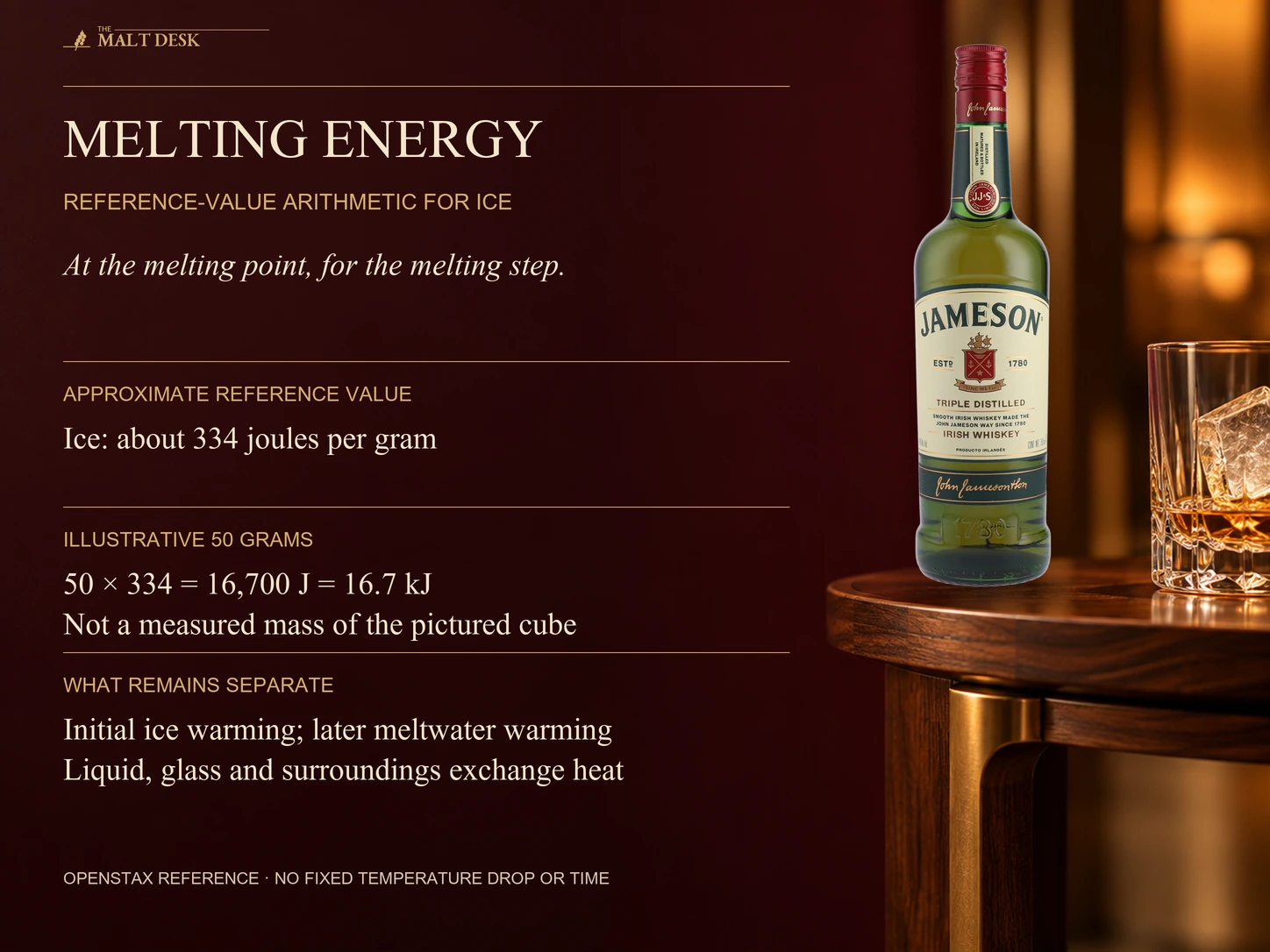
Using the reference latent heat of about 334 joules per gram, an illustrative 50 g of ice melting at its melting point absorbs about 16,700 joules, or 16.7 kJ, for the melting step. Initial warming from below zero is separate. This energy calculation is not a prediction of a fixed drink temperature or cooling time; liquid, glass and surroundings also exchange heat.
Heat flows from the warmer liquid and glass into the colder object. For a solid stone, the energy absorbed depends on its mass, material and temperature change. A small stone and a large stone therefore cannot be compared by their material name alone.
Ice has an additional mechanism: melting. OpenStax’s physics treatment gives the heat needed to melt ice at about 334 joules per gram at its melting point. This phase-change energy is separate from the energy absorbed while frozen ice warms to that point.
Ordinary solid soapstone and granite do not undergo a comparable phase change in the glass. However, some reusable metal chillers contain a sealed cooling medium. Their behavior depends on the filling and construction, so the claim that every reusable chiller lacks phase-change cooling is too broad.
Neither a universal temperature drop nor a fixed cooling time follows from those principles. Starting temperatures, drink volume, glass mass, chiller mass, stirring and room conditions all affect the result. Count and dimensions should be recorded when comparing products.
No meltwater does not mean no sensory change
A sealed reusable chiller can cool a drink without directly adding water. That preserves the starting composition more closely than melting ice, but temperature itself changes the conditions under which aromas reach the air above the glass.
This distinction is useful when evaluating “preserves the original flavor” claims. Fixed dilution and fixed temperature are different conditions. A comparison should state which was held constant rather than assuming that no added water means no change at all.
What dilution research can explain
Karlsson and Friedman’s 2017 Scientific Reports study used computer simulations of guaiacol in water–ethanol mixtures. It found concentration-dependent differences in where this aroma compound was located, including at the liquid–air interface. It was a molecular model, not a blind preference test proving that every whisky improves with water.
Adding water lowers alcohol concentration and can change aroma perception. Whether that is preferable depends on the whisky, amount added and individual preference. Measured water makes the comparison easier to reproduce than an ice cube that continues melting.
For example, treating volumes as approximately additive, 30ml of 40% ABV whisky plus 10ml of water gives about 30% ABV. This practical estimate treats liquid volumes as approximately additive. The serving guide explains common dilution methods.
Large cubes and small cubes
For equal total ice volume, dividing ice into smaller pieces increases the exposed surface area. That can speed heat transfer under comparable conditions. It does not mean a large cube guarantees less total dilution under every preparation.
The amount that melts also depends on the heat removed from the drink, glass and surroundings. Ice quantity, initial temperature, agitation and elapsed time matter alongside geometry. Compare the same starting conditions if you want to isolate cube size.
A large cube is a practical format for a rocks glass, while smaller ice may fit a tall glass more easily. Use clean water and store finished ice away from freezer odors.
Reusable chiller materials
Soapstone and other solid stone: performance depends on mass, heat capacity and heat transfer. Check that the product is intended for food contact and inspect it for chips or loose fragments.
Solid stainless steel: its mass and conductivity differ from stone, but the word steel alone does not specify cooling performance.
Filled stainless steel: the shell encloses a cooling medium. Filling composition, mass, seals and preparation instructions matter. Do not assume that a hollow product behaves like a solid metal block.
Use the manufacturer’s cleaning and freezing instructions. Lower hard chillers into a sturdy glass gently, and avoid letting them slide against teeth while drinking. Stop using a damaged, leaking or chipped item.
How to make a useful comparison
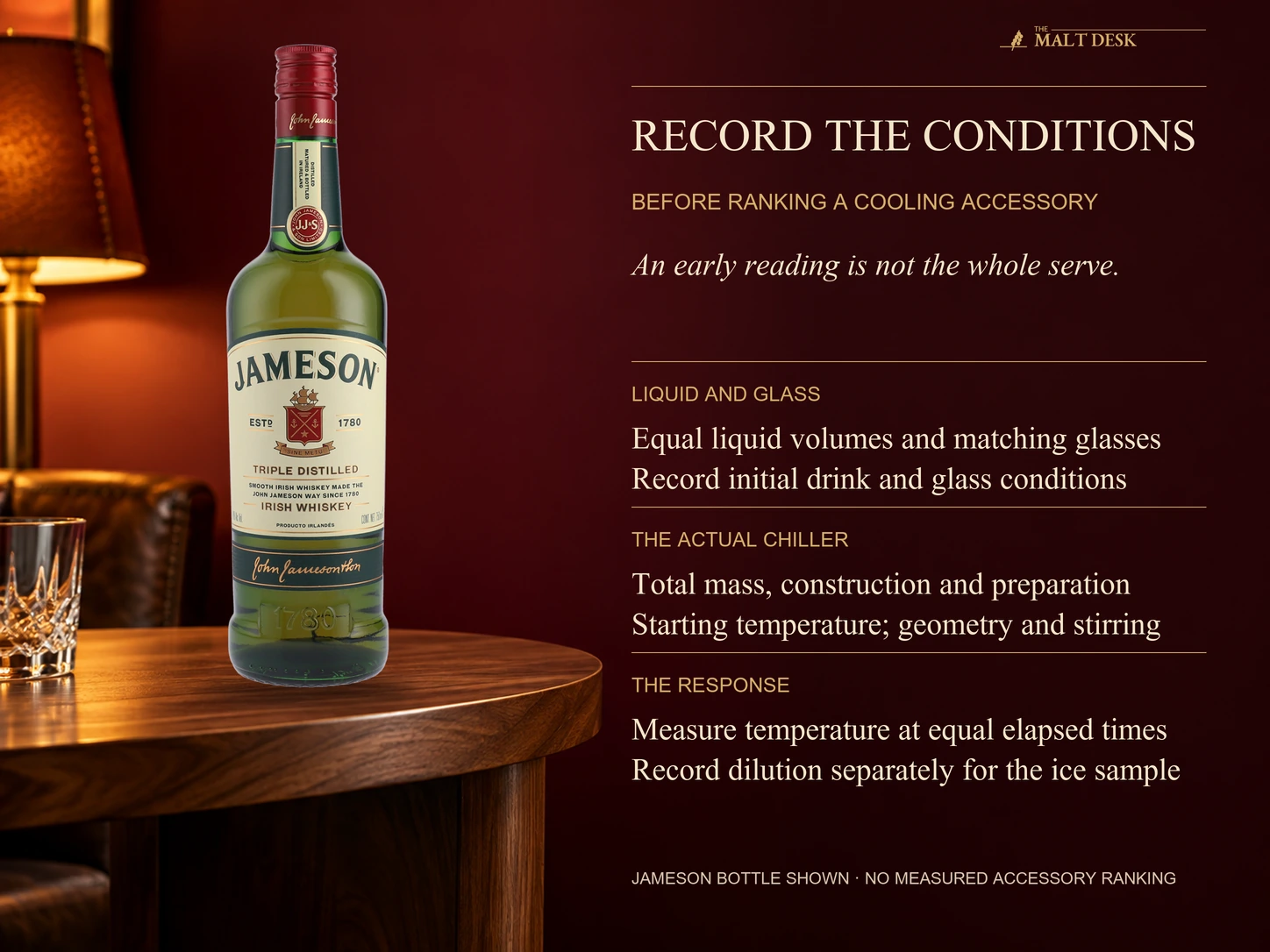
Start with equal liquid volumes in matching glasses. Record the initial drink and chiller temperatures where possible, the total chiller mass and whether the drink is stirred. Measure the temperature at the same elapsed times.
For an ice sample, also record dilution if you can. A colder sample and an undiluted sample answer different questions, so a single “winner” can obscure the trade-off. A test using water also should not be reported as a direct sensory test of whisky.
A chilled empty glass offers another modest cooling option without a loose object in the drink. It still has a limited capacity to absorb heat. The storage guide separates serving temperature from long-term bottle care.
An Energy Budget Puts the Mechanisms on the Same Page
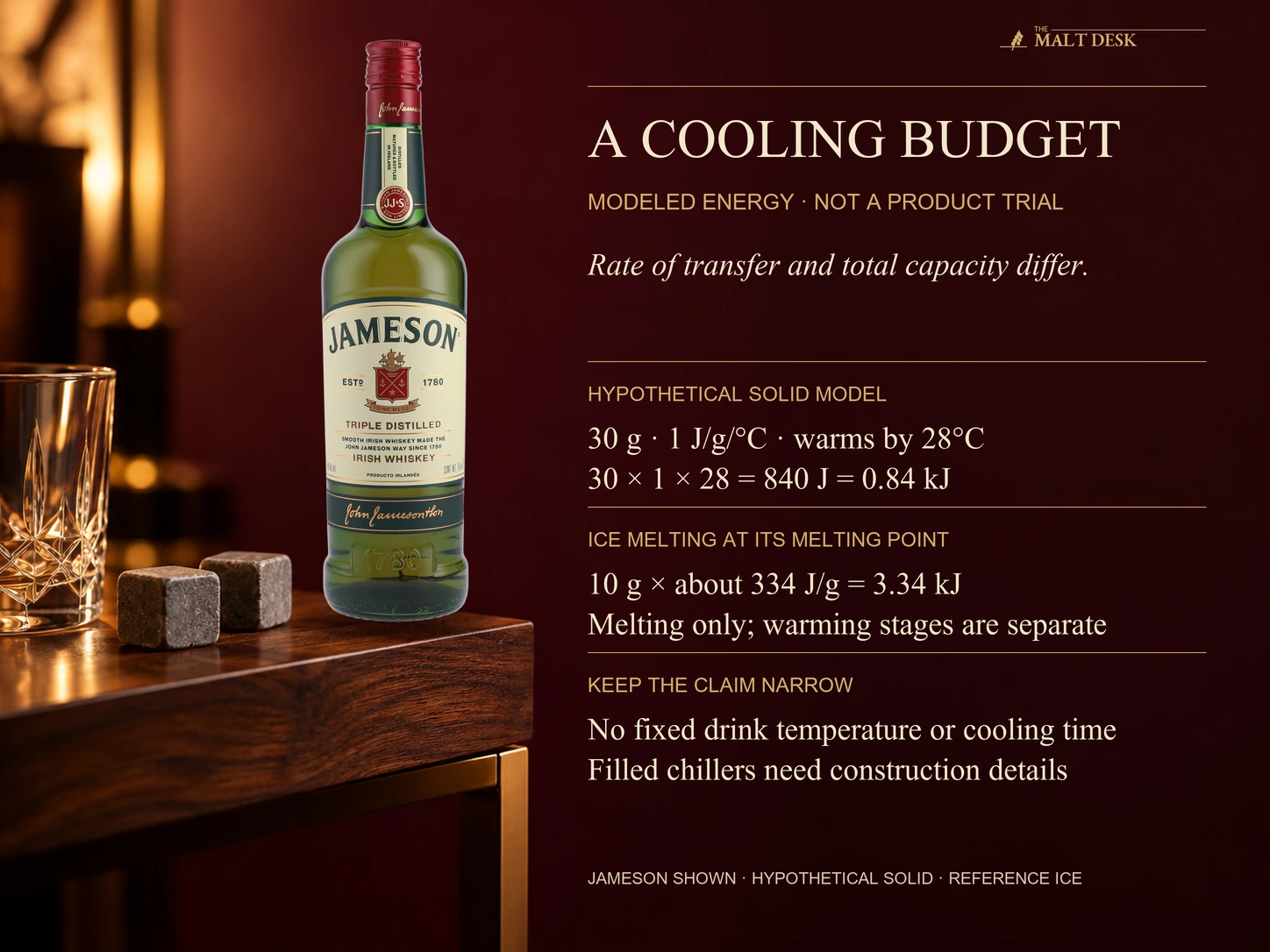
Take a hypothetical solid chiller weighing 30 g with a constant specific heat of 1 joule per gram per degree Celsius. If it warms from −18°C to 10°C without changing phase, its modeled heat uptake is 30 × 1 × 28 = 840 joules, or 0.84 kJ. The calculation uses explicitly invented product properties for the arithmetic example.
By comparison, melting 10 g of ice at its melting point absorbs approximately 3.34 kJ using the roughly 334-joule-per-gram reference. That melting step alone takes up nearly four times the example solid’s modeled energy. Initial warming of frozen ice and later warming of meltwater are separate, so this is not a complete equilibrium calculation for a drink.
| Illustrative mechanism | Specified inputs | Modeled heat uptake |
|---|---|---|
| Solid warming, no phase change | 30 g; 1 J/g/°C; 28°C rise | 0.84 kJ |
| Ice melting at its melting point | 10 g; approximately 334 J/g | 3.34 kJ for melting alone |
Faster Transfer Cannot Create More Capacity
A high heat-transfer rate can use available capacity sooner, but it does not increase the total budget in that same object. Once a solid warms close to the drink, there is less temperature difference driving further cooling. A material comparison that records only the first minute can therefore miss how the temperatures develop afterward.
The arithmetic also cannot predict the drink’s final temperature from the chiller alone. The liquid, glass and surroundings supply heat, and a filled metal product may have additional phase-change behavior. To evaluate an actual accessory, record its construction and total mass and measure the temperature under the intended conditions. Do not assign the hypothetical solid’s value to every stone or sealed metal cube.
If limiting meltwater is the priority, reduce the initial cooling demand where appropriate by chilling the glass or ingredients beforehand, or select a separately measured water addition for the intended concentration. These choices change the preparation. They should be recorded as such rather than credited as improved performance of an unchanged accessory.
Equipment Details to Compare
The earlier equipment prices lack complete original records of seller location, dimensions, stock and offer conditions, so they are not used as current offers or historical category averages. Match the actual construction and final local cost when considering equipment.
A useful equipment comparison includes dimensions, total mass, material, food-contact suitability and cleaning instructions. A gift box or included tongs can change the price without changing cooling performance. Ice molds and reusable chillers solve overlapping but different preparation needs.
Choosing a preparation
For an unchanged reference, use a neat sample at a recorded temperature. For controlled dilution, add measured water. For an iced drink, use ice and accept that both temperature and dilution develop over time. For cooling without meltwater, a suitable reusable chiller can provide an alternative, with performance depending on its construction.
Highball and stirred-cocktail recipes normally account for ice in their preparation. Substituting a reusable chiller changes the recipe’s cooling and dilution, so it is not a direct one-for-one replacement. See the highball guide for preparation context.
Choose Cooling Capacity and Cooling Speed Together
Choose ice when cooling plus evolving dilution is the intended serve. For stones or steel chillers, compare usable mass, starting temperature and a recorded temperature history in the intended glass. Check that the pieces fit and can be handled comfortably. The practical choice follows both how quickly the drink cools and how much cooling the chiller can sustain.
Common questions
Do stones add water?
An intact, clean reusable chiller does not add meltwater in the way ice does. Surface frost or residual wash water can still introduce a small amount.
Does a large cube never over-dilute?
No. It still melts. Size affects heat-transfer conditions, while the total heat absorbed and time in the glass also matter.
Is steel always better than stone?
There is no universal result from the material name alone. Compare mass, construction, starting conditions and the desired temperature change.
Sources
OpenStax, Physics, Phase Change and Latent Heat; Karlsson and Friedman, Dilution of whisky – the molecular perspective (2017), checked October 4, 2026. The 50 g example is reference-value arithmetic, not a product cooling trial.
Cooling-budget analysis note: the solid’s mass and heat capacity are hypothetical. Ice uses an approximate reference latent heat. These energy examples do not predict final drink temperature, cooling time, actual product performance or sensory preference.