Three Irish Blends, Three Production Descriptions
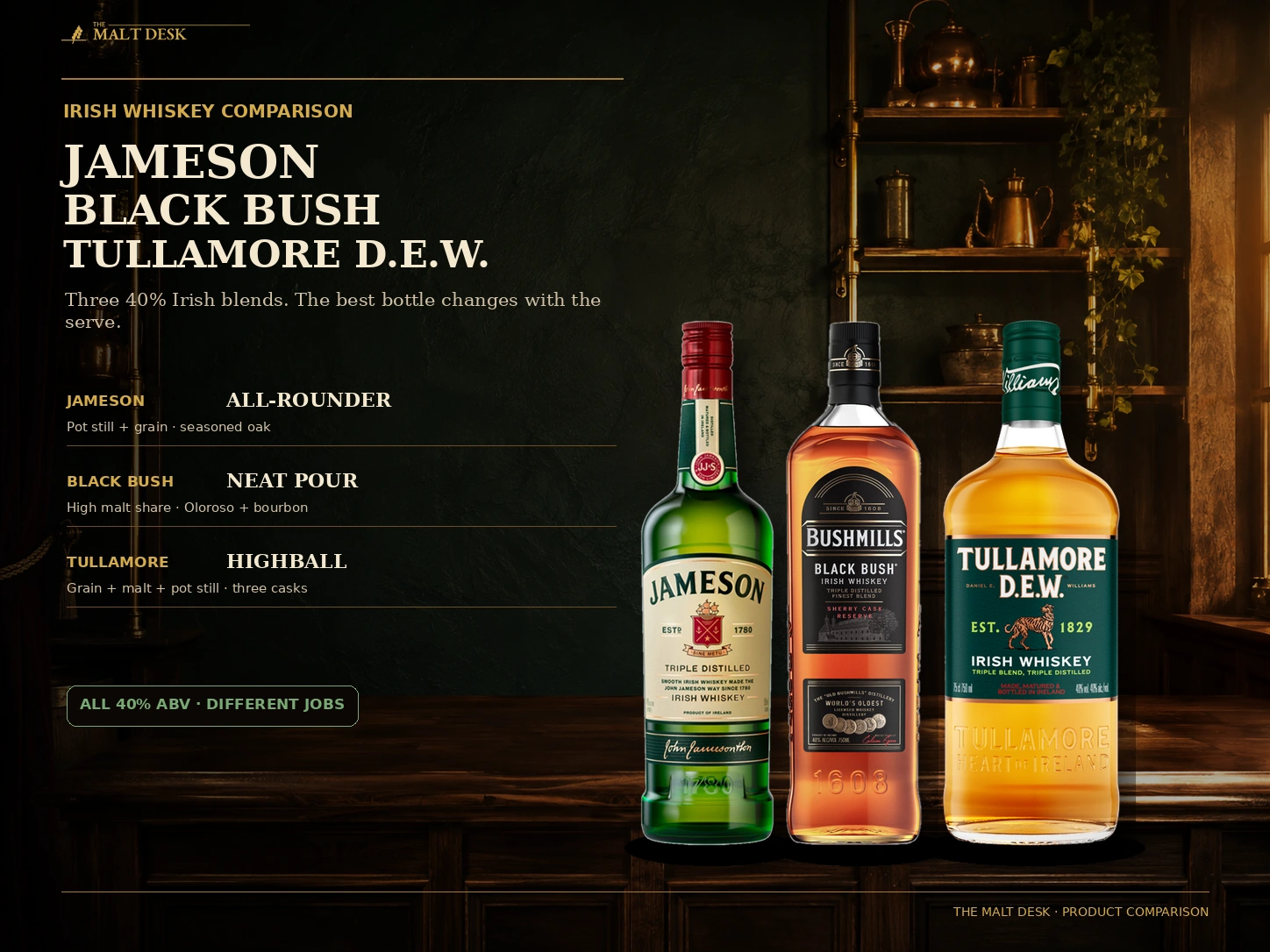
Jameson Original, Bushmills Black Bush, and Tullamore D.E.W. Original are blended Irish whiskeys. The standard reference bottles compared here are 40% ABV, equivalent to 80 U.S. proof. Their useful differences lie in the component whiskey types and maturation descriptions rather than a universal “winner.”
This guide compares producer information and explains how to compare local prices. Flavor language is attributed to the producers; no firsthand tasting, highball test, or numerical mixability score is presented.
Jameson Original: Pot Still and Grain
Jameson describes pot still and grain components, triple distillation, and at least four years in seasoned oak. These details distinguish the standard expression from a single pot still whiskey and from other Jameson releases. The brand’s smoothness language is a sensory claim, not a mathematical consequence of distilling three times.
The Jameson guide provides individual expression context. A consistent brand identity does not establish that a whiskey is best for every serving method.
Bushmills Black Bush: Malt and Casks
Bushmills describes a high malt proportion blended with grain whiskey and identifies former Oloroso sherry and bourbon casks. Its producer description emphasizes fruit and depth. The official page consulted here does not quantify the malt percentage, so the comparison does not assign a precise share.
That recipe description differs from Jameson’s pot still and grain formulation. It does not prove a measured difference in body or finish length. See the Black Bush guide for expression-specific information.
Tullamore D.E.W. Original: Three Whiskey Types
Tullamore describes a combination of grain, malt, and pot still whiskey. In its explanation, grain is associated with sweetness, malt with fruit, and pot still with spice. Those are the producer’s broad descriptions of component roles, not separate flavor measurements.
“Triple blended” and “triple distilled” describe different aspects of production. Three component types do not mean equal proportions, and they do not establish that the final whiskey is more complex than a blend with two types. The Tullamore D.E.W. guide explores the terminology.
Why Component Types Matter
Malt, grain, and pot still are production categories. They should not be treated as interchangeable labels for sweetness, fruit, or spice. A producer may use those associations to explain a recipe, but the actual profile also depends on fermentation, distillation, maturation, and the final blend.
The single pot still guide explains why a blend containing pot still whiskey is not automatically sold as single pot still whiskey. The category on the bottle remains the starting point.
How to Compare U.S. Prices
This guide does not establish current local prices for the three expressions. A usable comparison needs the same bottle volume, a dated listing, and consistent treatment of taxes and other charges.
A higher asking price does not by itself establish a longer finish or a preferred flavor. Compare the documented blend and maturation information separately from the cost of an equivalent local bottle.
Neat and Highball Comparisons
A highball adds a mixer and changes concentration, temperature, and often carbonation. Calling one whiskey the best highball value requires both reliable prices and a stated recipe and evaluation method. No such test is reported here.
The same limitation applies to “best neat” or “safest all-rounder.” Those are preference judgments, not consequences of a malt proportion or a 40% ABV label. The serving guide explains the underlying terms.
Frequently Asked Questions
Are the standard reference bottles the same strength?
This comparison uses 40% ABV reference bottlings. Verify the specific market label rather than assuming every release under the brand has that strength.
Does Black Bush have a stated malt percentage here?
No. This guide uses the producer’s qualitative high-malt description without adding an unconfirmed percentage.
Does triple blending guarantee better balance?
No. It identifies three component whiskey types. Balance is a sensory judgment that cannot be calculated from that count.
Which should win the comparison?
No universal winner is established. The guide identifies production differences and the information needed for a local price comparison.
Sources and Scope
Jameson Original, Bushmills Black Bush, and Tullamore D.E.W. Original producer product pages. Producer descriptions are distinguished from the price-comparison method. This is an informational comparison with no firsthand tasting scores or retailer purchase links.