Buffalo Trace, Woodford Reserve, and Four Roses Small Batch
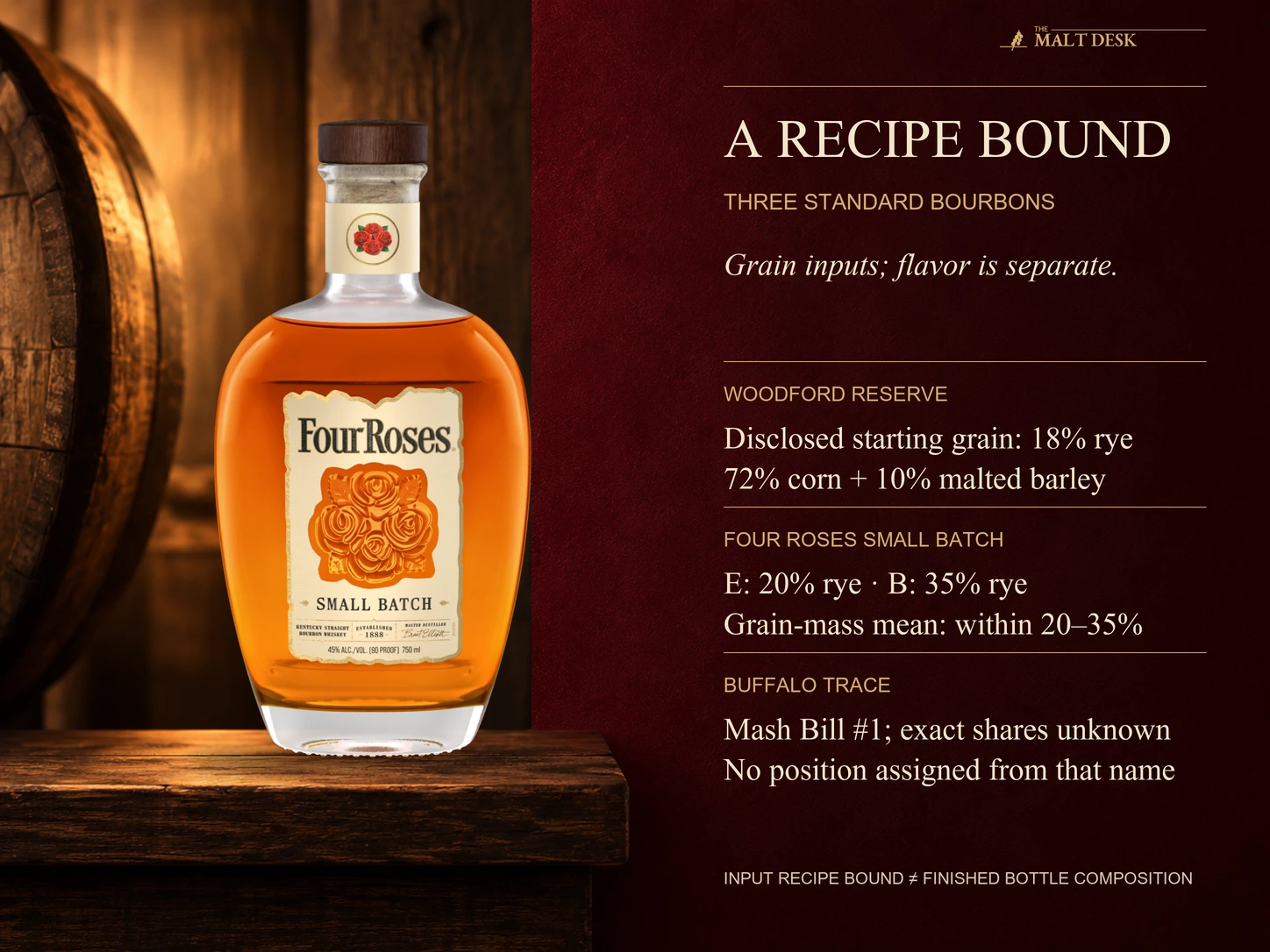
A “low rye to high rye” ladder looks like an appealing way to distinguish these three near-90-proof bourbons. The evidence supports only part of that ladder. Woodford discloses 18% rye in its grain recipe; Four Roses uses two recipes with 20% and 35% rye; Buffalo Trace’s named mash-bill family does not supply an exact producer-published percentage in this comparison.
The useful answer is therefore a bounded production comparison, with one position left unassigned. It can resolve a question such as whether Four Roses’ “lower rye” recipe is actually lower in rye than Woodford’s disclosed recipe.
These three bourbons sit near 90 U.S. proof, but their production descriptions and published flavor vocabulary differ. This comparison covers the standard Buffalo Trace Bourbon, Woodford Reserve Bourbon, and Four Roses Small Batch expressions.
Strength and Product Identity
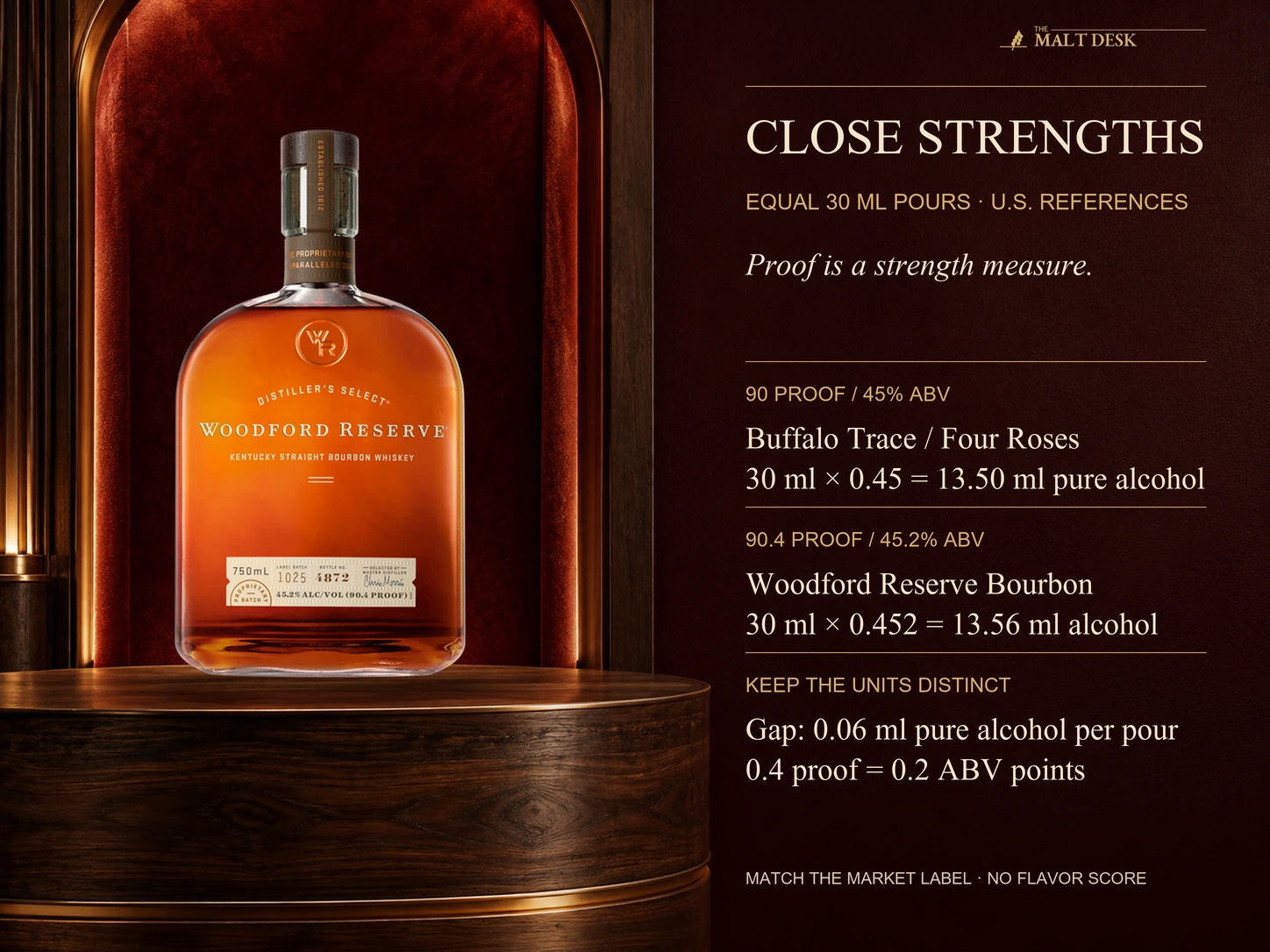
In equal 30 ml measures, the 45% references contain 13.5 ml pure alcohol and Woodford’s 45.2% reference contains 13.56 ml. The difference is 0.06 ml. In U.S. units, 90.4 versus 90 is 0.4 proof, equivalent to 0.2 ABV percentage points.
The U.S. reference strengths are 90 proof for Buffalo Trace, 90.4 for Woodford Reserve, and 90 for Four Roses Small Batch: 45%, 45.2%, and 45% ABV respectively. The small difference in proof does not establish which has more body, a longer finish, or greater complexity. Confirm the label on the specific market bottling.
Do not substitute Woodford Double Oaked for standard Woodford Bourbon, or Four Roses Small Batch Select for Small Batch. Similar brand names can conceal materially different products. An expression-level comparison is more useful than treating every bottle from one producer as interchangeable.
What Each Producer Actually Discloses
| Standard expression | U.S. strength | Published recipe detail | Age information |
|---|---|---|---|
| Buffalo Trace Bourbon | 90 proof / 45% ABV | Producer identifies Mash Bill #1; exact grain percentages are not published on its product page. | No age statement on the standard bottle; the producer says it matures for many years. |
| Woodford Reserve Bourbon | 90.4 proof / 45.2% ABV | Producer specifies 72% corn, 18% rye and 10% malted barley; it combines pot- and column-distilled whiskey. | No age statement on the standard bottle; do not infer a number from its color. |
| Four Roses Small Batch | 90 proof / 45% ABV | Producer identifies four recipes using two mash bills and two yeast strains: OBSK, OBSO, OESK and OESO. | The producer describes the component bourbons as six to seven years old; this is not a front-label age statement. |
This is a comparison of what is published. Woodford gives exact grain proportions, Buffalo Trace names a mash-bill family without percentages, and Four Roses names the component recipes. A missing percentage or age statement should remain unknown in this comparison.
Buffalo Trace: Published Profile
Buffalo Trace’s producer notes describe vanilla, mint, molasses, brown sugar, and spice.
The Buffalo Trace guide covers the standard expression. A local price or allocation pattern should be documented separately from the flavor description.
Woodford Reserve: Published Profile
Woodford’s bourbon page describes dried fruit, citrus, cocoa, mint, and spice.
The Woodford Reserve guide provides expression-specific context.
Four Roses Small Batch: Recipe Information
Four Roses identifies four recipes for Small Batch: OBSK, OESK, OBSO, and OESO. Its explanation associates the K yeast with spice and the O yeast with fruit. The company’s wider production system uses two mash bills and five yeast strains; the existence of ten recipes does not mean all ten are present in this expression.
The producer’s range information describes Small Batch as 90 proof with components aged six to seven years. A producer age description and a front-label age statement are different pieces of evidence. Record both accurately rather than replacing one with the other.
See the Four Roses Small Batch guide for the specific expression.
Four Roses’ Lower-Rye Recipe Is Still Above Woodford’s Disclosed Rye Share
Four Roses calls E its lower-rye recipe relative to B. E contains 20% rye, while B contains 35%; Woodford specifies 18%. On that grain-recipe basis, E is two percentage points above Woodford, and B is seventeen points above it. A relative description within one producer’s system is not a universal low-rye threshold. This is why an E identifier cannot be read as evidence of less rye grain than Woodford.
| Production question | What the disclosed recipes establish | What remains outside the answer |
|---|---|---|
| Woodford’s original grain recipe | 18% rye; 72% corn and 10% malted barley | A numerical prediction of perceived spice |
| Four Roses Small Batch’s named recipes | E has 20% rye; B has 35%; both appear among its four codes | A complete current allocation or finished-liquid grain percentage |
| Buffalo Trace’s place in a rye-percentage ladder | No exact position established from the cited producer disclosure | A guessed numerical percentage from the Mash Bill #1 name |
There is also a useful bound without knowing Small Batch’s four recipe shares. Any grain-mass-weighted combination of the disclosed B and E grain recipes must fall between 20% and 35% rye; both positive contributions put the combined grain-input average inside those endpoints. It cannot become an 18% grain recipe by changing their weights alone. This is an input-recipe bound, not a statement that the bottled whiskey contains 20–35% rye material, and it does not disclose the producer’s batch formula.
For a deliberately invented grain example, equal 50 kg portions of B and E input recipes would contain 17.5 kg plus 10 kg rye: 27.5 kg out of 100 kg. Equal volumes of matured B and E whiskey do not automatically justify that same calculation. Grain quantities, alcohol yield, maturation losses and stock strengths are different bases. A table of finished-whiskey component shares cannot silently be treated as a table of starting-grain mass.
Comparing the Flavor Profiles
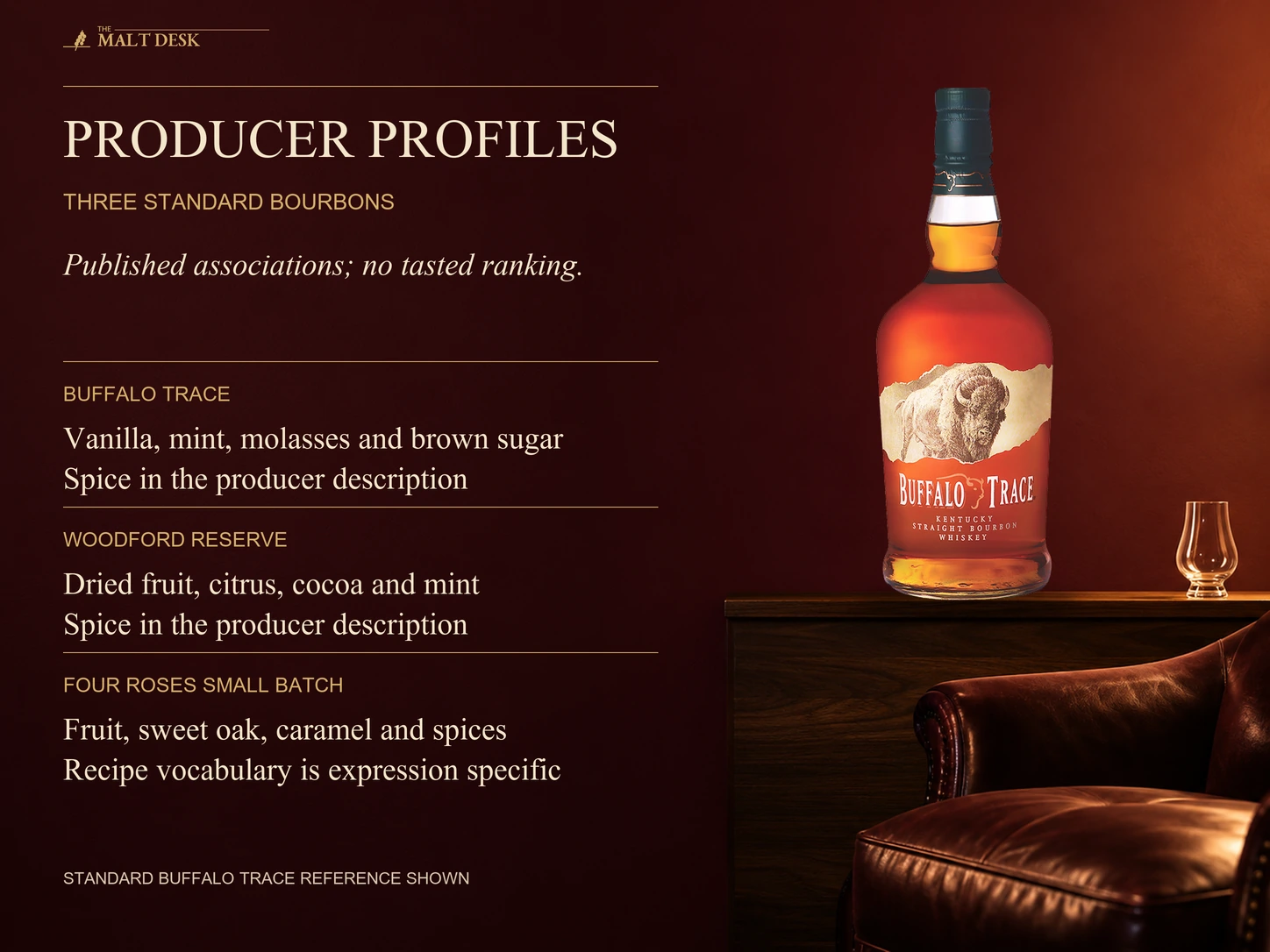
The published profiles offer three starting points: vanilla, molasses and spice for Buffalo Trace; dried fruit, citrus and cocoa for Woodford Reserve; and fruit and spice from the recipes in Four Roses Small Batch. Read these alongside strength and production details when comparing styles.
How to Compare U.S. Prices
The earlier price image and purchase thresholds lack complete original retailer, location, stock and final-cost records, so they are not used as current prices or a verified historical range. Compare the exact standard expression, printed bottle volume and strength, and dated local offer conditions.
Normalize the prices to the same volume before comparing them. For example, divide each bottle’s price by its volume and multiply by 750 to express the cost on a common 750 ml basis. This is a calculation method.
Neat, Ice, and Cocktails
Serving conditions change a comparison. Ice adds cooling and dilution; syrup and bitters introduce additional ingredients.
The serving guide explains terminology, and the bourbon and rye guide covers category differences. Neither a preferred recipe nor a producer’s suggested serve establishes universal superiority.
In Brief
The three bourbons differ in disclosed recipes and attributed producer vocabulary. Their U.S. reference strengths are close, but not identical. Equal-pour calculations, age disclosures, flavor descriptions and local cost answer separate questions.
Use the Rye Disclosures to Narrow the Bourbon Choice
For a documented recipe comparison, Woodford’s 18% rye and Four Roses’ two higher-rye component recipes provide a concrete contrast. Buffalo Trace’s undisclosed exact percentage remains a separate field. Use those records to choose a recipe question, then compare each complete bourbon’s attributed profile and intended serve before deciding which expression fits your preference.
Questions This Comparison Can Answer
Which has the highest reference proof?
Woodford Reserve is listed at 90.4 proof, compared with 90 for the other two reference bottlings. That is a small strength difference.
Which is smoothest or best in an Old Fashioned?
Preference depends on individual taste, dilution and the proportions of syrup and bitters.
Which costs least?
The lowest-cost option depends on current local listings for equivalent bottle sizes. The production comparison alone cannot answer that question.
Sources
Buffalo Trace Bourbon producer information; Woodford Reserve Bourbon Whiskey and Our Story; Four Roses Small Batch, Our Recipes and Our Process, checked October 4, 2026. The Story of Small Batch (August 6, 2019) remains a dated account rather than a current complete batch formula.
Additional grain-comparison sources: Woodford Reserve’s Our Story and Four Roses’ Featured Recipe OESK, Featured Recipe OESV and dated Small Batch account, checked October 7, 2026. The 20–35% bound concerns a hypothetical combined grain-input basis; the 100 kg illustration is invented and is not the current Small Batch formula or a finished-whiskey composition claim.