Four Roses Small Batch: Recipe and Label Guide
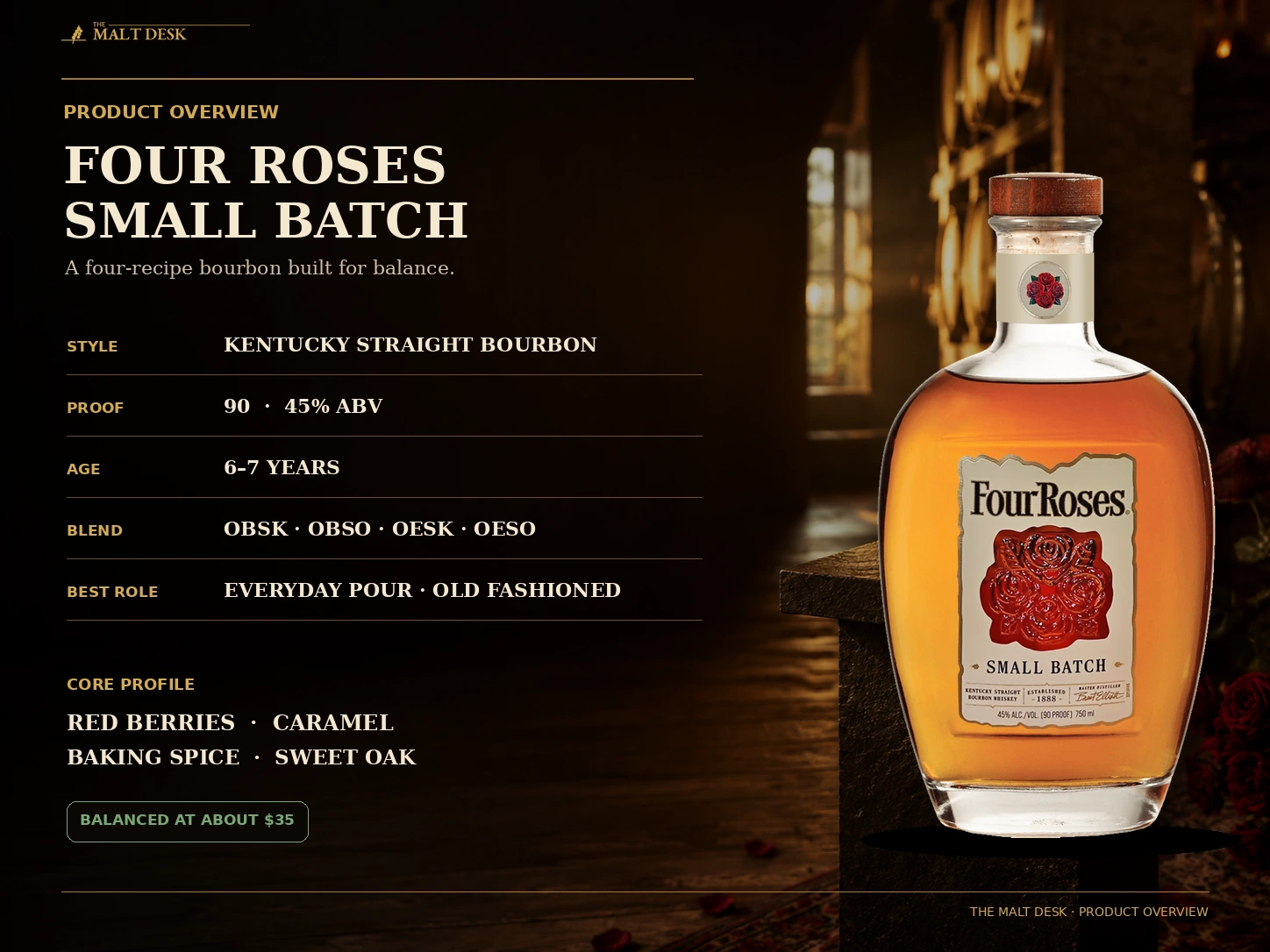
Four Roses Small Batch combines four of the distillery’s recipes at 90 proof, or 45% ABV. This guide explains the recipe identifiers, the producer’s published age information and flavor notes, and a dated U.S. price comparison. The information is source-based; no firsthand tasting or cocktail test is presented.
The Four Recipes
The producer lists OBSK, OBSO, OESK, and OESO for standard Small Batch. Four Roses’ production system combines two mash bills with five yeast strains to create ten recipes, so the four used here represent a subset of that system. The recipe codes supply production information rather than a ranking.
The B and E identifiers distinguish mash bills, while K and O distinguish yeast strains. Four Roses associates these component recipes with spice, fruit, and vanilla. The letters do not disclose precise sensory intensities or allow a reader to calculate the final flavor from the recipe names.
Age, Strength, and Similar Names
The official Small Batch page identifies 90 proof and six-to-seven-year maturation. Keep that producer statement distinct from the wording printed on a particular bottle. Product descriptions and label age statements should be recorded as the evidence actually presents them.
Small Batch Select is a different expression, as is Single Barrel. Do not carry over another expression’s strength, filtration claim, or recipe composition merely because the Four Roses name appears on both. The full product name matters when comparing specifications or a retailer listing.
Published Flavor Descriptions
The producer describes fruit, oak, and caramel on the nose; berries and spice on the palate; and a soft, extended finish. These are the producer’s sensory descriptions, not notes recorded by The Malt Desk. They identify advertised flavor vocabulary without establishing that this bourbon is smoother, fruitier, or better balanced than a competitor.
A term such as berry is a flavor association, not evidence that berries are an ingredient. Likewise, “smooth” is not a measure of alcohol content. Individual perception and serving conditions can differ even when a label specification remains the same.
The Whiskey Flavor Map explains descriptive categories. Decimal ratings such as 8.5 for fruit would require an explicit method, so no numerical intensity scores are assigned here.
Historical U.S. Price Records
The site’s historical notes record 750 ml listings for August 30, 2026: $32.99 at Total Wine, $34.99 through an Instacart listing using Total Wine pricing, and $38.99 at Target. These figures have not been reverified as current offers. They are dated records rather than live offers, national averages, or promised final totals.
An intermediary listing and a retailer’s own listing may refer to the same store and do not necessarily constitute independent market observations. Delivery charges, taxes, promotions, and local inventory can also change the comparison.
A useful price comparison identifies the exact expression, volume, location, and date. The historical amounts do not establish a universal “strong buy below $35” rule or prove that a different bourbon above or below that price is better value.
Serving and Comparison Limits
Neat, water-added, and ice-cooled servings change temperature and concentration. A cocktail also changes the ingredient mixture. No documented test here establishes that berry notes survive dilution, that a specific cube improves balance, or that this expression performs better in an Old Fashioned.
The serving guide explains the terms. For production context, see bourbon versus rye. A rye-containing bourbon recipe should not be confused with the rye-whiskey category.
Related Bourbons
The Woodford Reserve, Maker’s Mark, Wild Turkey 101, and Buffalo Trace guides provide other expression-level reference points. Compare their stated strength and production information without assuming that price or proof establishes personal preference.
Frequently Asked Questions
Which recipes are used?
The producer lists OBSK, OBSO, OESK, and OESO for standard Small Batch.
Is Small Batch the same as Small Batch Select?
No. They are distinct expressions. Use each product’s own specifications and label.
Is it better than Wild Turkey 101?
No universal ranking is established here. The expressions have different specifications, and this guide reports no comparative tasting.
Are the prices current?
No. They are the original August 30, 2026 records and have not been refreshed.
Sources and Scope
Four Roses, Small Batch product page, Our Recipes, and The Story of Small Batch. Production facts and sensory wording are attributed to the producer; price records are separately dated. This informational guide includes no firsthand tasting scores or retailer purchase links.