Bourbon in an Old Fashioned: A Reference Guide
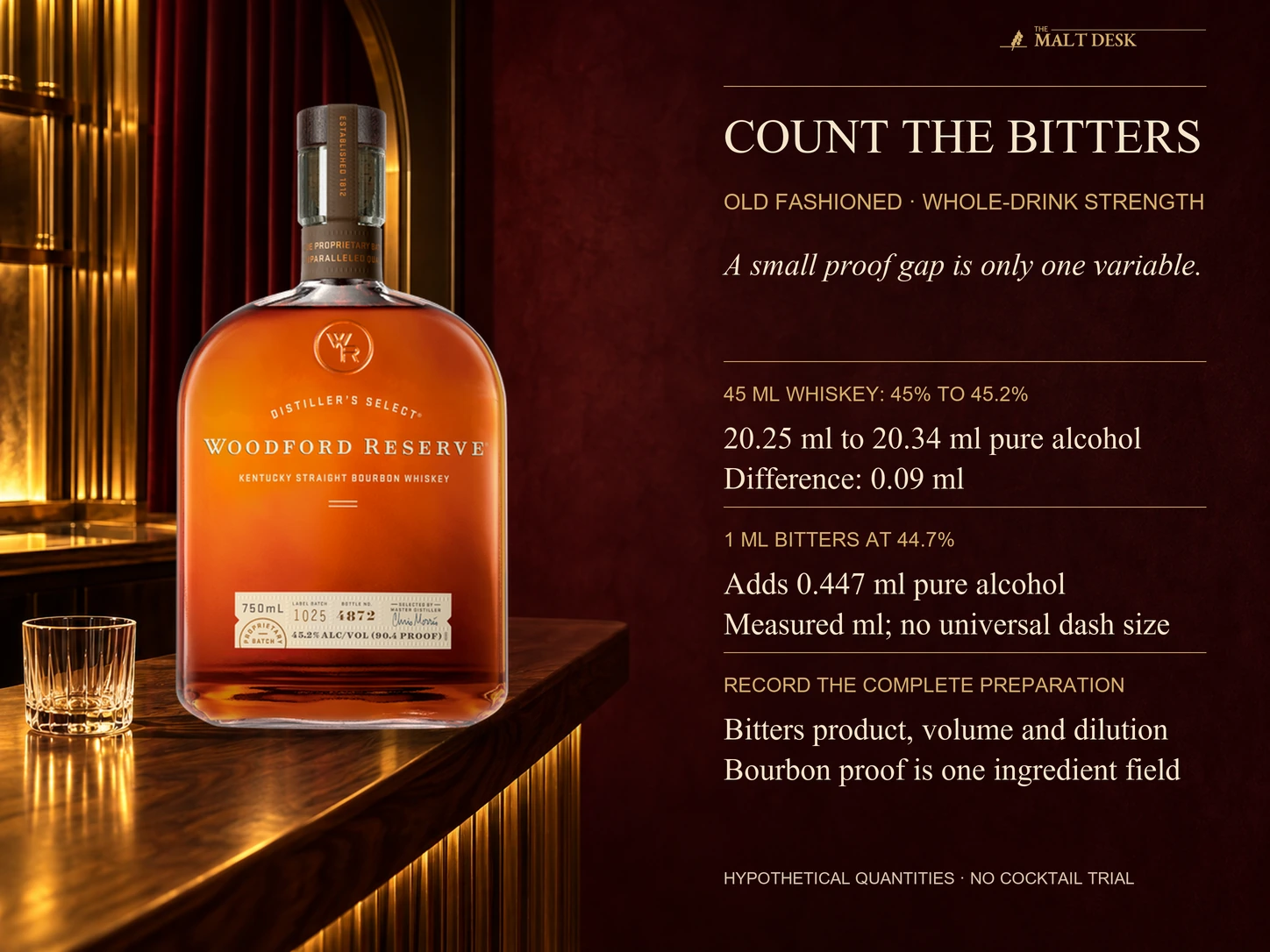
For an Old Fashioned comparison between 90-proof bourbon and Woodford’s 90.4-proof reference, the bourbon-only concentration gap is very small. A less obvious ingredient can outweigh it: alcoholic bitters. The IBA recipe includes bitters. A whole-drink alcohol calculation needs the actual bitters product, ABV and measured volume.
This matters when a recipe comparison concludes that one drink is stronger because its bourbon label has the larger number. If the bitters quantities changed too, even the direction of the whole-drink alcohol difference can reverse. A short calculation exposes that problem before a reader attributes the outcome to the bourbon.
An Old Fashioned combines whiskey, sugar, bitters, and water from the recipe and melting ice. This guide explains how bourbon specifications relate to that structure. It covers seven expressions and the differences in their specifications.
The most direct comparisons are bottle proof, grain recipe when disclosed, age statement, and documented price. Terms such as “most polished” or “best overall” require an evaluation method. They have been replaced here with the information readers can actually check.
A Published Recipe Reference
The International Bartenders Association specifies 45 ml bourbon or rye, a sugar cube, a few dashes of Angostura bitters, and a little water. Its method dissolves the sugar with bitters and water before adding ice and whiskey and stirring gently. Orange and a cocktail cherry are listed as garnish.
What Proof Changes
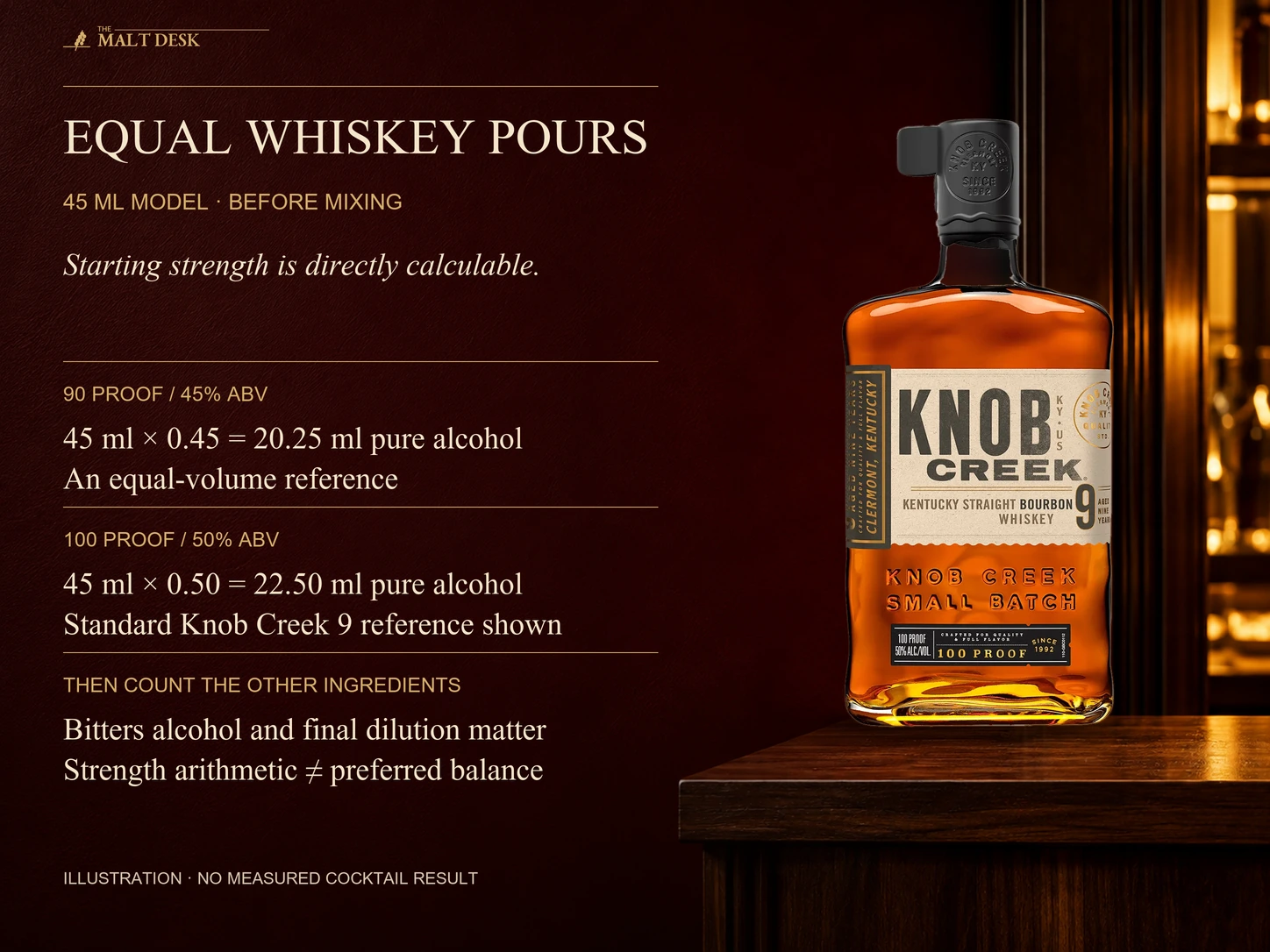
U.S. proof is twice alcohol by volume: 90 proof is 45% ABV, while 100 proof is 50% ABV. With equal whiskey volumes and otherwise identical ingredients, a higher starting ABV produces a higher final alcohol concentration.
For illustration, 45 ml of whiskey at 45% ABV contains 20.25 ml of pure alcohol before mixing. At 50% ABV, the same volume contains 22.5 ml. Water reduces concentration by increasing total volume; it does not remove that alcohol. The actual drink also depends on any alcohol in the bitters and the amount of dilution.
Seven Expressions and Their Specifications
Wild Turkey 101 — 101 Proof
The producer identifies American white oak with a heavy char and describes vanilla, caramel, oak, spice, and orange peel. Its Old Fashioned suitability is a producer claim rather than a result tested here.
Related expression guide: Wild Turkey 101.
Buffalo Trace — 90 Proof
The distillery’s published notes include vanilla, mint, molasses, and brown-sugar associations. They describe the bourbon, not a controlled result after syrup, bitters, and dilution.
Related expression guide: Buffalo Trace.
Maker’s Mark — 90 Proof
The standard expression uses wheat in its grain recipe. The producer describes fruit, vanilla, oak, and soft spice. Wheated is a recipe distinction, not proof that every mixed drink will be softer.
Related expression guide: Maker’s Mark.
Woodford Reserve — 90.4 Proof
The producer’s bourbon description includes dried fruit, citrus, cocoa, and spice. The standard bourbon should be distinguished from Double Oaked and other expressions.
Related expression guide: Woodford Reserve.
Elijah Craig Small Batch — 94 Proof
The producer identifies charred oak and describes spice and subtle smoke. Small Batch is a product designation.
Four Roses Small Batch — 90 Proof
Four Roses identifies four component recipes for Small Batch. Do not confuse this expression with Small Batch Select or Single Barrel, which have different specifications.
Knob Creek 9 — 100 Proof
The producer states nine years of maturation and 100 proof for the standard bourbon. Its age statement and strength can be compared directly; claims of greater maturity in a cocktail require tasting evidence.
Sugar, Bitters, and Dilution
A sugar cube and syrup deliver sugar in different forms. Syrup also adds water, and its concentration must be known before equal spoonfuls can be treated as equivalent. A recipe using rich syrup cannot simply substitute the same volume of a weaker syrup and claim an identical result.
A dash is not a precise universal volume. Bitters bottles and dispensing styles vary, so a recipe comparison should record the bitters and amount as well as the whiskey. Ice size, starting temperature, stirring time, and serving conditions also affect dilution.
The whiskey serving guide explains dilution terminology. The bourbon and rye comparison explains why the IBA recipe’s two whiskey categories are not interchangeable production terms.
Count the Bitters Before Ranking the Whole Drink’s Strength
Virginia ABC’s official product record lists Angostura aromatic bitters at 44.7% ABV. Check the actual bitters label; this figure should not be transferred to every bitters product. At the 45 ml whiskey measure in the IBA reference, moving from 45% to 45.2% bourbon adds just 0.09 ml pure alcohol. One measured milliliter of the 44.7% bitters adds 0.447 ml: nearly five times that bourbon-only difference.
| Hypothetical preparation | Bourbon alcohol | Bitters alcohol | Total ingredient alcohol |
|---|---|---|---|
| 45 ml of 45% bourbon + 2 ml of 44.7% bitters | 20.25 ml | 0.894 ml | 21.144 ml |
| 45 ml of 45.2% bourbon + 1 ml of 44.7% bitters | 20.34 ml | 0.447 ml | 20.787 ml |
The second preparation uses the higher-proof bourbon but contains 0.357 ml less pure alcohol overall in these two alcoholic ingredients. If each illustrative drink is brought to the same 60 ml final volume with the same sugar mass and measured water as needed, the approximate ABVs are 35.24% and 34.65%. Those are explicitly designed arithmetic examples. The 1 ml and 2 ml bitters quantities are not claims about the number or size of anyone’s dashes.
This does not mean bitters erase the whole seven-bourbon proof range. At equal 45 ml whiskey measures, the difference between 45% and Wild Turkey’s 50.5% is 2.475 ml pure alcohol, much larger than the 0.447 ml difference in this bitters example. The answer is specific: small proof gaps are easy to overwhelm with an unrecorded ingredient quantity. Record the actual bitters product and delivered volume, sugar source and final dilution before using bourbon proof to explain a whole-drink result.
Comparing Cost per Measure
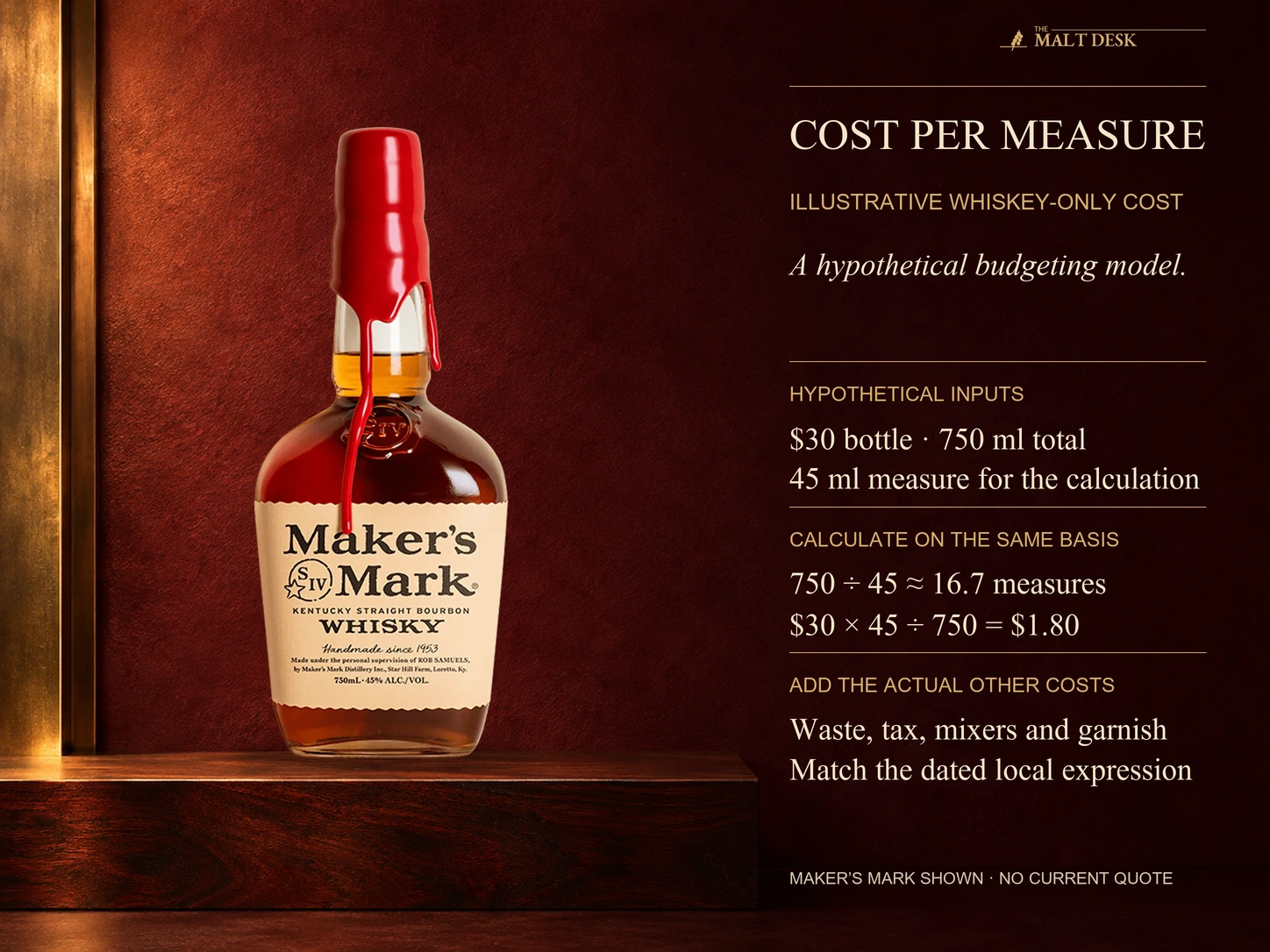
For a cost comparison, record each bourbon’s exact expression, bottle volume, local price, date, and tax treatment. This guide does not establish a verified current price range for the seven expressions.
A cost-per-measure comparison requires a consistent measure and bottle volume. For example, a hypothetical $30, 750 ml bottle contains about 16.7 measures of 45 ml, giving a whiskey-only cost of $1.80 per measure before waste, tax, mixers, or garnish. This calculation is a budgeting illustration, not an instruction about serving size or drinking frequency.
What a Meaningful Comparison Would Require
To claim that one bourbon performs better in this cocktail, an article should document the recipe, quantities, ice, dilution, serving conditions, and evaluation method. Without that evidence, it is more accurate to explain the differences in proof and production and attribute flavor language to its source.
The listed products offer different strengths and disclosed production details. Price, aroma, and texture answer different questions, so a single winner is less useful than a comparison that keeps those variables separate.
In Brief
A classic Old Fashioned combines spirit, sugar, bitters and dilution. Proof and bottle cost are useful comparison points.
Record the Whole Old Fashioned Recipe
For a useful Old Fashioned comparison, fix the bourbon measure, sugar, bitters product and measured bitters amount, then record dilution. Include the bitters’ alcohol contribution when calculating the whole drink. Once the recipe is repeatable, compare the bourbon expressions in that same preparation and judge the result against the style of Old Fashioned you want.
Frequently Asked Questions
Is higher proof automatically better?
No. It raises the starting alcohol concentration for an equal volume. Preference and perceived balance are separate questions.
Must an Old Fashioned use bourbon?
No. The IBA reference also permits rye whiskey. A recipe’s whiskey category should be identified when discussing its structure.
Does a premium price prove a better cocktail?
No. Price alone cannot establish how a mixture will be perceived, and historical prices are not current local availability.
Sources
International Bartenders Association, Old Fashioned, recipe rechecked October 3, 2026; producer product information for Wild Turkey 101, Buffalo Trace Bourbon, Maker’s Mark, Woodford Reserve Bourbon, Elijah Craig Small Batch, Four Roses Small Batch, and Knob Creek 9. Product descriptors are attributed to those producers; calculations are explicit illustrations.
Additional ingredient source: Virginia ABC’s official Angostura aromatic bitters product record, checked October 7, 2026, for its 44.7% reference. The comparison uses the existing IBA 45 ml whiskey measure with explicitly hypothetical measured bitters quantities and final volumes.