Scotch Whisky Geography Explained
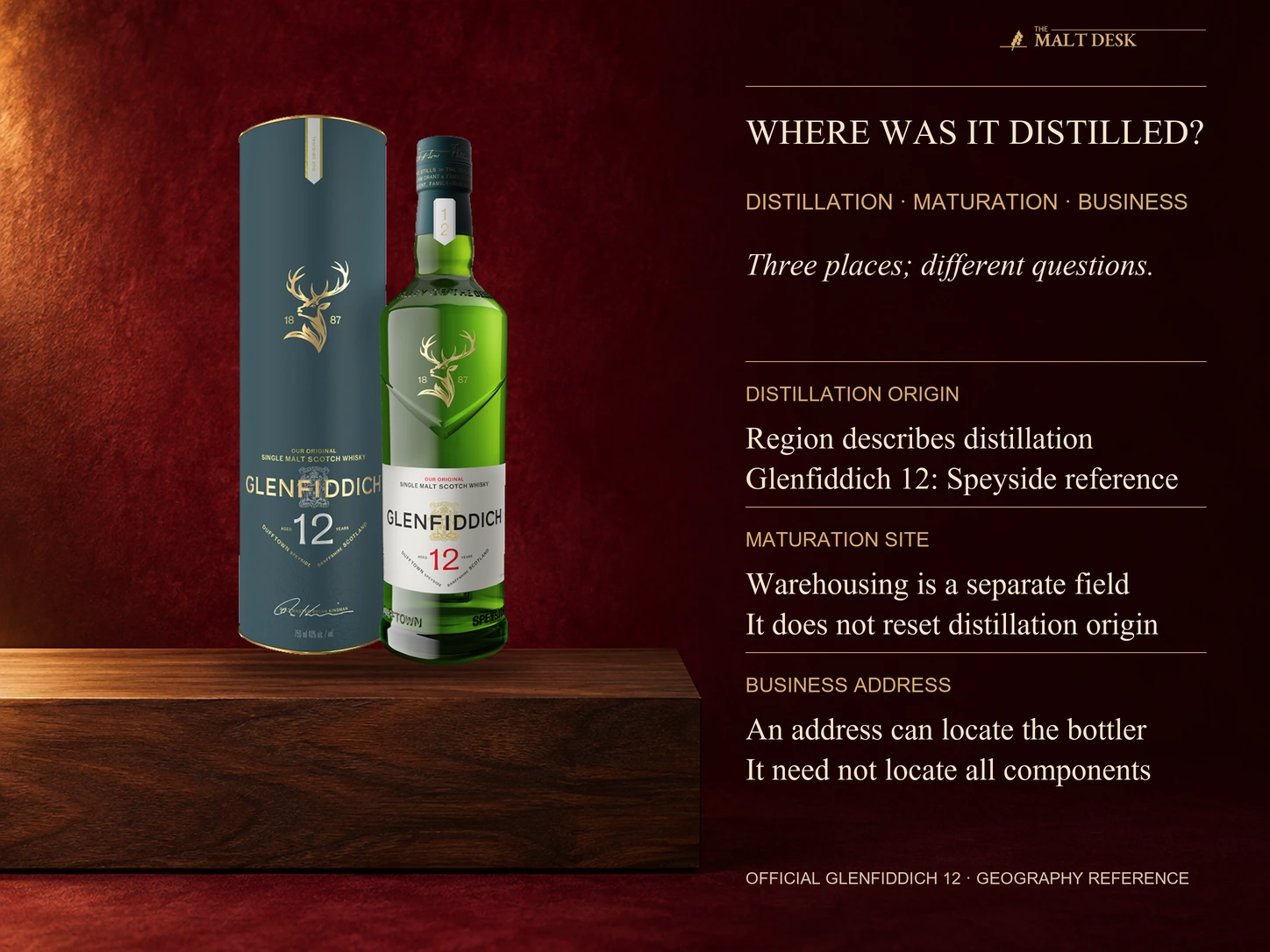
A Scotch region answers where the whisky was distilled. It does not necessarily answer where every cask stood afterward or where the bottle was filled. A distillery’s origin, a maturation site and a bottler’s business address can therefore point to different places without describing three regional origins for the same whisky.
This is the practical map-reading question behind a regional label: which location does each piece of wording describe? Treating every Scottish address on a bottle as a distillation claim can move a whisky to the wrong place on a tasting map even when all the addresses are accurate.
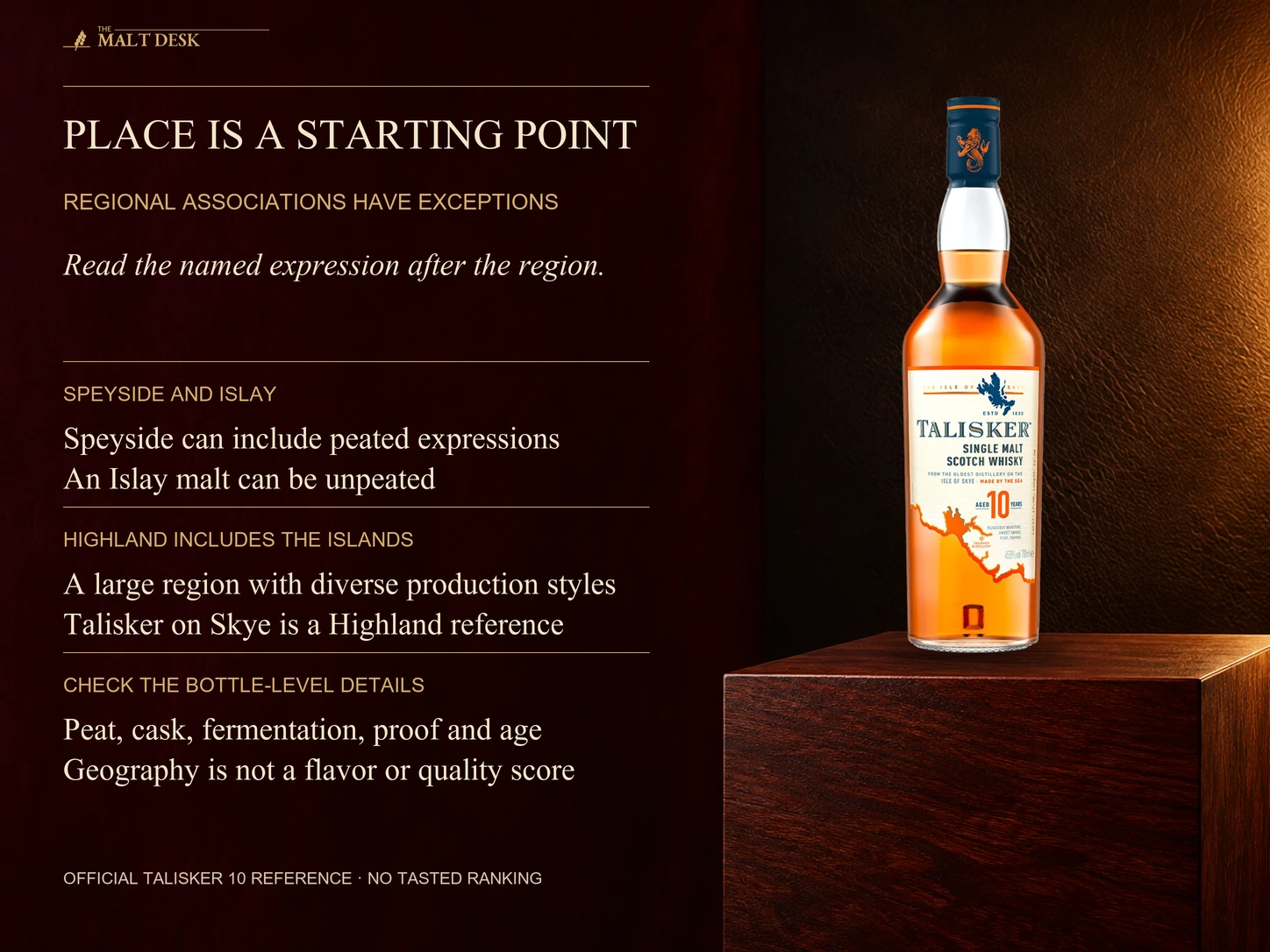
Scotch whisky is commonly organized into five protected regional and locality names: Speyside, Highland, Lowland, Campbeltown, and Islay. Region identifies distillation geography and can provide a starting point for reading flavor descriptions. It does not guarantee a flavor. A Speyside malt can be smoky, an Islay malt can be unpeated, and the enormous Highland region includes diverse production styles.
Peat level, cask type, fermentation, still shape, proof, age and blending decisions are often more predictive than the regional name by itself.
Key Takeaways
- Speyside often points toward orchard fruit, honey, vanilla and sherry-influenced richness.
- Lowland identifies a distillation region; its diverse producers should not be reduced to one light or grassy profile.
- Highland is the broadest region and includes the islands in the official framework.
- Campbeltown is often associated with oily texture, salt, fruit, toffee and smoke.
- Islay is famous for peat and maritime character, but not every Islay whisky is heavily smoky.
- Use region to organize a geographical shortlist, then narrow it with the expression’s cask and peat account.
If the category labels themselves are still unclear, start with Types of Whiskey before using the regional map.
What Does “Region” Mean in Scotch Whisky?
The Scotch Whisky Association explains that protected regional and locality names identify where whisky was distilled. The five names help organize distilleries and communicate place, history and broad style associations. They do not prescribe one recipe. Distilleries within the same region may use different barley specifications, peat levels, fermentation times, still designs and maturation programs.
Geographical wording and the whisky category answer separate questions. A single malt comes from one distillery and uses malted barley, while a blend combines components to create a target profile. The distinction is explained in Single Malt vs Blended Scotch. Geography and whisky type answer different questions.
The Five Geographical Names at a Glance
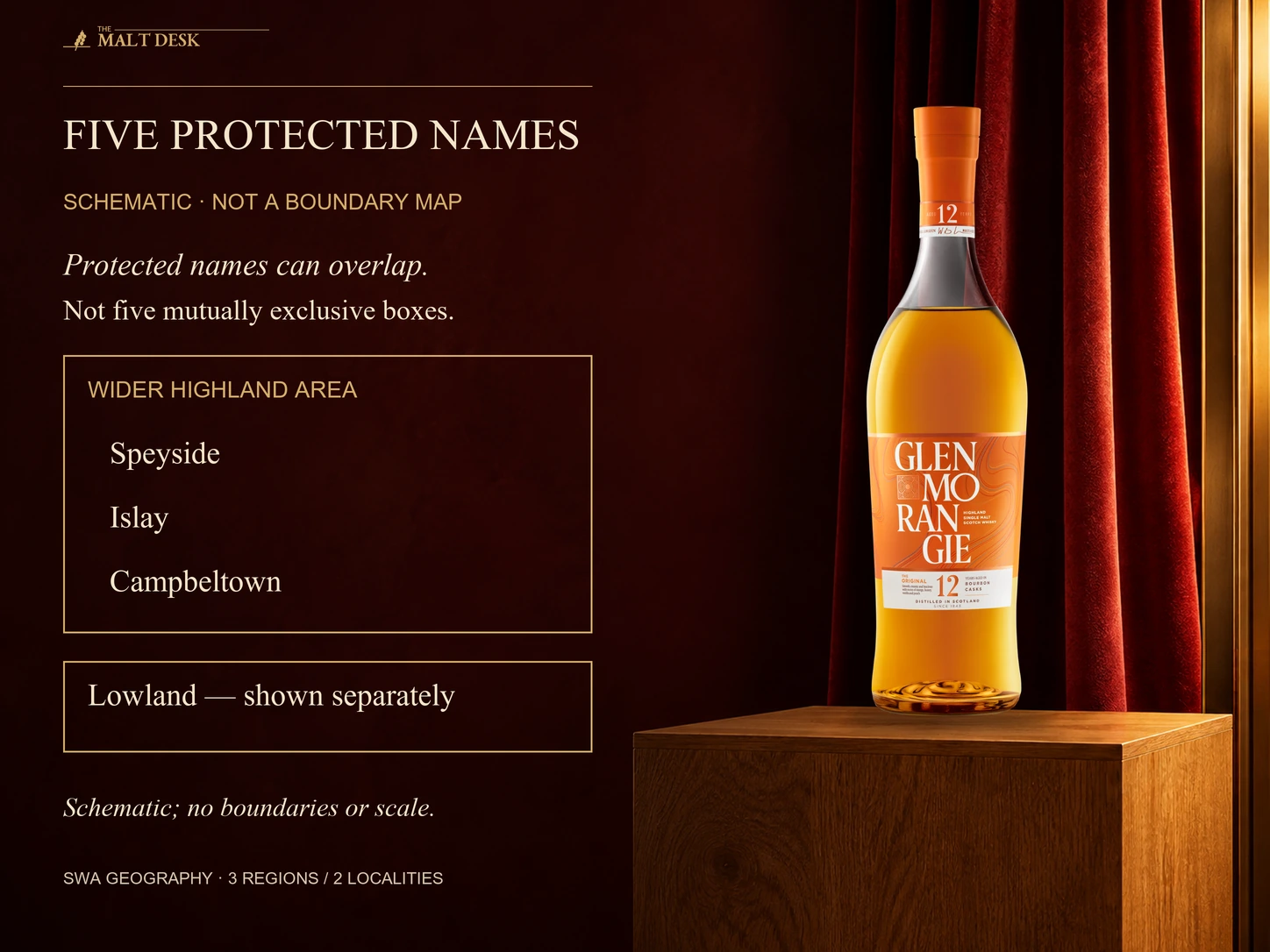
“Five regions” is familiar shorthand. Regulation 10 formally distinguishes Highland, Lowland and Speyside as regions, and Campbeltown and Islay as localities. These names concern distillation geography rather than a flavor or quality grade.
The SWA explains that Campbeltown, Islay and Speyside also lie within the wider Highland area. The five names therefore do not form five mutually exclusive geographical boxes. The diagram below shows their relationship schematically; it is not a boundary or scale map.
| Name | Familiar starting point | Important exception |
|---|---|---|
| Speyside | Orchard fruit, honey, vanilla, spice | Peat and very dry profiles also exist |
| Lowland | Light body, cereal, grass, citrus | Modern Lowland whisky is increasingly diverse |
| Highland | Floral, fruity, rich, coastal or smoky | It is too large for one dependable flavor |
| Campbeltown | Oil, salt, fruit, toffee, smoke | Small output makes distillery identity especially important |
| Islay | Peat smoke, ash, seaweed, sweetness | Some Islay malts are lightly peated or unpeated |
The islands are not a sixth official region. Distilleries on Skye, Orkney, Mull, Jura, Arran and other islands sit within the Highland region for the official classification, even though drinkers often discuss “Island whisky” as a useful informal style group.
Speyside
The Familiar Profile
Speyside holds a dense concentration of distilleries around the River Spey. The familiar profile is fruit-forward and approachable: pear, apple, honey, vanilla, malt and baking spice. Sherry-seasoned casks are common enough that raisin, nut, orange and chocolate are also strongly associated with the region.
Where the Stereotype Breaks
Speyside is not a synonym for soft or sweet. Cask choice can create dry tannin, sulfur, tropical fruit or intense oak, and a distillery can make peated spirit. Treat pear-and-honey as a useful entry point, not a rule.
The Glenfiddich 12 guide provides an expression-specific example of how published fruit descriptions relate to the broader Speyside association.
Lowland
The Familiar Profile
The SWA describes Lowland whisky as diverse and notes the growth of distilleries in the region. Light, grassy or citrusy may describe a particular expression, but they are not requirements of a Lowland label. Check the producer’s description for the specific bottle.
Where the Stereotype Breaks
The modern Lowland scene is expanding. Distillation methods, yeast, barley, cask programs and new distilleries create more variation than the old “light and floral” label suggests. Triple distillation is part of Lowland history, but it is not a requirement for every distillery in the region.
Highland
The Familiar Profile
Highland is the largest and least uniform region. A Highland malt can be floral and citrusy, honeyed and creamy, richly sherried, waxy, mineral, coastal or smoky. Geography stretches across mainland areas and officially includes the islands, so a single Highland flavor description is less useful than it is for a smaller region.
How to Interpret the Region
Check the distillery and cask information before relying on the Highland label. Glenmorangie can offer an accessible citrus-and-vanilla profile, while island distilleries may bring salt, smoke or a firmer mineral edge. Highland is the region where bottle-level information matters most.
The Glenlivet 12 guide and Whiskey Flavor Map are useful companion guides when fruit, body and smoke matter more than the map.
Campbeltown
The Familiar Profile
Campbeltown is small in output but large in identity. Drinkers often describe its whisky as oily, saline and robust, with fruit, vanilla, toffee, leather and smoke. The combination can feel coastal without relying only on heavy peat.
Where the Stereotype Breaks
With relatively few operating distilleries, individual production choices can dominate the regional label. Availability and price may also shape a buying decision more than the map. Campbeltown is best approached by learning the distillery and expression rather than expecting every bottle to deliver the same “funk.”
Islay
The Familiar Profile
Islay is the region most strongly associated with peat smoke. Ash, iodine, seaweed, brine, char and earthy smoke can appear beside lemon, vanilla, malt and sweetness. The most famous bottles are expressive enough that many drinkers treat Islay as a flavor category in its own right.
Where the Stereotype Breaks
Not every Islay whisky is heavily peated. Distilleries can make unpeated spirit, and cask selection can push fruit or wine character ahead of smoke. Even among peated malts, medicinal, earthy, maritime and barbecue-like smoke are different experiences.
What Is Peated Whisky? explains how peat becomes smoke flavor. Bottle-level examples include Ardbeg 10, Laphroaig 10 and Lagavulin 16.
Why Region Is Useful but Not a Flavor Guarantee
| Factor | What it can change |
|---|---|
| Peat level | Smoke intensity and character |
| Cask type | Fruit, vanilla, spice, tannin and wine influence |
| Fermentation | Fruity, floral, cereal and savory compounds |
| Still shape and cut points | Weight, texture and spirit character |
| Proof and dilution | Intensity, texture and flavor delivery |
| Age and blending | Integration, oak influence, balance and consistency |
This is why two neighboring distilleries can taste less alike than two bottles from opposite sides of Scotland. Region works best at the beginning of the decision, before cask, peat and proof provide the sharper filters.
Map the Distillation Claim, Not Every Address on the Bottle
Consider a hypothetical single malt distilled in Speyside, matured entirely in compliant oak casks at a Lowland warehouse, and bottled in Scotland. Its warehouse location would not convert its distillation origin to Lowland. The SWA’s regional guidance bases the regional description on where the whisky was wholly distilled, while the Scotch production requirements separately keep maturation in Scotland. This illustration is not a claim about the logistics of a named producer.
| Location statement | Question it can answer | Question it does not automatically answer |
|---|---|---|
| Speyside distillation origin in the hypothetical | Where the single malt was distilled | Where every cask matured |
| Lowland warehouse in the hypothetical | Where maturation took place | Whether the whisky was distilled in Lowland |
| Bottler’s address | Where the named business is located | The origin of every whisky component |
| An applicable regional category description | Whether all the whisky has that distillation origin | Whether it shares one regional flavor |
A blend needs particular care. A bottling address in one region does not place all its component distilleries there. The SWA also permits blends to identify the component regions under its stated conditions, including specifying all relevant regions. “A blend of Highland and Islay malts” is information about origins within a blended-malt account, not evidence of one distillery or a maturation site called Highland-and-Islay.
The five protected names are not the only geographic descriptions that can be meaningful. The SWA gives Orkney Blended Malt as an example of another place description when all the whisky was distilled there. Orkney does not become an additional protected region by appearing on such a label, and “Islands” is not itself a Scottish place name suitable for that same category description. Distinguish a specific island origin from an informal group of islands.
How Flavor Associations Relate to Geography
| If you want | Start here | Then check |
|---|---|---|
| Fresh pear and honey | Speyside | Bourbon cask and low peat |
| Light cereal and citrus | Lowland | Proof and distillation style |
| The widest possible range | Highland | Distillery, coast and cask |
| Oil, salt and layered fruit | Campbeltown | Availability and peat level |
| Smoke and maritime notes | Islay | Medicinal vs earthy smoke |
These associations help decode descriptions. Expression-level production details and attributed flavor notes are more specific than a regional stereotype.
Best Whiskeys for Beginners provides a broader first-bottle path, while How to Drink Whiskey helps separate the bottle from the serving method.
Common Region Myths
| Myth | Better rule |
|---|---|
| All Islay whisky is heavily peated | Check the expression and peat level |
| All Speyside whisky is sweet | Check cask, peat and distillery style |
| Island is an official sixth region | The islands officially sit within Highland |
| Single malt region determines quality | Region describes place, not quality |
| Older whisky tastes more regional | Age and oak can reshape the distillate |
Reading the Map Accurately
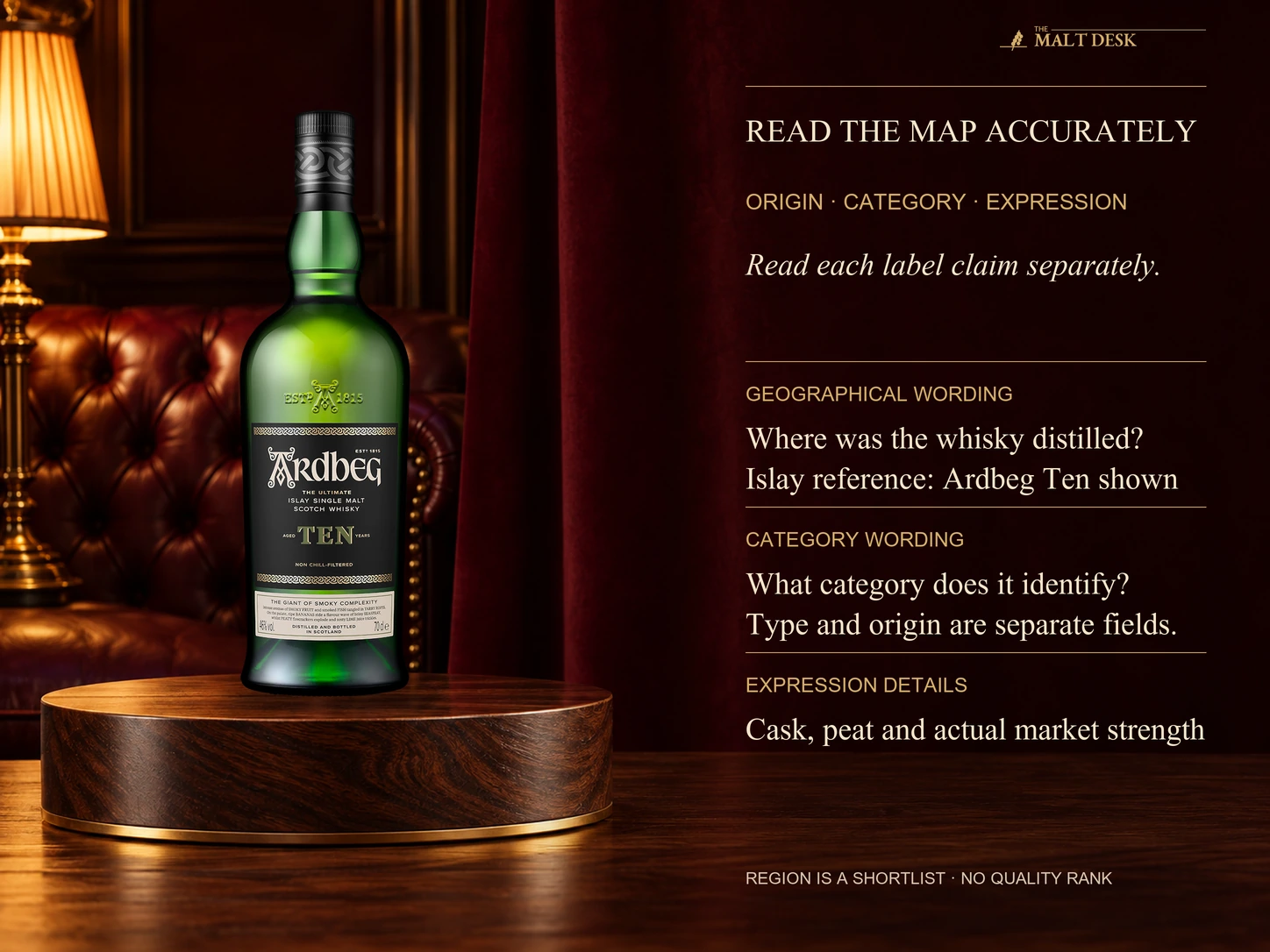
The five protected regional and locality names provide a useful shelf map. Speyside often begins with fruit, Lowland with lighter cereal and citrus, Highland with maximum diversity, Campbeltown with oil and salt, and Islay with peat and the sea. Those descriptions are starting points, not promises.
A regional name supplies geographical information. Peat, cask history, alcohol content, and a named expression’s production details answer different questions. Keep those categories separate when interpreting a label.
Give Each Scotch Place Name Its Own Role
Use the distillation location for the Scotch regional origin, then record maturation and bottling addresses in their own fields. When choosing a style to explore, add expression-specific cask and peat information to that geographical record. This keeps a map useful for provenance while giving the actual bottle’s production account a clear role in the flavor shortlist.
Frequently Asked Questions
Which Scotch whisky geographical names are formally protected?
Regulation 10 names Highland, Lowland and Speyside as protected regions, and Campbeltown and Islay as protected localities. “Five regions” is common shorthand for these five geographical names.
Is the Islands category an official Scotch region?
“Islands” is an informal grouping rather than an additional protected regional name. Islay has its own protected name. The SWA also explains that Islay, Campbeltown, and Speyside lie within the wider Highland area, so the geographical names can overlap.
Which Scotch region is the smokiest?
Islay is most strongly associated with peat smoke, but peat level varies by distillery and expression.
Does a regional name establish suitability for beginners?
No. A regional name alone does not establish how an individual will perceive alcohol, smoke, or flavor intensity. Read the details of the specific expression.
Does region determine Scotch quality?
No. Region describes production location. Ingredients, distillation, maturation, blending and execution determine the bottle’s quality and style.
Sources
Reference material, checked October 3, 2026: Scotch Whisky Association, “Scotch Whisky Regions” and “Scotch Whisky FAQs”; Scotch Whisky Regulations 2009, regulation 10. Regional flavor language is a broad descriptive convention, not a claim that every distillery or bottling shares the same sensory profile.
Additional geography sources: SWA FAQs, its 2025 Guidance for Bottlers and Producers regional-label section, and Protecting Scotch Whisky, checked October 7, 2026. The Speyside-to-Lowland warehouse example is hypothetical. Distillation origin, maturation location and business address are not treated as interchangeable, and no legal opinion about a specific brand label is asserted.