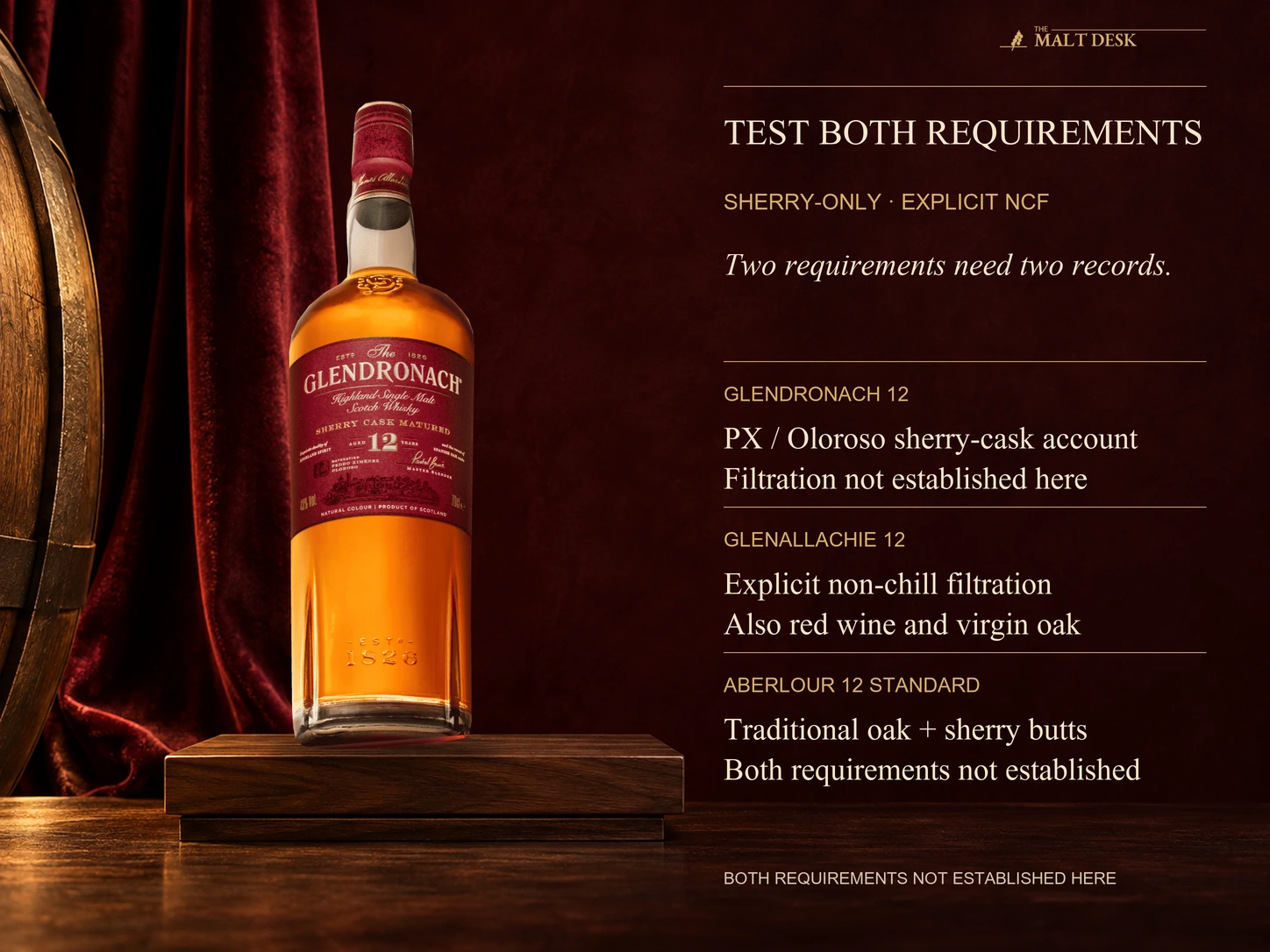
These three twelve-year names can be tested against a more exact request than “richest”: documented sherry-cask-only maturation together with explicit non-chill filtration. The available producer records do not establish one standard expression here as satisfying both. Each field needs its own evidence; a darker profile or a larger ABV cannot supply a missing process statement.
This is useful for a reader paying a premium for a specific production specification. GlenDronach’s PX-and-Oloroso account, GlenAllachie’s explicit non-chill filtration and Aberlour’s double-cask account answer different parts of the request. They should not be combined into an imaginary bottle carrying the strongest specification from each column.
These three 12-year single malts disclose different cask programs and reference strengths. GlenDronach 12 lists PX and Oloroso sherry casks; GlenAllachie 12 lists four cask inputs at 46% ABV; Aberlour 12 lists traditional oak and sherry casks at an international 40% reference. This comparison separates those measurable specifications from each producer’s flavor words.
Quick Answer
The shared 12-year label gives a common minimum age, not identical maturation. GlenDronach’s 43%, GlenAllachie’s 46% and Aberlour’s 40% reference strengths differ, as do their named casks. Producer notes provide vocabulary for comparison. Check the exact market labels and dated local offers.
Readers who want the full background on each bottle can also see the individual guides to GlenDronach 12, GlenAllachie 12 and Aberlour 12.
Comparison at a Glance
| Whisky | Region | Published reference ABV | Cask direction | Published profile emphasis |
|---|---|---|---|---|
| GlenDronach 12 | Highland | 43% | Pedro Ximénez and Oloroso sherry casks | Dark, rich sherry character |
| GlenAllachie 12 | Speyside | 46% | PX and Oloroso sherry, red wine and virgin oak | 46% reference; four disclosed cask types |
| Aberlour 12 | Speyside | 40% | Traditional oak and sherry casks | Honey and orchard fruit |
All three carry a 12-year age statement, so age does not decide the comparison. The more useful differences are bottling strength, the combination of casks and the flavor direction described by each producer. These are published reference specifications; check the exact market label, especially for Aberlour 12 variants.
Cask Programs and Strength
GlenDronach 12: PX and Oloroso maturation
GlenDronach 12 lists Pedro Ximénez and Oloroso Spanish sherry casks and a 43% ABV reference. The producer also identifies natural color. Its fruit and spice notes describe the finished expression; the two wine names alone do not establish the proportion or sensory contribution of each cask type.
GlenAllachie 12: more strength and more cask inputs
GlenAllachie 12 lists 46% ABV, natural color and no chill filtration, with PX and Oloroso sherry, red-wine and virgin-oak cask inputs. Four disclosed inputs do not establish their proportions or quantify flavor complexity. The guide to sherry-cask and bourbon-cask maturation separates oak, previous contents and maturation stage.
Aberlour 12: oak and sherry-cask maturation
Aberlour 12 uses traditional oak and sherry casks. Its producer notes include honey, pear and red apple. The 40% figure is an international reference, so read the printed strength on the specific U.S. bottle before comparing variants.
Published Flavor Comparison
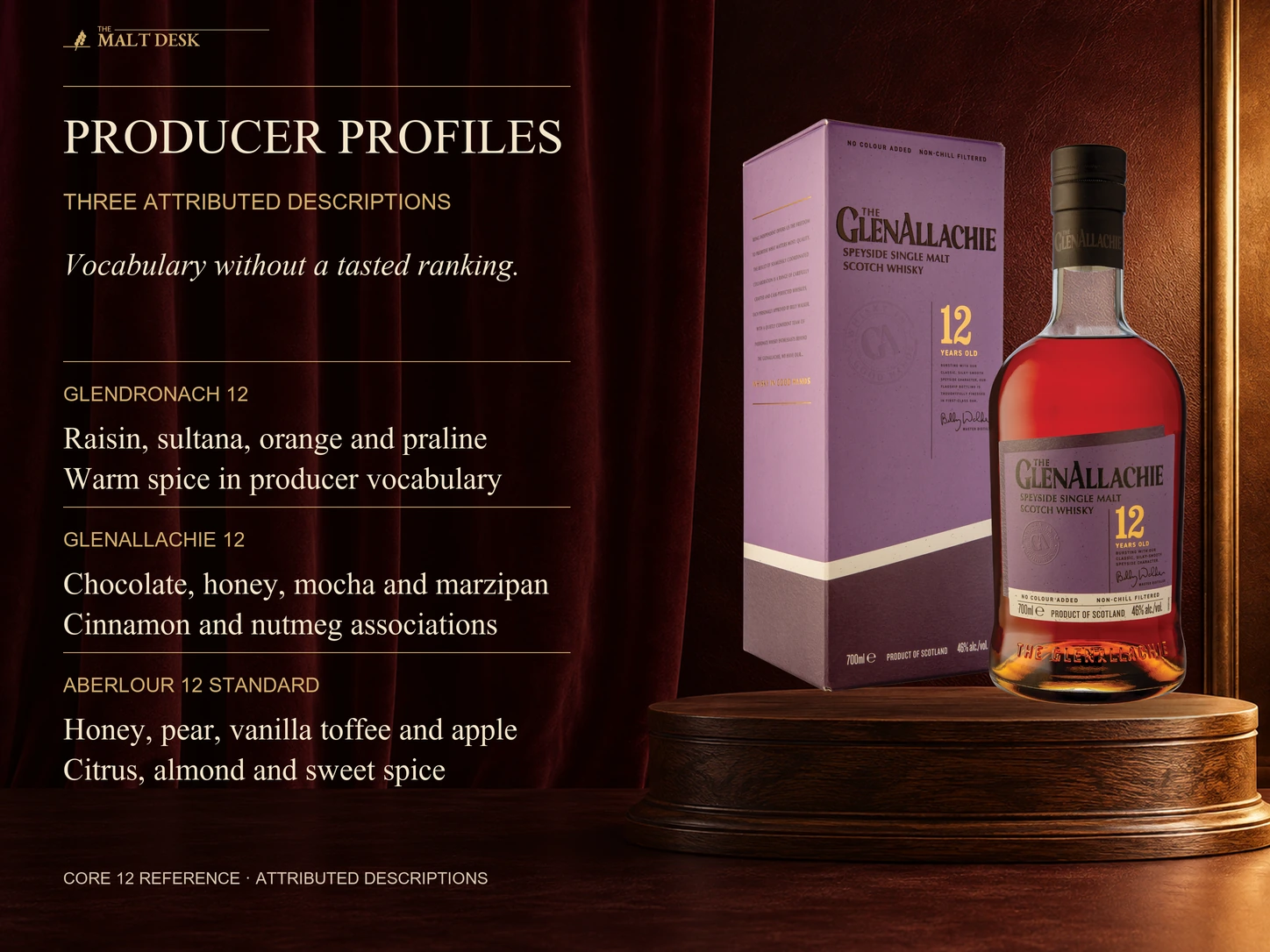
The profiles below summarize attributed producer descriptions.
GlenDronach 12
GlenDronach’s published notes include raisin, sultana, orange, chocolate praline and warming spice. These terms provide dried-fruit and confectionery comparisons.
GlenAllachie 12
GlenAllachie highlights dark chocolate, molasses, heather honey, raisins, mocha, marzipan, cinnamon and nutmeg. These are producer descriptors rather than results from a matched tasting of the three bottles.
Aberlour 12
Aberlour’s published notes include: honey, pear, vanilla toffee, orange, red apple, almond and sweet spice. Those terms provide an orchard-fruit comparison with the dried-fruit and chocolate words used in the other profiles. The whisky flavor map provides a wider framework for these contrasts.
U.S. Price Comparison
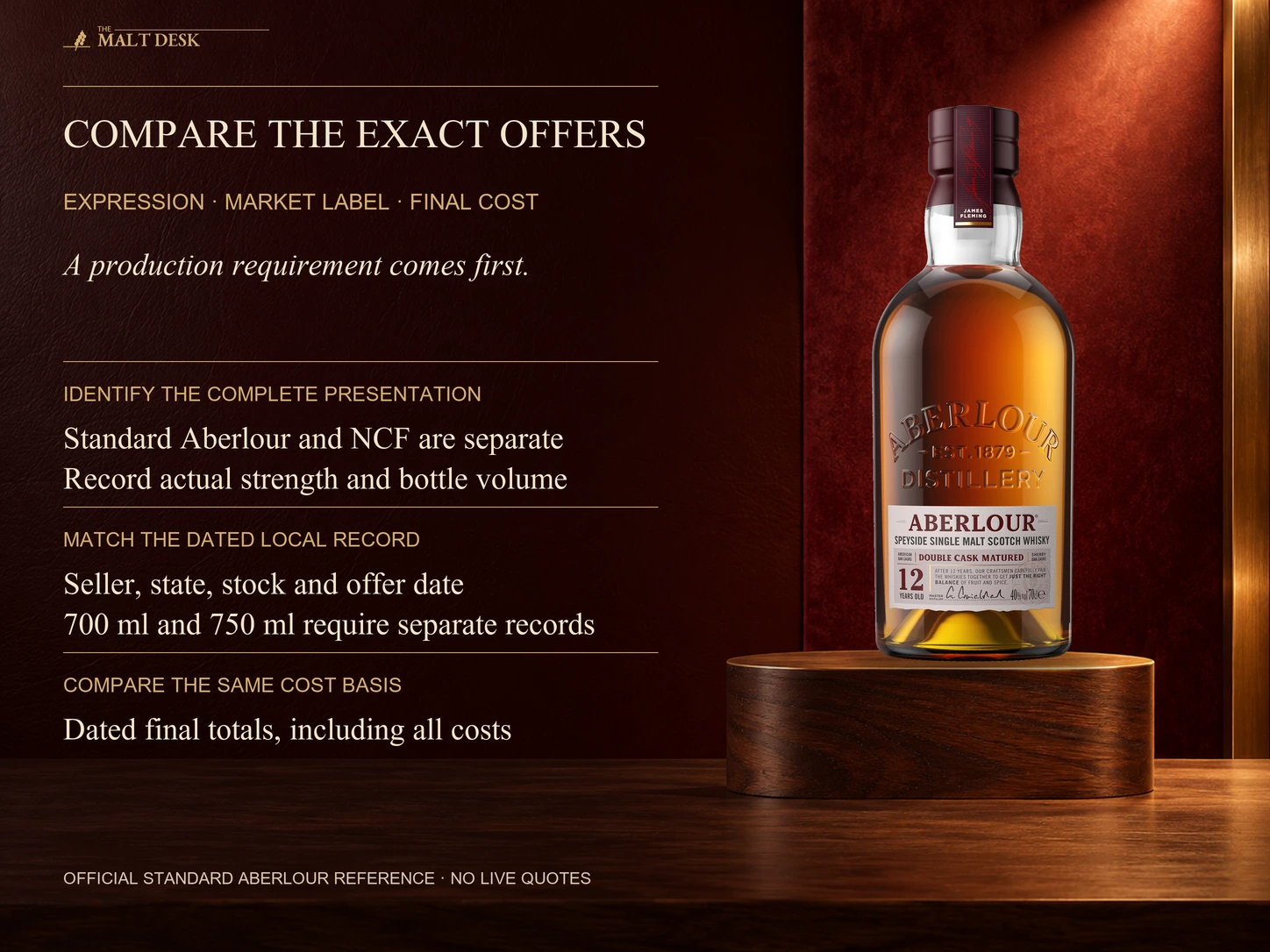
A useful U.S. price comparison needs dated local offers for the exact expression and market label. Record bottle volume, printed strength, seller, state, date and stock status. A 700 ml international bottle and a 750 ml U.S. bottle are not interchangeable price references.
Compare the total after tax, delivery and discounts for equivalent bottles in the same market. GlenAllachie’s 46% ABV and disclosed non-chill filtration are product details; they do not establish a price premium or a universal value winner. For different bottle sizes, divide the total by volume and compare cost per 100 ml.
Test Both Requirements and Keep “Not Established” Separate From “No”
| Exact standard expression | Cask account under the stated sherry-only requirement | Explicit non-chill filtration in the cited account | Both requirements established here? |
|---|---|---|---|
| GlenDronach 12 | Producer identifies maturation in PX and Oloroso sherry casks | Natural color is stated; that alone does not establish filtration | Not established from these cited records |
| GlenAllachie 12 | Producer’s 2025 account also includes red wine and virgin oak | Yes | No: the disclosed program is not sherry-cask-only |
| Aberlour 12 Double Cask Matured | Producer includes traditional oak alongside sherry butts | Not established for the standard reference here | No: the disclosed program is not sherry-cask-only |
The distinction between absent evidence and a conflicting specification matters. GlenAllachie’s positive non-chill-filtered statement answers one requirement, while its additional non-sherry cask inputs conflict with the other. For GlenDronach, a natural-color statement cannot be used as either proof of non-chill filtration or proof that chill filtration occurred. Those are two independent processing questions; the missing explicit filtration evidence remains an information limit in this comparison.
A broader request for sherry influence, rather than exclusively sherry-cask maturation, would create a different eligible set. All three producer accounts include sherry-associated casks, but that shared inclusion does not disclose their shares or make the other cask inputs disappear. Define which of those requests matters before comparing price: paying for a four-input program does not buy an exclusively sherry-cask program.
Aberlour’s separate twelve-year non-chill-filtered presentation illustrates why complete names matter too. Its official electronic label lists 48%, while this comparison’s standard consulted reference is 40%. Substituting it would change the expression and strength, and the non-chill-filtered designation would still not turn double-cask wording into sherry-only maturation. A separate variant can answer a separate shortlist question; it cannot silently repair the specifications of the standard bottle in this table.
Questions These Specifications Can Answer
- GlenDronach 12: what does a disclosed PX-and-Oloroso cask program establish, and what recipe proportions remain unknown?
- GlenAllachie 12: how do four named cask inputs differ from a two-cask account, independently of a 46% reference strength?
- Aberlour 12: which market strength and Double Cask expression is being compared, and which flavor words come from the producer?
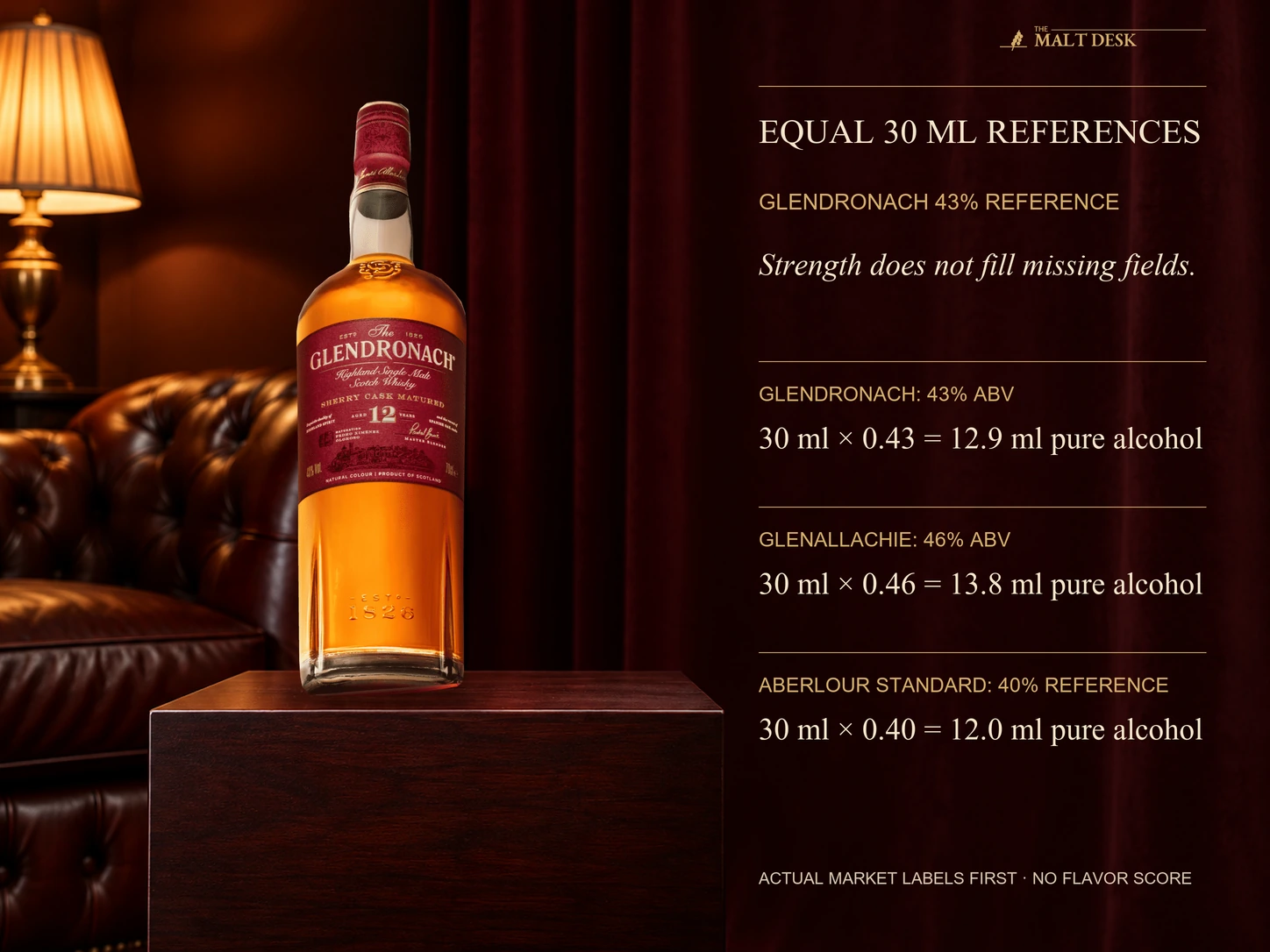
At an equal 30 ml pour, the reference strengths give approximately 12.9 ml of alcohol at 43%, 13.8 ml at 46% and 12.0 ml at 40%. Keep that quantity calculation alongside the separate cask, recipe and market-presentation fields. The Scotch whisky regions guide explains the geographical names.
Set the Sherry-Cask and Filtration Requirements First
If sherry-cask-only maturation is essential, shortlist expressions with that explicit production account. If explicit non-chill filtration is essential, check that separate field for the exact presentation. Keep both requirements when both matter and extend the search if needed. This turns a vague richness comparison into a shortlist whose cask program and processing disclosures match the reader’s brief.
Common Questions
Which is the richest?
GlenDronach emphasizes sherry casks and dried fruit, while GlenAllachie lists chocolate, honey and spice. A matched tasting would be needed to compare perceived richness under the same conditions.
Which is best for a first sherry-influenced single malt?
Aberlour’s published honey, pear and red-apple notes may be a useful starting point for readers drawn to orchard fruit. GlenDronach’s sherry-cask and dried-fruit notes offer a different comparison. Neither is a required first or next step.
Does the 46% ABV make GlenAllachie automatically better?
No. For an equal initial volume, 46% contains more alcohol than 43% or 40%. Adding water changes concentration without removing that alcohol.
Final Verdict
GlenDronach 12 emphasizes its PX-and-Oloroso sherry-cask identity. GlenAllachie 12 discloses 46% ABV and a broader cask program. Aberlour 12’s producer notes emphasize honey and orchard fruit. Match these published details to the question you want to explore, then compare exact bottles and dated local offers; no value or flavor winner is established here.
Sources
Product specifications and published flavor descriptions were checked against official GlenDronach, GlenAllachie and Aberlour product information. Official product details were rechecked on October 3, 2026. Comparable current U.S. retailer prices have not been established in this guide.
Additional specification sources: official GlenDronach 12 product information, GlenAllachie’s dated 2025 cask account and current stated filtration policy, and Aberlour’s product directory and linked non-chill-filtered twelve-year electronic label, checked October 7, 2026. The two requirements are an explicit hypothetical request. Missing filtration evidence is not reported as proof of filtration, and natural color is not treated as a filtration statement.