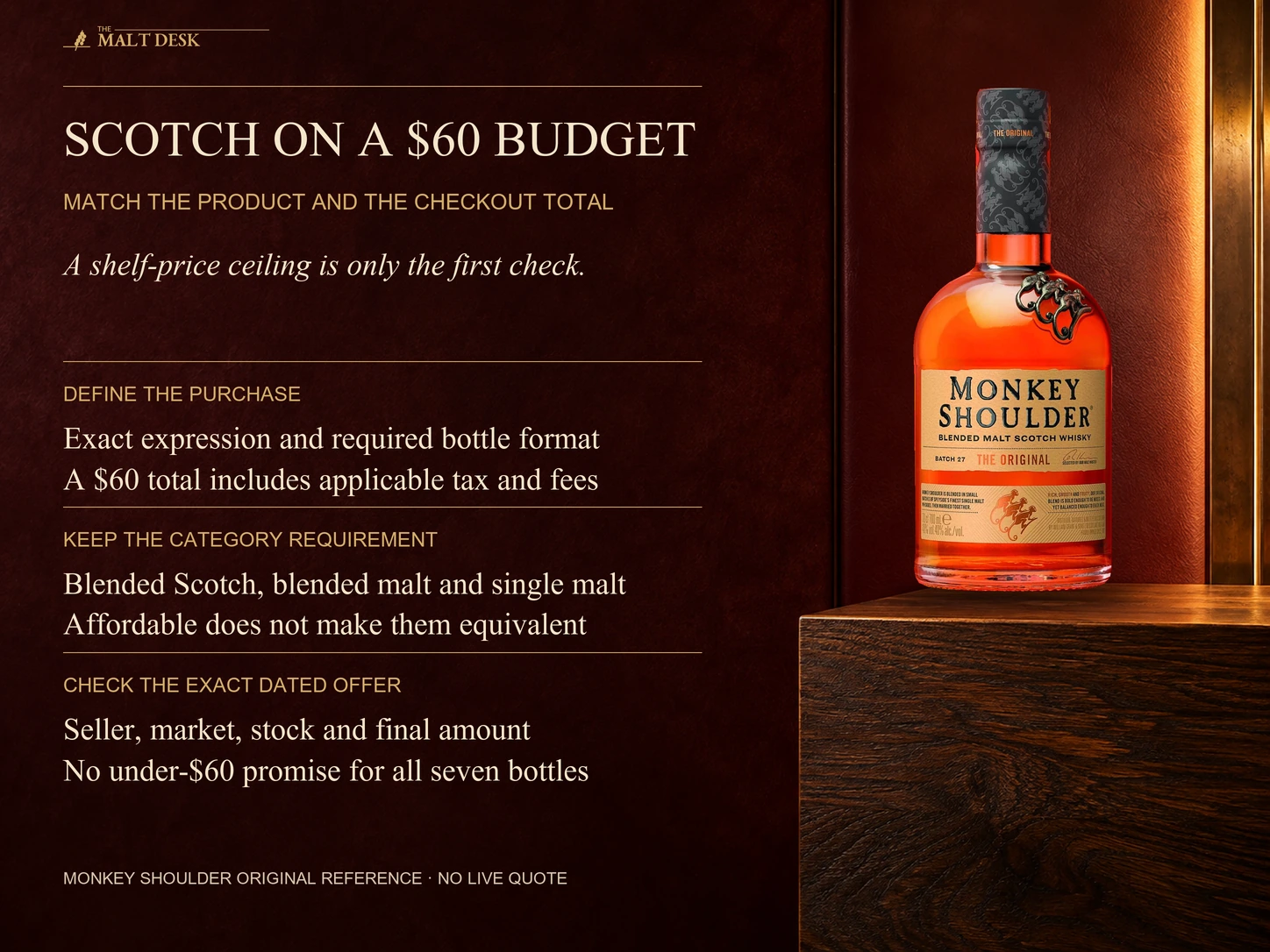
Scotch on a $60 Budget: What Can Be Compared?
A documented sale price below $60 can still miss a $60 total budget. Virginia ABC’s October 2026 specials give a concrete example in the 750 ml Glenfiddich American Oak entry below. Adding the agency’s stated sales tax takes that offer above the ceiling. It passes a shelf-price search but fails the amount available to spend.
That difference changes how I would use the seven-expression list below. A budget should first define the amount that can actually leave the wallet, then test an exact expression, format and dated offer against it. The list can organize production styles; it cannot make every bottle an available under-$60 purchase. The worked retailer examples below include one that fits the total and others that do not.
The seven expressions below organize three Scotch categories: blended Scotch, blended malt and single malt. The dated Virginia examples later in this guide test exact retailer entries against a total spending ceiling; they do not establish under-$60 availability for every expression in this overview.
Availability within a $60 total depends on location, format, tax and the date of the offer. The worked comparison records a sale period and exact product codes, then calculates the tax-inclusive amount. Any delivery or other charge also belongs in the actual purchase total.
The Seven Expressions
| Bottle | Style / strength | Comparison category |
|---|---|---|
| Johnnie Walker Black Label | 12-year blend · 40% | Blended Scotch |
| Dewar’s 12 | 12-year blend · 40% | Age-stated blended Scotch |
| Monkey Shoulder | Blended malt · check local label | Blended malt |
| Glenfiddich 12 | 12-year Speyside malt · 40% | Speyside single malt |
| Glenmorangie Original 12 | 12-year Highland malt · check local label | Highland single malt |
| Laphroaig 10 | 10-year Islay malt · check local label | Islay single malt |
| Balvenie DoubleWood 12 | 12-year Speyside malt · check local label | Sherry-finished single malt |
Strengths and packaging can differ by market. Read the specific bottle label before comparing two listings. A global product page is not necessarily a specification for a U.S. bottle, and an old 10-year expression should not be substituted for a newer 12-year one.
Monkey Shoulder
A blended malt Scotch, combining single malts rather than malt and grain whisky. The producer describes vanilla, orange, and spice, and explicitly positions the expression for mixing.
See the Monkey Shoulder guide for expression-specific context.
Dewar’s 12
A 12-year blended Scotch bottled at 40% ABV. Dewar’s describes a two-stage aging process and first-fill bourbon-cask finishing, with fruit and vanilla in its published profile. “Double aged” describes a production process.
See the Dewar’s 12 guide for expression-specific context.
Johnnie Walker Black Label
A 12-year blended Scotch whose producer description includes fruit, spice, vanilla, and smoke. Its category differs from a blended malt such as Monkey Shoulder.
See the Johnnie Walker Black Label guide for expression-specific context.
Glenfiddich 12
A 12-year single malt associated in the producer’s notes with pear and other fruit. Its single-distillery category, age statement, and published profile provide concrete points of comparison with the blends in the table.
See the Glenfiddich 12 guide for expression-specific context.
Glenmorangie Original 12
A 12-year single malt whose producer describes citrus, vanilla, honey, and peach. Distinguish it from the former 10-year Original and check the strength and size on the local bottle. An increased age statement does not, by itself, prove greater integration or better flavor.
See the Glenmorangie Original 12 guide for expression-specific context.
Laphroaig 10
A 10-year Islay single malt. The producer’s notes emphasize peat smoke, seaweed, and medicinal descriptors.
See the Laphroaig 10 guide for expression-specific context.
Balvenie DoubleWood 12
A single malt described by the producer as American-oak maturation followed by European-oak sherry-cask finishing. It illustrates how a finish differs from a vatting of separately matured whiskies. Presentation and a two-cask narrative are not evidence that it is the best gift or a superior whisky.
Three Scotch Categories in One Budget
This group includes blended Scotch, blended malt, and single malt. Those labels describe composition and production, not an ascending quality ladder. The single malt and blended Scotch guide explains the distinctions.
An age statement identifies the youngest component whisky, not the average age of a blend. A bottle without an age statement should not be assigned an age from its price, color, or reputation. These distinctions remain useful even when retail prices move outside the original budget.
A Dated Sale Still Needs the Checkout Test
The following entries come from Virginia ABC’s October specials, reported September 29, 2026, with these sale periods running October 1–31. All three listed bottles are 750 ml. This is a dated Virginia price-list comparison, not a national price range, a stock confirmation or a completed purchase.
| Exact retailer entry and code | Sale bottle price | Calculated total at 5.3% | Calculated total at 7% | Within a $60 total? |
|---|---|---|---|---|
| Monkey Shoulder Scotch — 005635 | $34.99 | $36.84 | $37.44 | Yes, at these rates |
| Glenfiddich 12 Year Scotch American Oak — 006473 | $57.99 | $61.06 | $62.05 | No |
| The Balvenie Doublewood 12 Year Scotch — 004356 | $79.99 | $84.23 | $85.59 | No |
The totals multiply the sale bottle price by one plus the stated sales-tax rate, rounded to cents, with no delivery or other fee assumed. Virginia ABC says its spirits retail prices already include the 20% state tax; adding that tax again would double count it. The separate local sales-tax rates are 5.3%, 6%, 6.3% or 7%. The two displayed endpoints show that the $57.99 entry misses this total ceiling throughout that stated range.
Move the Search Limit Before Replacing the Whisky
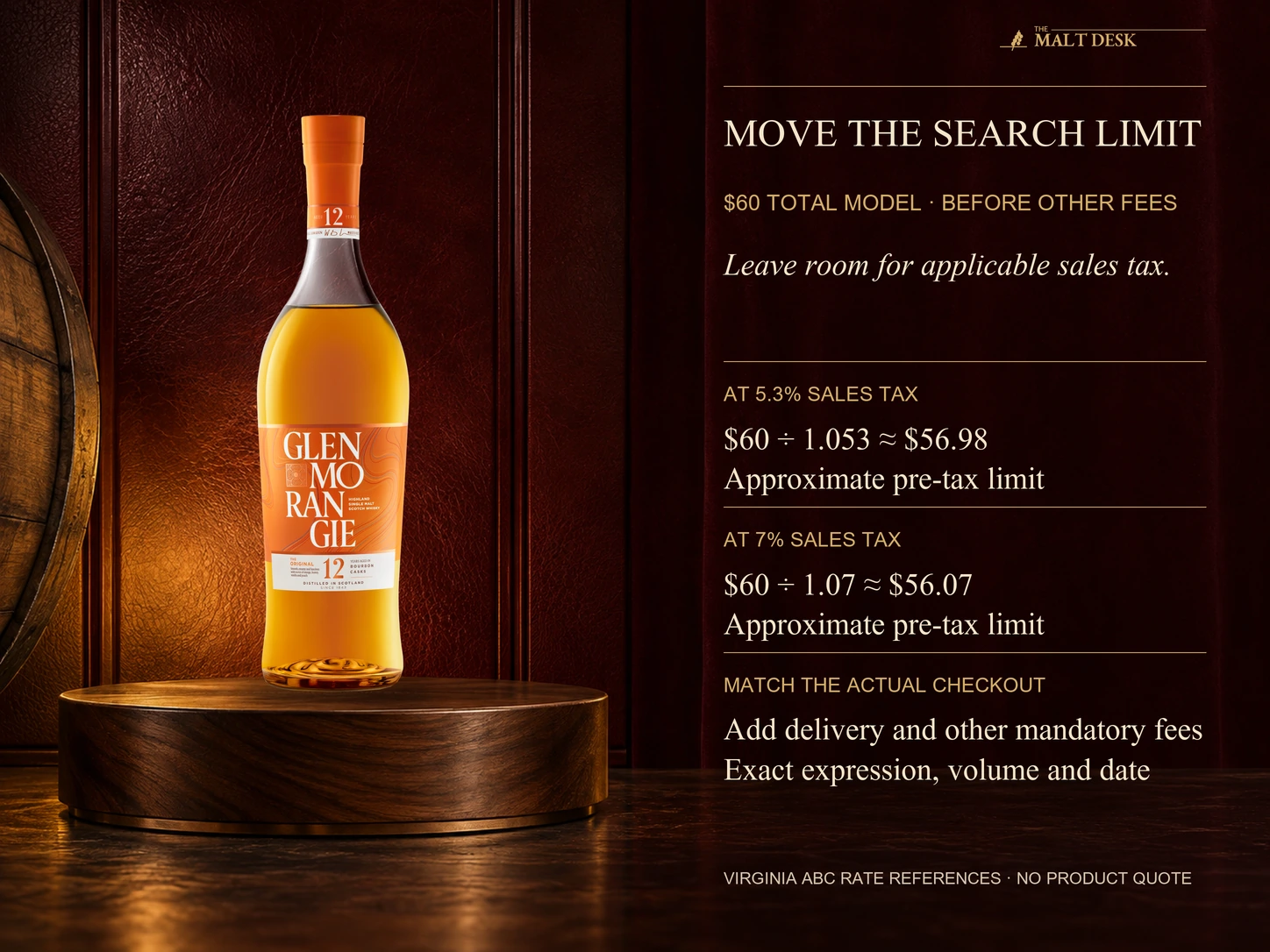
For a maximum $60 total and no other charge, divide 60 by one plus the applicable sales-tax rate to obtain the pre-tax limit. That is approximately $56.98 at 5.3% or $56.07 at 7%, before checkout rounding. An offer comfortably below that limit leaves room for the tax; searching right up to a $59.99 sticker leaves none. Add delivery or any other mandatory charge to the calculation before deciding the bottle fits.
This is a different decision from finding the lowest price per 100 ml. A larger bottle might offer a lower unit price yet fail the amount available to spend. A cheaper miniature might fit the cash limit but fail a requirement for a full 750 ml bottle. Specify the needed format first; neither a good unit price nor a small-format substitute can silently redefine the purchase.
The retailer names also matter. Its American Oak entry has code 006473; the same agency has separately listed the standard Glenfiddich twelve under another code. I would not transfer the sale to every listing shortened to Glenfiddich 12. The October list’s separate Sherry Finish entry is $64.99, already above this ceiling before sales tax. Similar age and brand wording do not make the promotion or expression interchangeable.
A Passing Price Is a Candidate, Not a Forced Substitute
Monkey Shoulder’s listed total passes this cash test, so it is a concrete candidate for a reader seeking its blended-malt production category and producer-described mixing role. It does not become a twelve-year single malt or a DoubleWood-style sherry finish by being affordable. If either of those is the essential brief, a passing Monkey Shoulder price answers the budget question but not the product requirement.
For an essential DoubleWood 12 purchase, the dated sale shown here fails the ceiling even before tax. I would keep the specification and the spending limit explicit, then seek another verified equivalent offer or defer the purchase. Spending more would be a changed budget; buying another expression would be a changed brief. Neither should be hidden inside a recommendation that claims to fit the original request.
The useful result is a shortlist tied to exact offers and a maximum checkout amount. These three records do not establish a current price for every bottle in the seven-expression overview. Absence from this worked table is not evidence that a product is unavailable or over budget. Check the actual store and final price: Virginia ABC states that prices can change and the point-of-sale price supersedes website information.
How to Compare a $60 Budget
The table separates product category and reference strength from price. A dated local listing is needed to determine whether a particular expression fits the budget. A price ceiling is not a permanent product specification.
Compare the same expression and volume in the same market. Record the date and whether tax is included. For a simple volume comparison, divide price by milliliters; otherwise a smaller bottle can appear cheaper while costing more per unit. Delivery charges and location-specific availability can make a headline price misleading.
For example, two 12-year blended Scotches may fit the same budget while differing in their blend recipes and published profiles. Compare those facts directly.
What Published Flavor Notes Can Tell You
Producer notes highlight the intended profile of each expression. Terms such as pear-led, peated and sherry-finished provide a starting point for comparing styles.
Finish length, texture, cocktail performance, and preference depend on the sample and serving conditions.
Related Reading
For category terminology, see what peated whisky means. The whiskey budget guide covers a broader group of styles, and the beginner guide explains the terms used in introductory descriptions.
In Brief
This guide compares seven Scotch expressions across blended and single malt categories. The dated Virginia examples show why a sale price below $60 can still fail a $60 checkout ceiling, and why an affordable bottle must also match the required expression and format.
Make the Sixty-Dollar Limit Describe the Checkout
Set the maximum total first and allow for the applicable tax and other charges before searching shelf prices. Use the exact dated Virginia entries as worked examples, then verify the intended local expression and format. Keep an affordable candidate only when its category and cask program also meet the brief; otherwise adjust the search, quantity or timing explicitly.
Frequently Asked Questions
Is one expression the best under $60?
This guide establishes no universal winner. The expressions differ in category, production, and published profile, and local availability below the budget must be checked separately.
Is a more expensive single malt automatically better?
Category identifies the production structure and price identifies the cost. Use the expression’s casks, attributed profile and intended role to decide whether that cost fits your brief.
Should tax or delivery be included in the comparison?
Yes, when comparing final costs. Keep the treatment consistent across listings and distinguish shelf price from the amount after tax and any other charges.
Sources
Product descriptions consulted: Monkey Shoulder Original; Dewar’s 12 Year Old; Johnnie Walker Black Label; Glenfiddich 12 Year Old; Glenmorangie The Original 12 Years Old; Laphroaig 10 Year Old; and The Balvenie DoubleWood 12. Flavor descriptions above are attributed to the respective producers. Price comparisons require separately dated local listings.
Retailer example checked October 7, 2026: Virginia ABC October 2026 Monthly Specials Detail, reported September 29, 2026, and its Pricing Information page. Quoted sale periods are October 1–31; the table uses three exact 750 ml entries. Totals are calculated, not receipts, and include only the listed bottle price and stated sales tax. No store stock, delivery, national price range or price for all seven overview bottles is asserted. The checkout-budget method and resulting choices are The Malt Desk’s editorial analysis.