Skip to content

The Malt Desk by K. Choi

  • Whiskey Profiles
    • Tennessee Whiskey
    • Peated Whiskey
    • Japanese Whiskey
    • Irish Whiskey
    • Bourbon whiskey
    • Blended Scotch Whiskey
    • Single Malt Scotch
  • Whiskey Comparisons
  • Whiskey 101
  • Gear & Glassware
  • Explore Whiskey

K. Choi

K. Choi edits The Malt Desk, an independent whisky information site. Guides compare published product specifications, label terms and dated price records. Flavor descriptions are attributed to their sources; the articles do not claim firsthand tasting.

Laphroaig 10 Guide: Peated Malt, Market Strengths and Flavor Profile
October 15, 2026August 11, 2026 by K. Choi
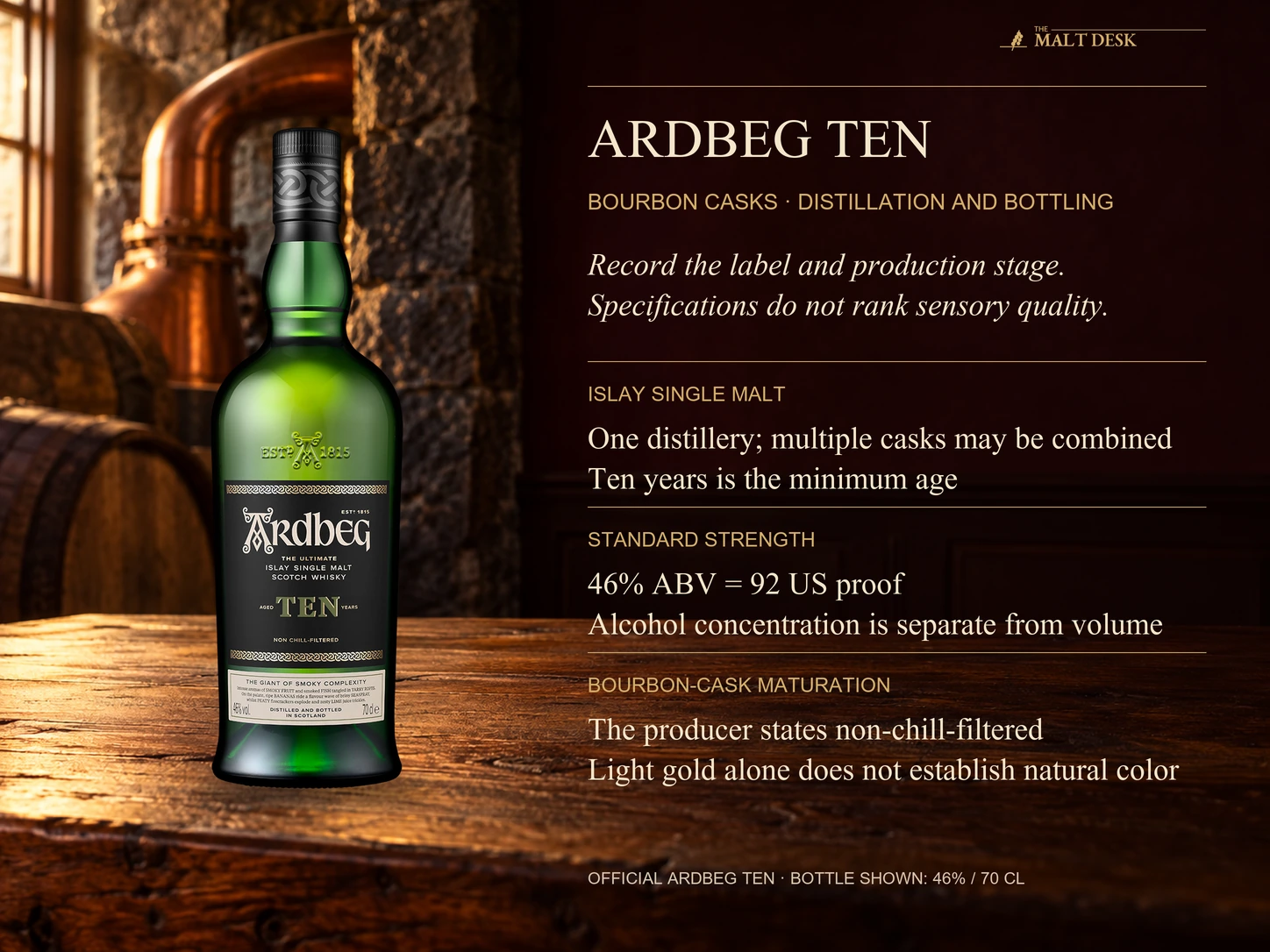
Official standard Laphroaig 10 Year Old bottle labeled 40 percent ABV and 700 ml, with ten-year minimum age, Islay single-malt category and ex-bourbon maturation; market presentations include 40 or 43 percent ABV and Cask Strength and Sherry Oak Finish are distinct expressions

Laphroaig 10 explained: peated malt preparation, ex-bourbon maturation, 40% and 43% market presentations, and the producer’s medicinal and maritime flavor vocabulary.

Categories Whiskey Profiles, Single Malt Scotch

Ardbeg 10 Guide: Peat, the Purifier and Bourbon-Cask Maturation

October 15, 2026August 10, 2026 by K. Choi
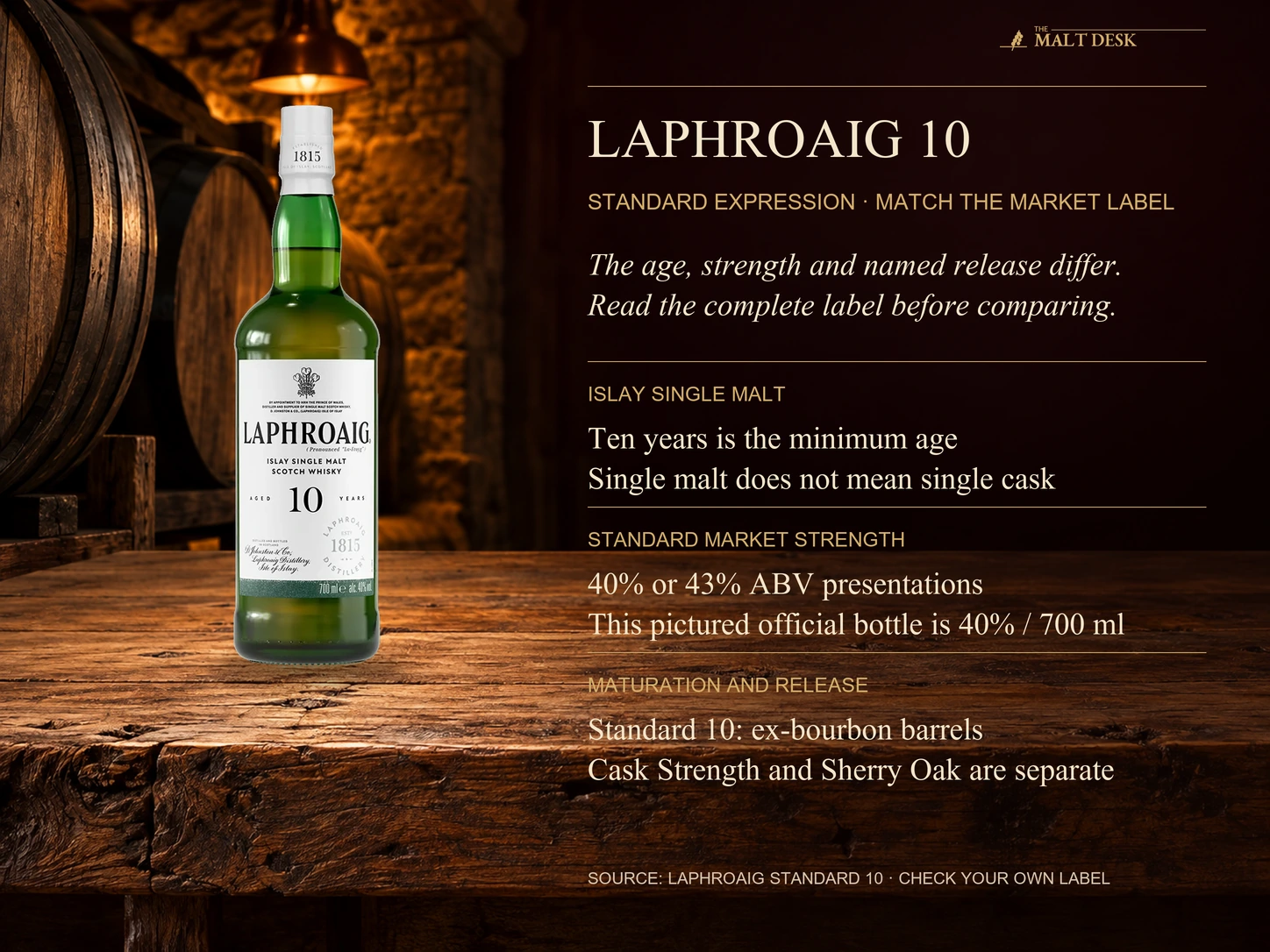
Official Ardbeg Ten Years Old bottle labeled 46 percent ABV and 70 cl, with ten-year minimum age, Islay single-malt origin, bourbon-cask maturation and explicit non-chill-filtered disclosure; a light-gold description alone does not establish a natural-color claim

Ardbeg Ten explained: the spirit-still purifier, bourbon-cask maturation, 46% ABV, non-chill filtration and the producer’s citrus-and-smoke flavor profile.
Categories Whiskey Profiles, Peated Whiskey

Single Malt vs Blended Scotch: Which Is Better?

October 15, 2026August 9, 2026 by K. Choi
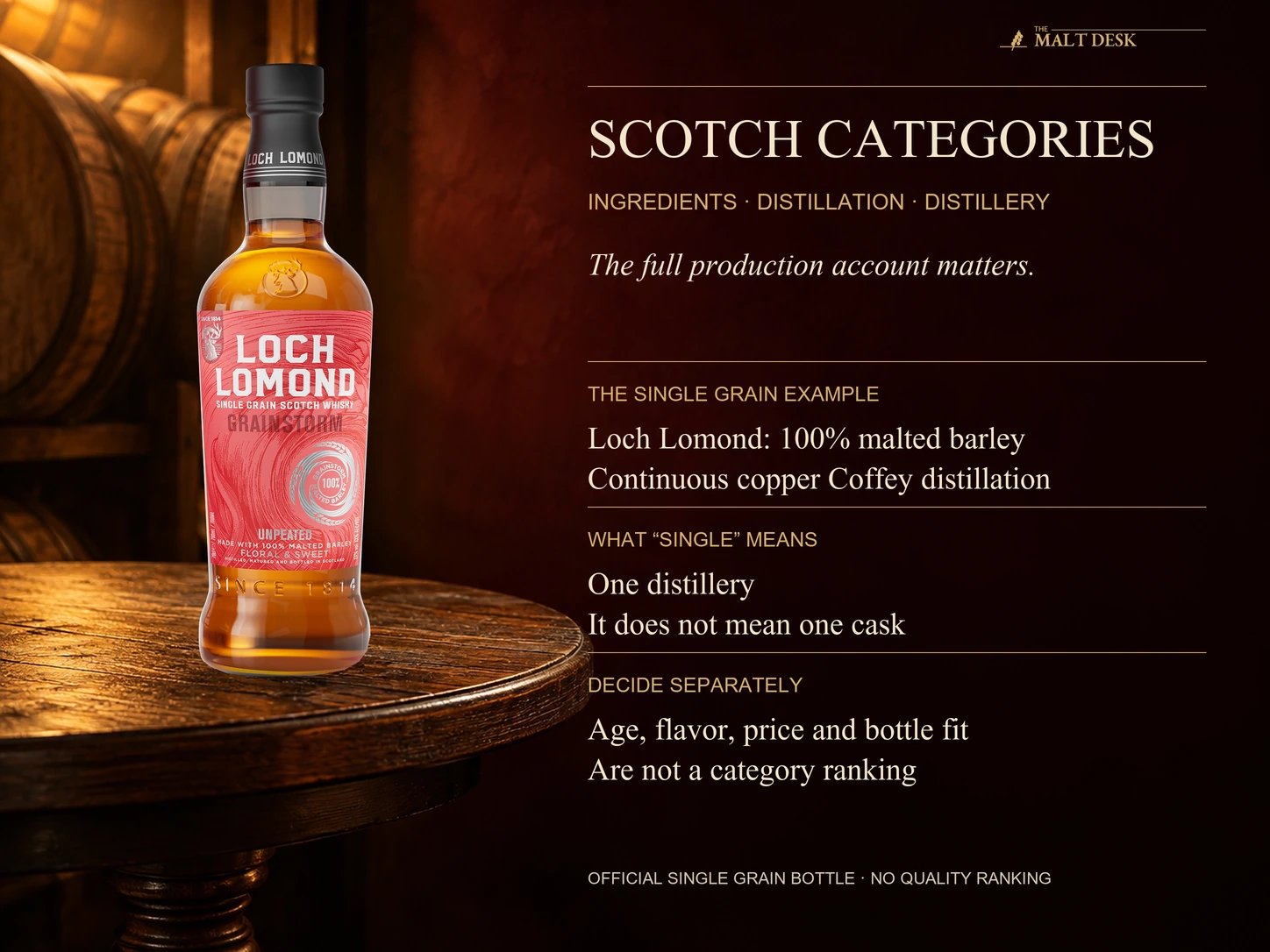
Official Loch Lomond Grainstorm Single Grain unpeated bottle with its producer’s 100-percent malted-barley and continuous copper Coffey-still production account, demonstrating that ingredients alone do not satisfy Single Malt Scotch requirements; single means one distillery and category is not a quality grade

Distinguish single malt, blended malt and blended Scotch, separate one distillery from one cask, and read age statements as the youngest component.
Categories Whiskey 101

Whiskey Glass Guide: Tulip, Rocks and Highball Shapes Explained

October 15, 2026August 8, 2026 by K. Choi
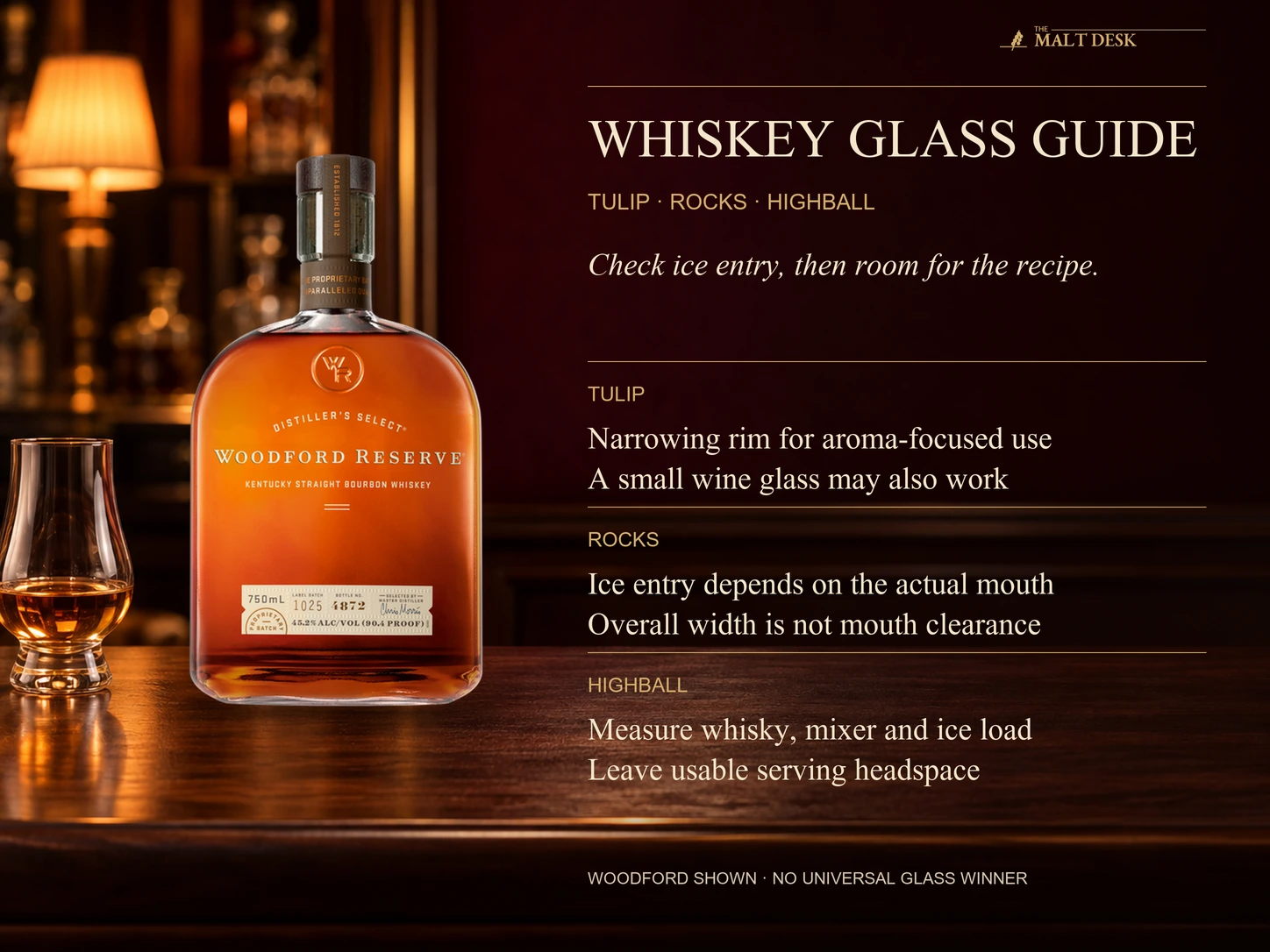
Official standard Woodford Reserve bourbon bottle beside an illustrative generic tulip glass and the article’s tulip, rocks and highball uses; check ice entry through the actual mouth before testing measured liquid, ice load and headspace

Compare tulip, rocks and highball glasses by function, opening and capacity, with a checked Glencairn model and an illustrative liquid-and-ice space calculation.
Categories Gear & Glassware

Woodford Reserve Bourbon Guide: Mash Bill, Distillation and Flavor

October 15, 2026August 7, 2026 by K. Choi
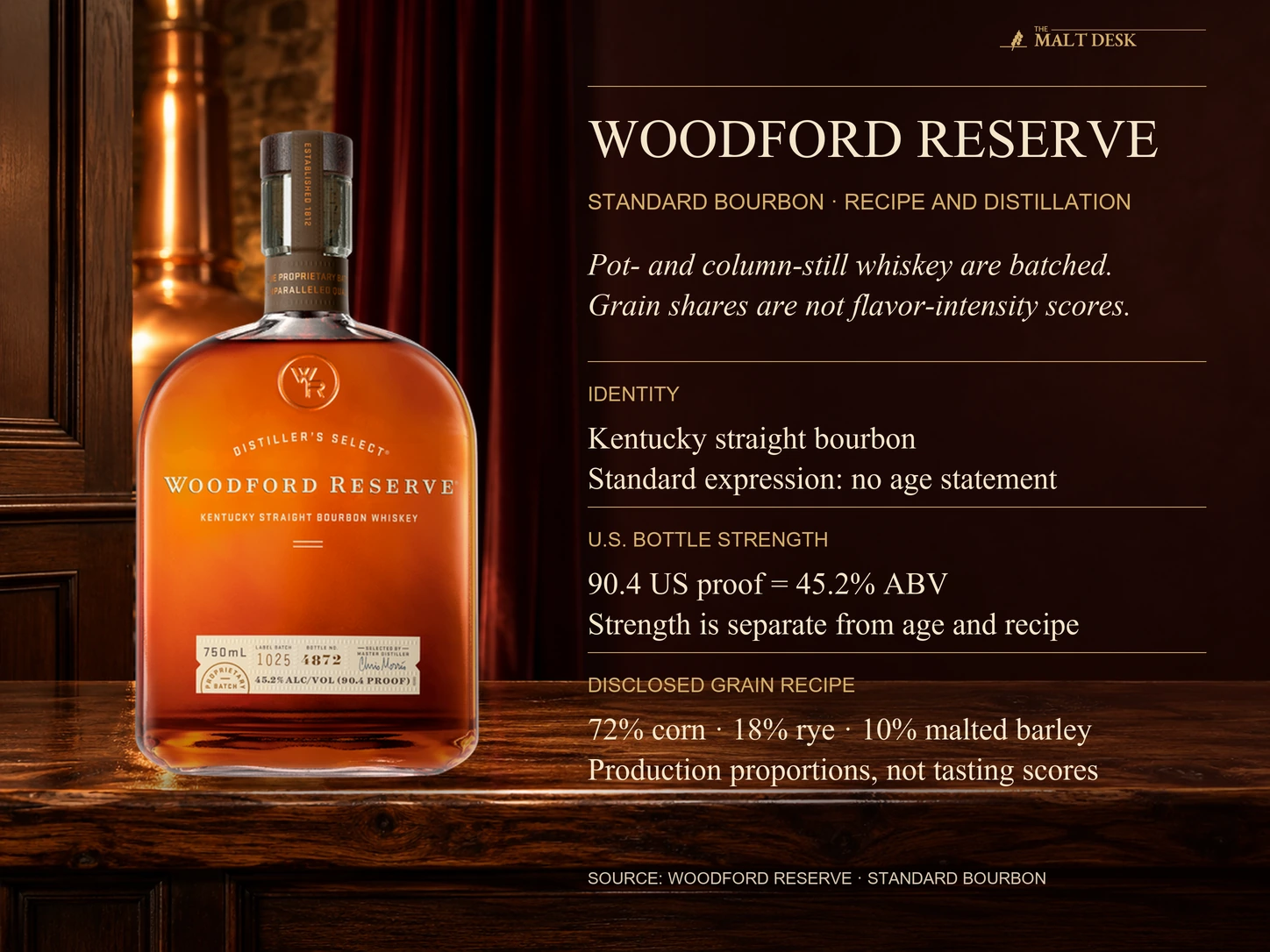
Official Woodford Reserve standard Kentucky Straight Bourbon bottle with 90.4 US proof equivalent to 45.2 percent ABV, no age statement, 72-percent corn and 18-percent rye and 10-percent malted-barley grain recipe, and batching of pot-still and column-still whiskey rather than exclusive pot distillation

Woodford Reserve’s standard bourbon explained through its 72/18/10 grain recipe, pot- and column-still components, 90.4 proof and producer-described flavor profile.
Categories Whiskey Profiles, Bourbon whiskey

How to Drink Whiskey: Neat, Water, Ice or Highball?

October 15, 2026August 6, 2026 by K. Choi
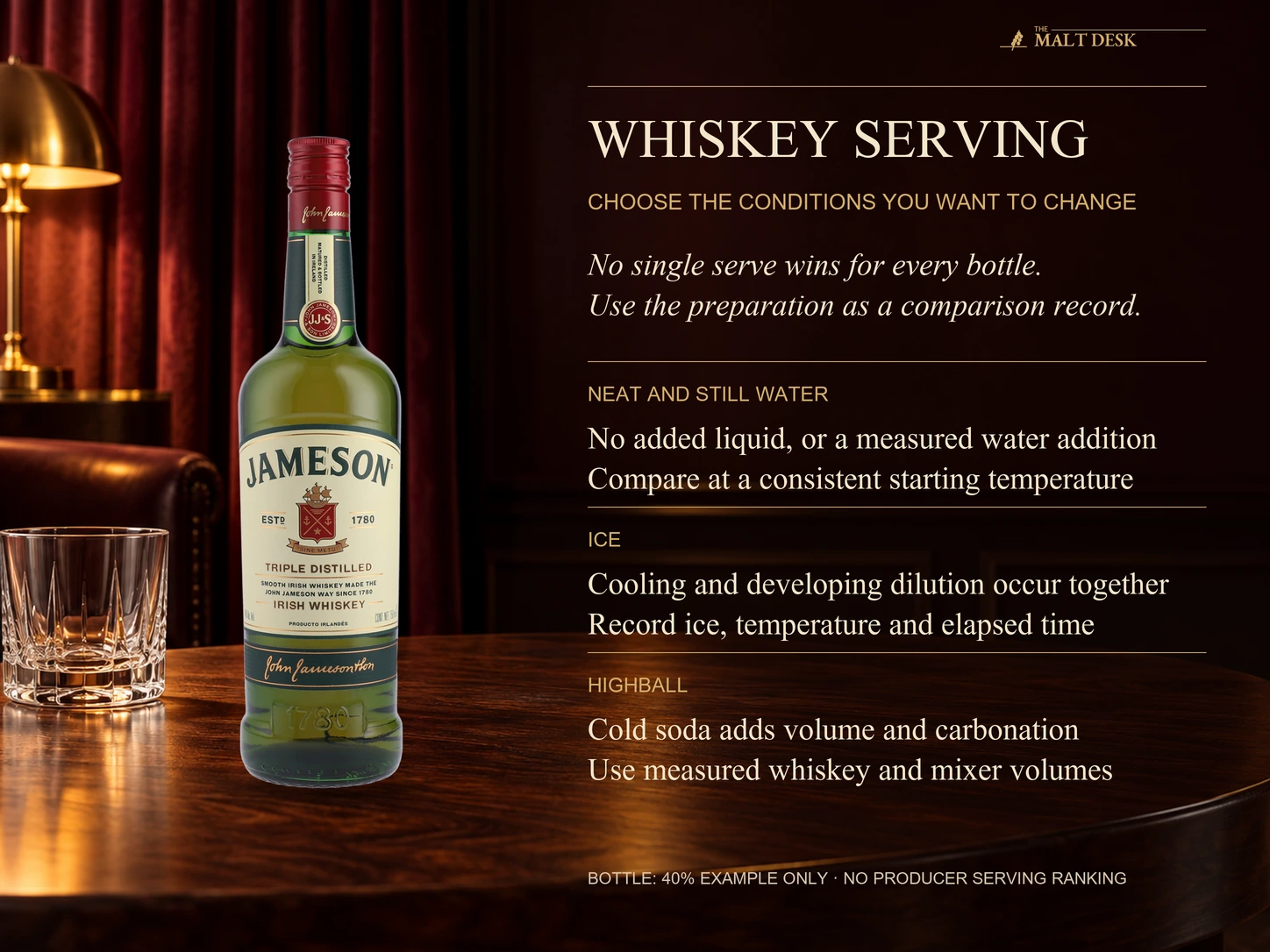
Official Jameson Original bottle as a 40-percent example only, beside whiskey-serving choices for neat or measured water, ice with cooling and developing dilution, and a recorded soda highball; no brand or serving preference ranking

Compare neat whiskey, water, ice and highballs, and use the dilution calculator to estimate ABV, total volume and alcohol in a measured pour.
Categories Whiskey 101

Johnnie Walker Black Label Guide: The 12-Year Blend Explained

October 15, 2026August 5, 2026 by K. Choi
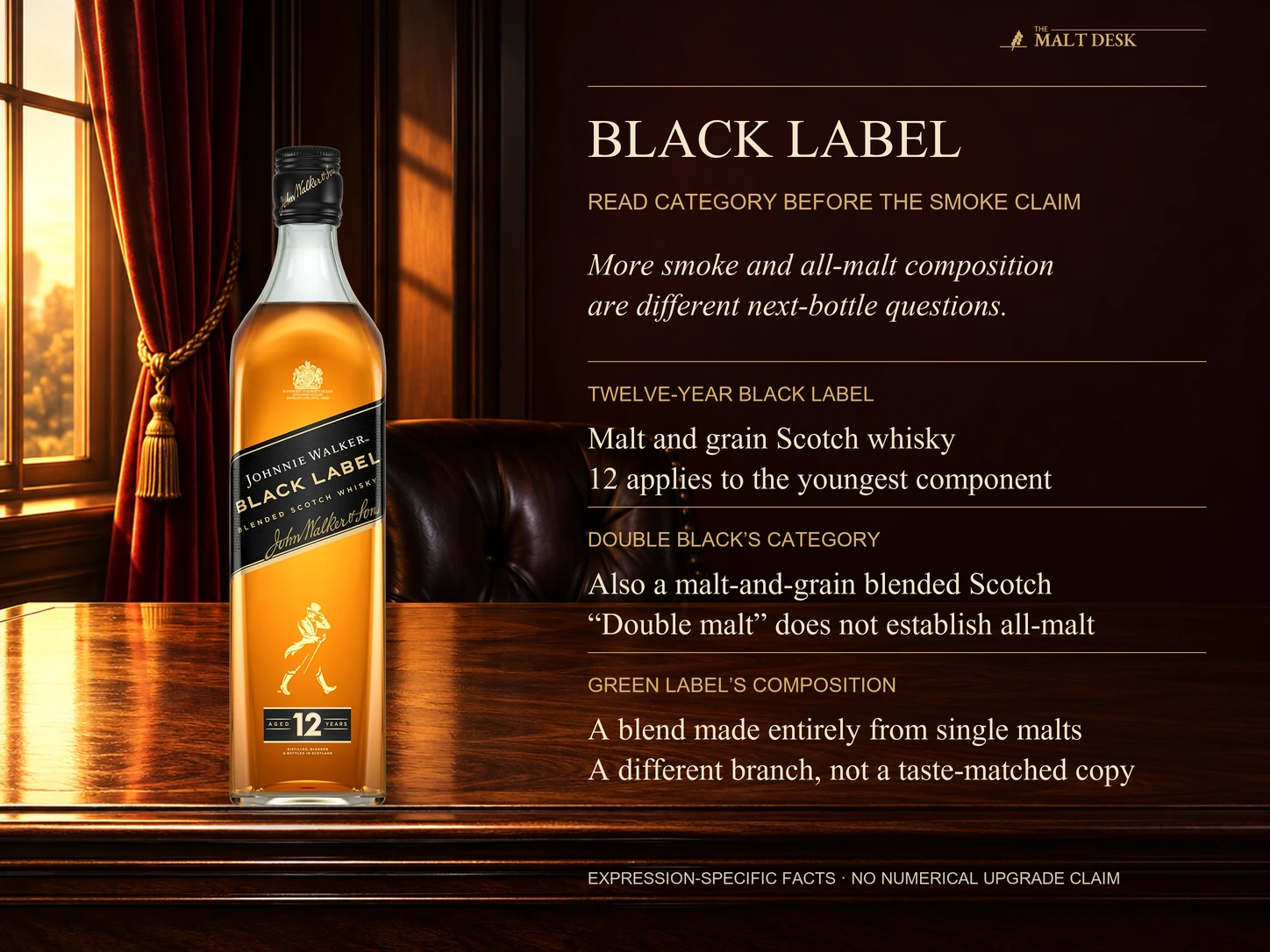
Official Johnnie Walker Black Label 12 bottle beside the article’s separate next-bottle questions: Black Label and Double Black are malt-and-grain blended Scotch, casual double-malt wording does not establish all-malt composition, and Green Label’s single-malt-only composition is a different branch rather than a taste-matched copy

Johnnie Walker Black Label explained through its blended Scotch category, 12-year minimum age, 40% ABV and producer-described fruit, vanilla, spice and smoke.
Categories Blended Scotch Whiskey, Whiskey Profiles

Types of Whiskey Explained: Scotch, Bourbon, Irish, Tennessee & Japanese

October 15, 2026August 4, 2026 by K. Choi
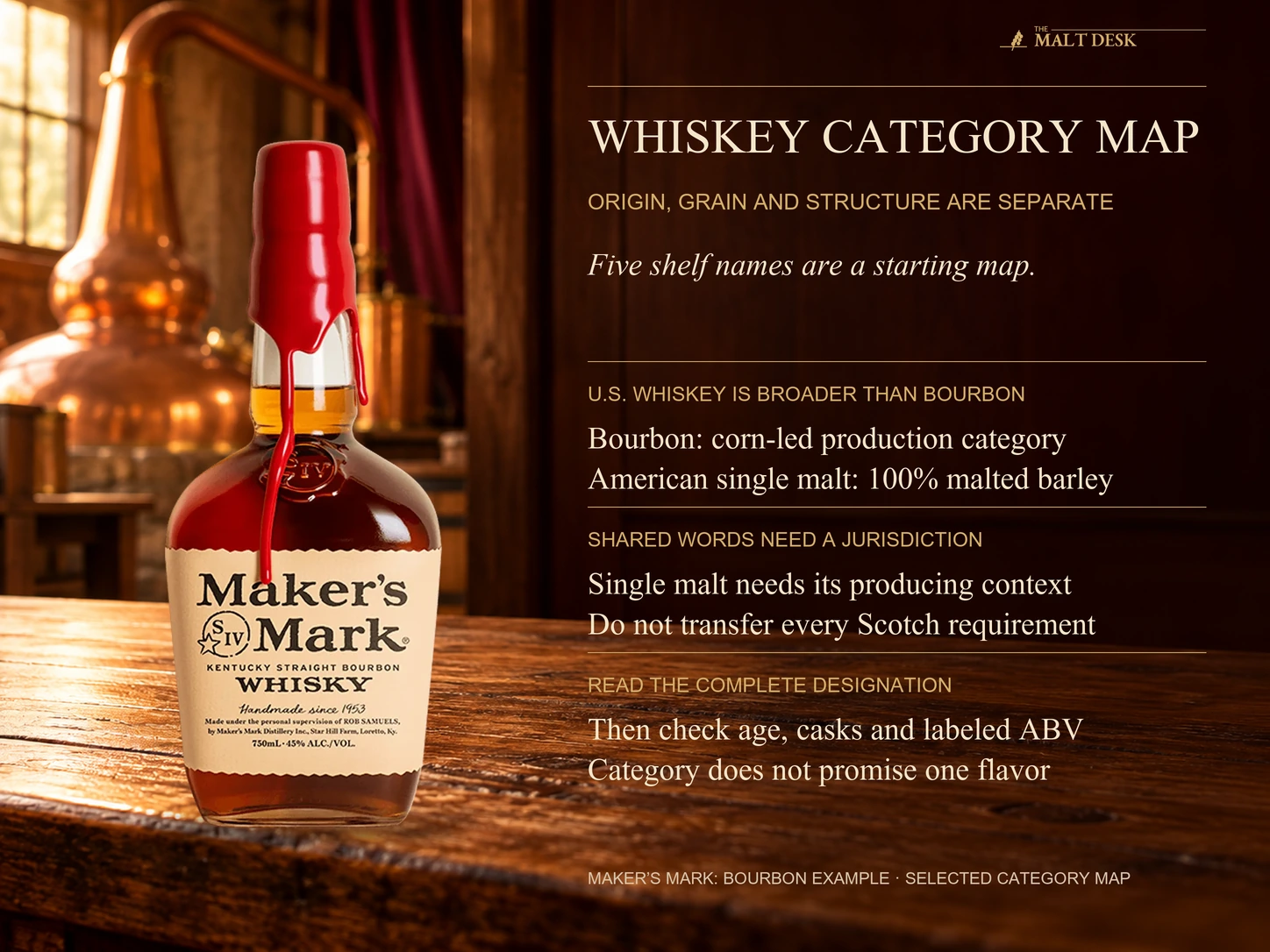
Official Maker’s Mark bourbon bottle illustrating a selected whiskey category map that separates origin grain and production structure, recognizes American single malt beyond bourbon, and reads complete designations without transferring every Scotch requirement or promising a category-wide flavor

Read Scotch, bourbon, Irish, Tennessee and JSLMA Japanese whisky definitions, with rye and Canadian context and a clear distinction between rules and flavor.
Categories Whiskey 101

Buffalo Trace vs Maker’s Mark vs Wild Turkey 101: Recipe and Proof

October 15, 2026August 3, 2026 by K. Choi
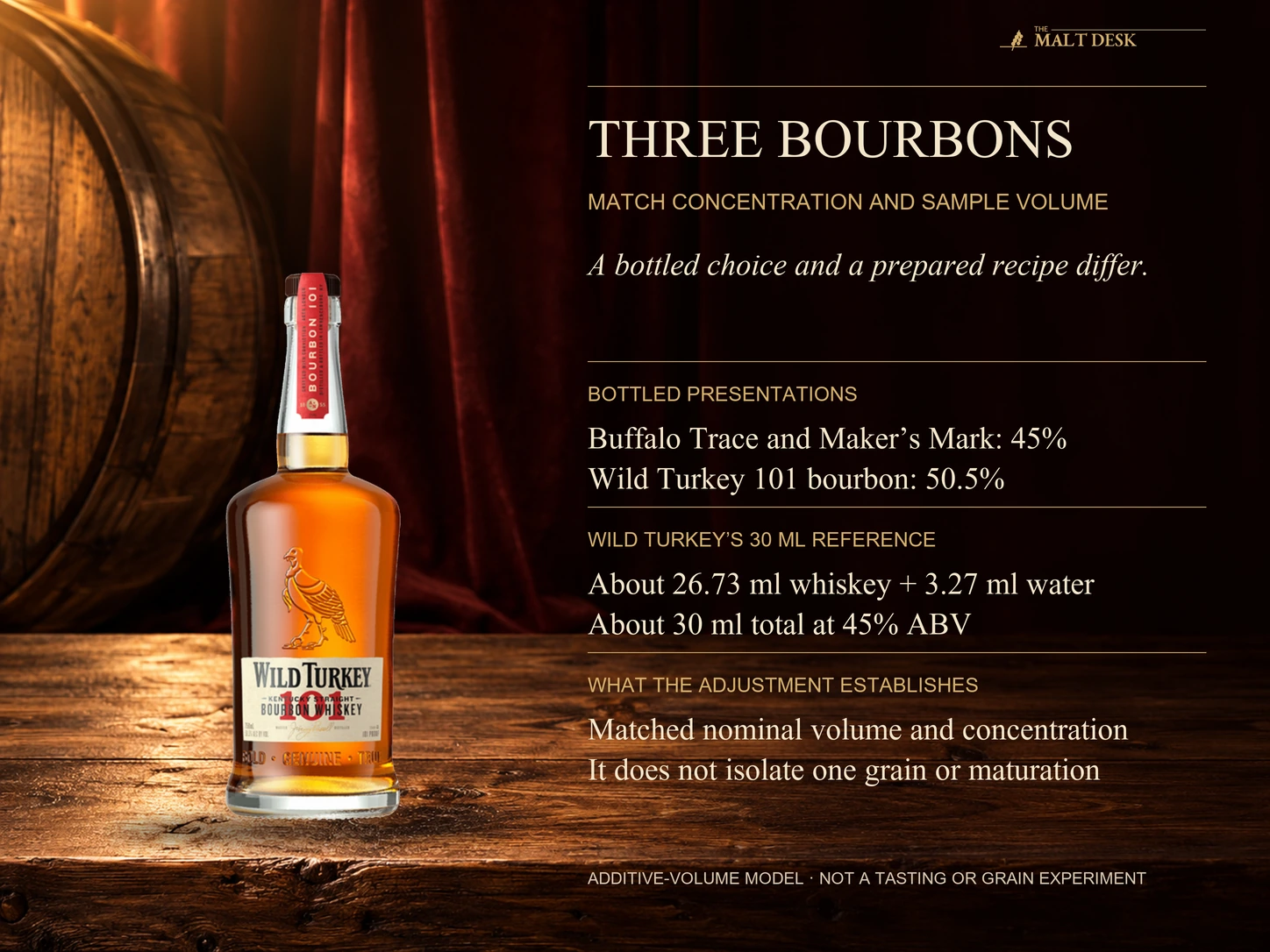
Official Wild Turkey 101 bourbon bottle illustrating the article’s approximately 26.73-milliliter 50.5-percent whiskey plus 3.27-milliliter water construction for a 30-milliliter 45-percent reference, matching standard Buffalo Trace and Maker’s Mark nominal strength and sample volume without isolating grain or maturation

Compare Buffalo Trace, Maker’s Mark and Wild Turkey 101 through disclosed grain choices, 90 versus 101 proof, producer flavor descriptions and label differences.
Categories Whiskey Comparisons

Whiskey Highballs: Seven Bottles, Mixers and Dilution Explained

October 15, 2026August 2, 2026 by K. Choi
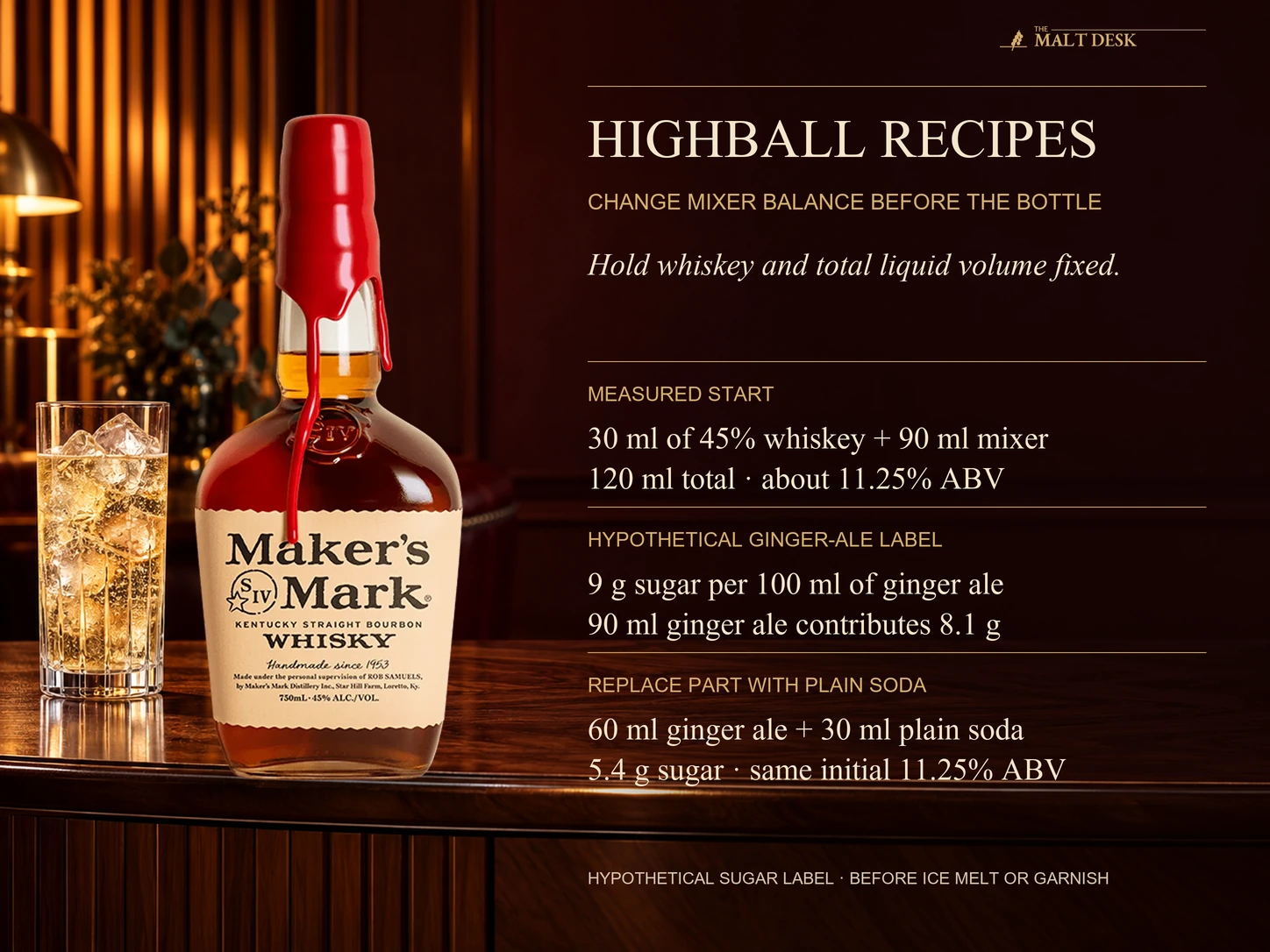
Official standard 45-percent Maker’s Mark bottle illustrating the article’s fixed 30-milliliter whiskey and 90-milliliter mixer example: replacing 30 milliliters of hypothetical 9-gram-per-100-milliliter ginger ale with plain soda reduces its sugar contribution from 8.1 to 5.4 grams while initial ABV stays about 11.25 percent before ice and garnish

Learn how whiskey category, mixer and ratio shape a highball, with seven bottle examples and clear calculations for dilution and approximate finished ABV.

Categories Whiskey Comparisons
Older posts
Newer posts
← Previous Page1 … Page4 Page5 Page6 Page7 Next →

The Malt Desk by K. Choi — whiskey profiles, comparisons and practical guides.

About · Contact · Privacy Policy · Affiliate Disclosure · Editorial Policy

© 2026 The Malt Desk by K. Choi • Built with GeneratePress
Cookie choices

Optional cookies support site statistics and saved preferences. Functional cookies remain active. Accept or reject optional cookies, or use View preferences to choose categories. You can change your choice later using Manage consent.

Functional Always active
The technical storage or access is strictly necessary for the legitimate purpose of enabling the use of a specific service explicitly requested by the subscriber or user, or for the sole purpose of carrying out the transmission of a communication over an electronic communications network.
Preferences
The technical storage or access is necessary for the legitimate purpose of storing preferences that are not requested by the subscriber or user.
Statistics
The technical storage or access that is used exclusively for statistical purposes. The technical storage or access that is used exclusively for anonymous statistical purposes. Without a subpoena, voluntary compliance on the part of your Internet Service Provider, or additional records from a third party, information stored or retrieved for this purpose alone cannot usually be used to identify you.
Marketing
The technical storage or access is required to create user profiles to send advertising, or to track the user on a website or across several websites for similar marketing purposes.
  • Manage options
  • Manage services
  • Manage {vendor_count} vendors
  • Read more about these purposes
View preferences
  • {title}
  • {title}
  • {title}