Quick Answer
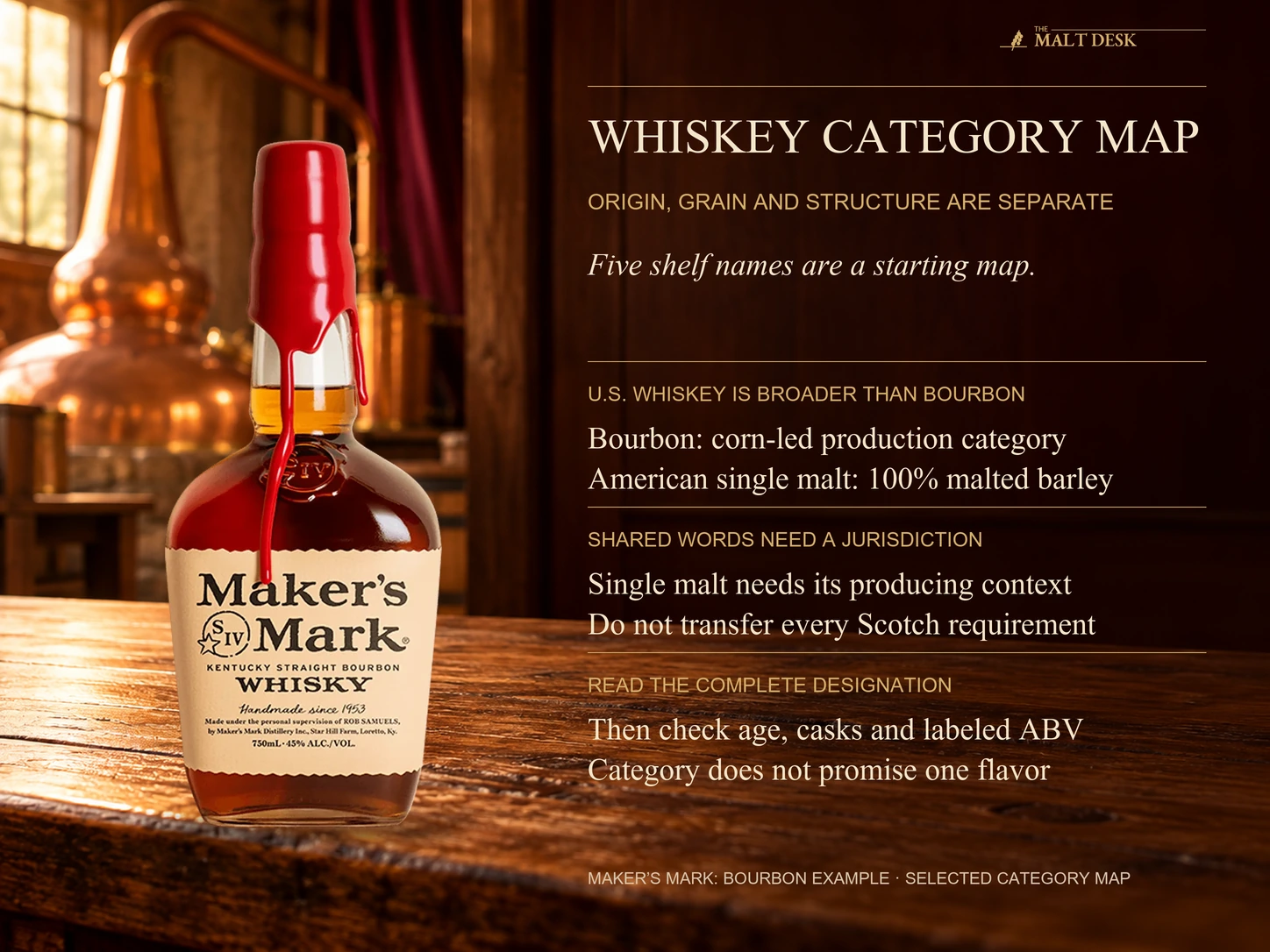
The five familiar shelf names in this guide do not form five mutually exclusive, exhaustive boxes. Bourbon describes a U.S. grain-and-production category; Tennessee adds a state identity; single malt describes another production structure. The current American single malt standard makes that overlap especially visible: U.S. whiskey is broader than bourbon, and single malt is broader than Scotch.
A reader looking for an American malt whisky therefore needs a branch missing from a simple country list. The useful map starts with the complete designation and its own rules, then uses country, grain and production structure as separate coordinates.
The main types of whiskey are separated first by where and how they are made, not by a guaranteed flavor.
- Scotch whisky must be made and matured in Scotland for at least three years. It includes single malt, single grain and several blended categories.
- Bourbon whiskey must be made in the United States from at least 51% corn and aged in new charred oak. Bourbon itself has no federal minimum age.
- Irish whiskey must be made on the island of Ireland and matured in wooden casks for at least three years.
- Tennessee whiskey is produced in Tennessee, overlaps with bourbon standards and is generally charcoal mellowed before aging under state law.
- Japanese whisky, under the Japan Spirits & Liqueurs Makers Association standard, is fermented, distilled, aged and bottled in Japan, with at least three years of maturation.
Flavor varies within every category. Production rules provide a framework, while the exact recipe, distillation, casks and bottling choices shape the individual expression.
Key Takeaways
- A country or style name is a production identity.
- “Whiskey” versus “whisky” is mostly a naming convention. It does not create the category.
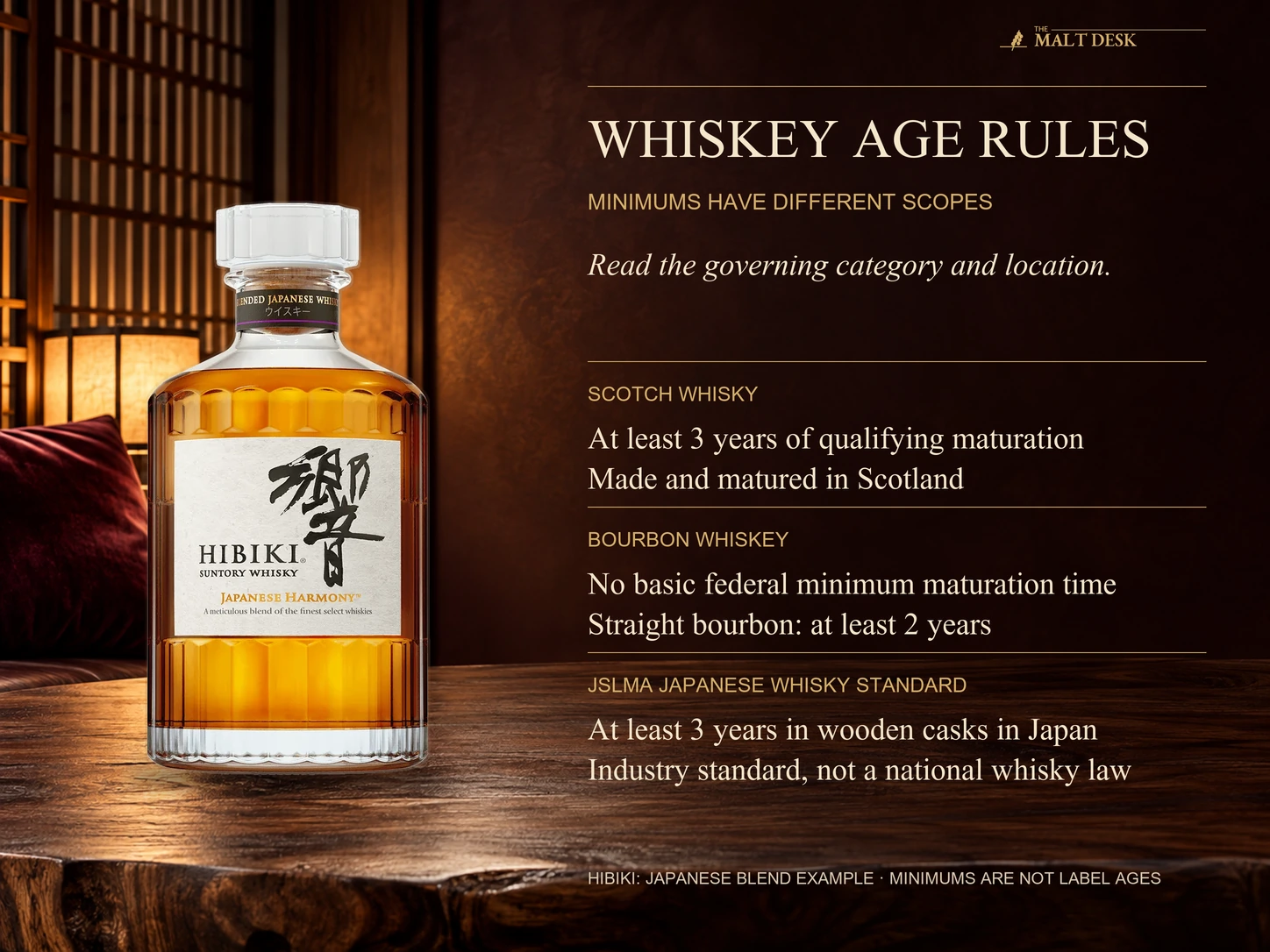
- Scotch and Irish whiskey require at least three years of maturation. The current Japanese industry standard also requires three years.
- Bourbon needs new charred oak but has no minimum age unless it is labeled straight, which requires at least two years.
- Tennessee whiskey is closely related to bourbon, but place and charcoal mellowing matter to the label.
- Single malt and blended describe production structure within a wider origin category; they are not competing countries.
- The easiest first bottle depends more on preferred flavor and serving style than on prestige.
What Does “Whiskey Type” Actually Mean?
A useful whiskey type tells you what rules shaped the spirit. Those rules can control origin, grain, distillation strength, cask type, maturation location, minimum age and bottling strength.
The categories do not control every aroma. The producer descriptions for Glenfiddich 12 emphasize pear and orchard fruit, while Lagavulin 16 names peat, iodine and seaweed. Both are single malt Scotch. These are attributed descriptions.
The same distinction applies elsewhere. The law sets the frame; grain recipe, still design, fermentation, warehouse, cask history, age, blending and bottling strength create the individual bottle.
Whiskey vs Whisky: Does the Spelling Matter?
The spelling usually follows regional convention:
- Scotland, Canada and Japan commonly use whisky.
- Ireland and the United States commonly use whiskey.
It is not a perfect rule. Maker’s Mark labels its bourbon whisky, and U.S. regulations use whisky in formal class definitions. A label’s missing e does not turn bourbon into Scotch or change how it was matured.
Five Major Types at a Glance
| Type | Origin and production core | Minimum age | Category detail to read | Linked starting example |
|---|---|---|---|---|
| Scotch whisky | Made in Scotland; categories determine whether malted barley is used alone or with other grains | 3 years | Single malt, single grain, blended malt, blended grain or blended Scotch | Glenfiddich 12 |
| Bourbon whiskey | Made in the U.S.; at least 51% corn; new charred oak | None; straight bourbon is 2+ years | Corn-majority recipe; straight is a separate minimum-age claim | Buffalo Trace |
| Irish whiskey | Made on the island of Ireland; malted cereals with or without other grains | 3 years | Pot still, malt, grain and blended production varieties | Jameson |
| Tennessee whiskey | Made in Tennessee; bourbon-related rules plus state identity | None; straight rules still apply when claimed | Tennessee manufacture and maturation; state charcoal rule has an exemption | Jack Daniel’s Old No. 7 |
| Japanese whisky | JSLMA standard: production and three-year maturation in Japan | 3 years | JSLMA member provenance standard; grain need not be grown in Japan | Hibiki Japanese Harmony |
The table summarizes selected production requirements. It is a starting map rather than an exhaustive list of whiskey designations; rye, Canadian whisky and American single malt require additional branches.
What Is Scotch Whisky?
Scotch whisky must be distilled and matured in Scotland. The Scotch Whisky Regulations require at least three years in oak casks no larger than 700 liters and a minimum bottling strength of 40% ABV.
There are five legal categories:
- Single Malt Scotch Whisky
- Single Grain Scotch Whisky
- Blended Malt Scotch Whisky
- Blended Grain Scotch Whisky
- Blended Scotch Whisky
Is single malt the same as Scotch?
Single Malt Scotch is a specific Scotch category made at one distillery from water and malted barley using batch pot distillation. Single malt terminology also appears outside Scotland under other jurisdictions; the term alone does not establish Scottish origin. Single refers to one distillery, not one barrel.
That is why The Glenlivet 12, The Macallan 12 Double Cask and Lagavulin 16 can all be single malts while tasting very different. For a direct beginner comparison, see Glenfiddich 12 vs Glenlivet 12 vs Macallan 12.
Blended Scotch combines one or more single malt Scotch whiskies with one or more single grain Scotch whiskies. Johnnie Walker Blue Label and Chivas Regal 12 are product examples.
What does Scotch usually taste like?
Scotch encompasses varied styles. Unpeated malts may show apple, pear, honey, cereal, vanilla, dried fruit or sherry-cask spice. Peated malts can add smoke, earth, medicinal notes and coastal character.
Region can provide context, but it is not a flavor guarantee. Cask choice and peat use tell you more than a region name alone.
What Is Bourbon Whiskey?
Bourbon must be made in the United States from a fermented mash containing at least 51% corn. It is distilled at no more than 80% ABV, entered into new charred oak at no more than 62.5% ABV and bottled at no less than 40% ABV.
Bourbon does not have to come from Kentucky. Kentucky is the category’s best-known center, but U.S. origin—not one state—is the federal requirement.
Does bourbon have to be aged for two years?
No. Bourbon itself has no federal minimum maturation period. Straight bourbon must be stored in new charred oak for at least two years, and younger straight bourbon needs an age statement under U.S. labeling rules.
New charred oak helps explain bourbon’s common vanilla, caramel, brown sugar, coconut, baking spice and toasted-oak direction. Corn contributes to the impression of sweetness, but bourbon is not simply sweetened whiskey.
Buffalo Trace names Mash Bill #1 without a complete grain formula. Maker’s Mark identifies wheat as a supporting grain, while Wild Turkey 101 has a 101-proof reference. These are separate disclosure and strength facts. See Buffalo Trace vs Maker’s Mark vs Wild Turkey 101 for the expression-level comparison.
What Is Irish Whiskey?
Irish whiskey must be produced on the island of Ireland, including Northern Ireland, and matured there in wooden casks no larger than 700 liters for at least three years. The technical file recognizes malt, pot still, grain and blended Irish whiskey styles.
Irish whiskey is often described as smooth because many familiar brands use light grain whiskey, triple-distilled components or both. Triple distillation is common, not universal, and it is not the legal definition of Irish whiskey.
Jameson Original combines pot still and grain whiskey. Its producer describes floral, spiced-wood, vanilla and nut associations.
What Is Tennessee Whiskey?
Tennessee whiskey is one of the most confusing labels because it overlaps heavily with bourbon.
Tennessee law generally requires the whiskey to be produced in Tennessee, meet bourbon standards and pass through maple charcoal before aging—the process commonly called the Lincoln County Process. The statute includes a limited exemption, so every Tennessee whiskey is charcoal mellowed is too absolute.
Is Jack Daniel’s bourbon?
Jack Daniel’s Old No. 7 meets the federal production standards associated with bourbon, but the brand identifies it as Tennessee whiskey and emphasizes charcoal mellowing as part of that identity.
Charcoal mellowing describes a production step, not an added charcoal flavor or a guarantee of cocktail performance. Old No. 7’s producer notes include vanilla, caramel and toasted-oak associations. The Best Whiskeys for Highballs guide explains mixed-drink variables.
What Is Japanese Whisky?
Japanese whisky needs the most careful wording. The current definition used here is the Japan Spirits & Liqueurs Makers Association industry labeling standard, established in 2021 and fully implemented in April 2024. It is not presented as a national whisky law equivalent to the Scotch Whisky Regulations.
Under the standard, qualifying Japanese whisky requires malted grain, permits other cereal grains and requires water extracted in Japan; the grain itself need not be grown in Japan; saccharification, fermentation and distillation take place in Japan; distillation is below 95% ABV; maturation lasts at least three years in Japan in wooden casks no larger than 700 liters; and bottling in Japan is at least 40% ABV. Plain caramel coloring is permitted.
The standard can cover single malts, grain whiskies and blends. It establishes production and labeling conditions, not one sensory profile.
Hibiki Japanese Harmony is a malt-and-grain blend. Suntory’s published notes include floral fruit, honey and orange associations. The Best Whiskey Gifts guide separates presentation from product specifications.
What About Rye Whiskey and Canadian Whisky?
American rye whiskey
U.S. rye whiskey uses at least 51% rye and follows the same main distillation, entry-proof and new-charred-oak framework as bourbon. Rye often feels drier, more herbal or more peppery, but recipe and proof can move it toward fruit or sweetness.
Canadian whisky
Canada’s current Food Compositional Standards, section 2.1.3, require Canadian whisky to be mashed, distilled and aged in Canada, with at least three years in small wood and at least 40% ABV. The standard permits flavouring. The composition rules now sit in that incorporated document; the former B.02.020(1) was repealed.
Canadian rye whisky does not mean the same thing as U.S. rye whiskey. In Canada, rye can be a traditional style name for Canadian whisky rather than a guarantee of a 51% rye mash.
Single Malt vs Blended: A Different Comparison
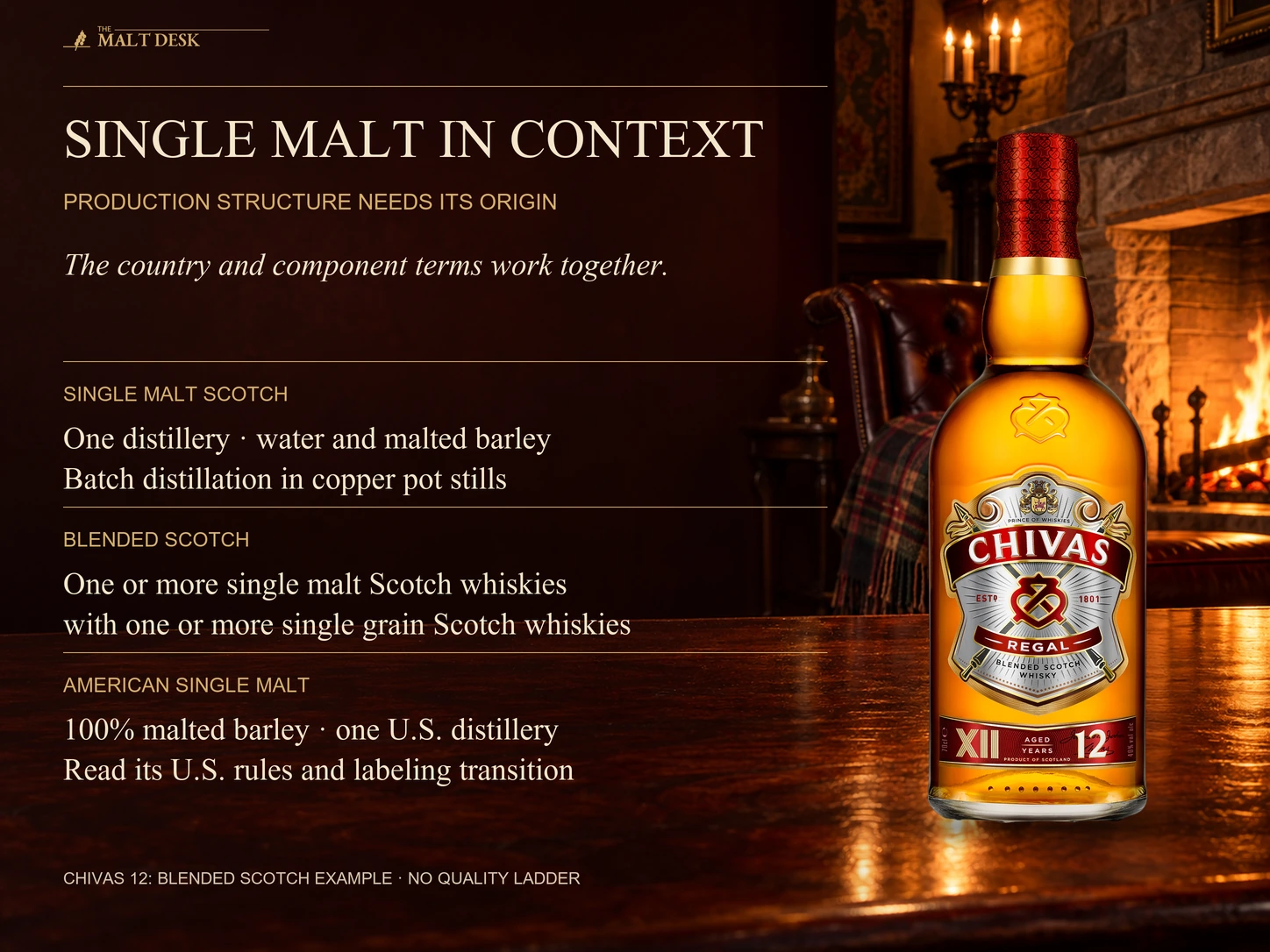
Country styles and production structures answer different questions.
- Scotch, Irish, bourbon, Tennessee and Japanese tell you about origin and category rules.
- Single malt, single grain and blended tell you how components and distilleries are organized within a category.
A single malt is not automatically richer, and a blend is not automatically cheaper or simpler. Blending can target consistency, balance and texture; single malt can show one distillery’s character with either great clarity or very little intensity.
Where American Single Malt Fits on This Map
TTB’s American single malt standard took effect on January 19, 2025. Its core account requires a 100% malted-barley mash, distillation entirely at one U.S. distillery, and mashing, distilling and aging in the United States. It permits used or new oak barrels within the stated capacity limit. That creates a clear counterexample to treating all American whiskey as corn-majority bourbon in new charred oak.
The shared single malt words do not carry every Scotch requirement into the American category. Scotch’s single-malt definition specifies batch copper-pot distillation; the TTB account sets a maximum distillation proof without imposing that same still description. U.S. origin also does not turn a whisky into bourbon merely because its barrels happen to be new and charred: the grain and complete category conditions still matter.
This changes how I would search or read a shelf. An American malt-whisky inquiry should not stop at a bourbon-only list. A Scotch single-malt inquiry should not accept American origin as interchangeable. Both can be relevant to an interest in malted barley, but their provenance and production requirements answer different parts of that interest.
Date adds another coordinate. TTB announced a transition for qualifying older-rule labeling on spirits bottled before January 19, 2030. A current date by itself therefore does not establish that every bottle bearing the designation was labeled under the new criteria. Keep the exact product account and the applicable transition conditions alongside any legal-category conclusion, rather than treating a web headline as a universal product certification.
The rest of this guide remains useful as a map of selected categories, not a census of everything called whiskey. Rye, Canadian whisky and American single malt can require additional branches. The map succeeds when it directs the reader to the right production framework; forcing every bottle into the original five labels would make it less useful.
How to Read a Category Without Assuming a Flavor
Start with the full label: country or protected origin, production category, age statement if present and ABV. Then check disclosed grains and cask history. Flavor notes describe the particular expression; the country name cannot stand in for those details.
Two products in one category can differ substantially, while products from different categories can share descriptors such as vanilla, fruit or smoke. There is no required progression from blends to single malts or from lighter to more heavily peated whisky.
Keeping Rules and Descriptions Separate
Origin, grains, stills, maturation and labeling requirements define the production framework. Sensory descriptions and personal preference answer different questions. Reading the exact category alongside the expression’s own specification gives a clearer account than assigning one flavor or quality level to a whole country.
Read Whiskey Identity in Separate Fields
Read country, production category, grain information and age disclosure as separate fields. This lets a reader place American single malt alongside bourbon and distinguish a single malt from a blended Scotch without forcing every bottle into one shelf hierarchy. When a new label appears, use the same fields to identify which part of the production story has actually changed.
Frequently Asked Questions
What are the five main types of whiskey?
For a practical beginner map, the five are Scotch whisky, bourbon whiskey, Irish whiskey, Tennessee whiskey and Japanese whisky. Rye and Canadian whisky are also important categories and are covered briefly above.
Is whiskey the same as whisky?
Yes at the broad spirit level. The spelling usually follows regional convention, but it is not a universal legal separator. Scotland and Japan commonly use whisky; Ireland and the U.S. commonly use whiskey.
Is single malt the same as Scotch?
Single Malt Scotch is one of five Scotch categories, alongside single grain, blended malt, blended grain and blended Scotch. Other countries also use single malt terminology; read the origin and applicable rules.
Is Jack Daniel’s a bourbon?
Jack Daniel’s meets the federal bourbon production framework but is labeled and marketed as Tennessee whiskey. Tennessee identity and charcoal mellowing are central to the brand’s classification.
Does bourbon have to be made in Kentucky?
No. Bourbon must be made in the United States. Kentucky is its most famous production center, not the only legal origin.
Which type of whiskey is the smoothest?
The word can describe alcohol warmth, texture or flavor integration, which depend on the expression and sensory conditions.
Which whiskey type is the sweetest?
Sweet-associated aromas such as vanilla and caramel occur across categories.
Which whiskey type is smoky?
Peated Scotch is the best-known smoky style. Not all Scotch is peated, and smoke is a production choice rather than a requirement of Scotch whisky.
Is all Japanese-branded whisky made in Japan?
The JSLMA standard defines when member products may use Japanese whisky labeling under its rules. Older or loosely Japanese-presented products did not always meet that production standard, which is why the actual label and producer information matter.
Does every whiskey need three years of aging?
No. Scotch and Irish whiskey require three years, and the JSLMA Japanese whisky standard also uses three years. Bourbon and Tennessee whiskey have no general minimum age, although straight American whiskey requires at least two years.
Sources
Scotch Whisky Association producer/bottler guidance; 27 CFR 5.143 and 5.74; Tennessee Attorney General Opinion 15-23; published Irish Whiskey Technical File; JSLMA member-labeling standard; Canadian Food Compositional Standards 2.1.3 and CFIA labeling guidance. Category sources checked October 4, 2026. Named producer descriptions are separated from category requirements.
Additional category reference: TTB’s December 2024 announcement of the American single malt standard, checked October 5, 2026, alongside SWA category guidance. The U.S. effective date and labeling transition are distinguished; the five-category introductory table is expressly non-exhaustive.