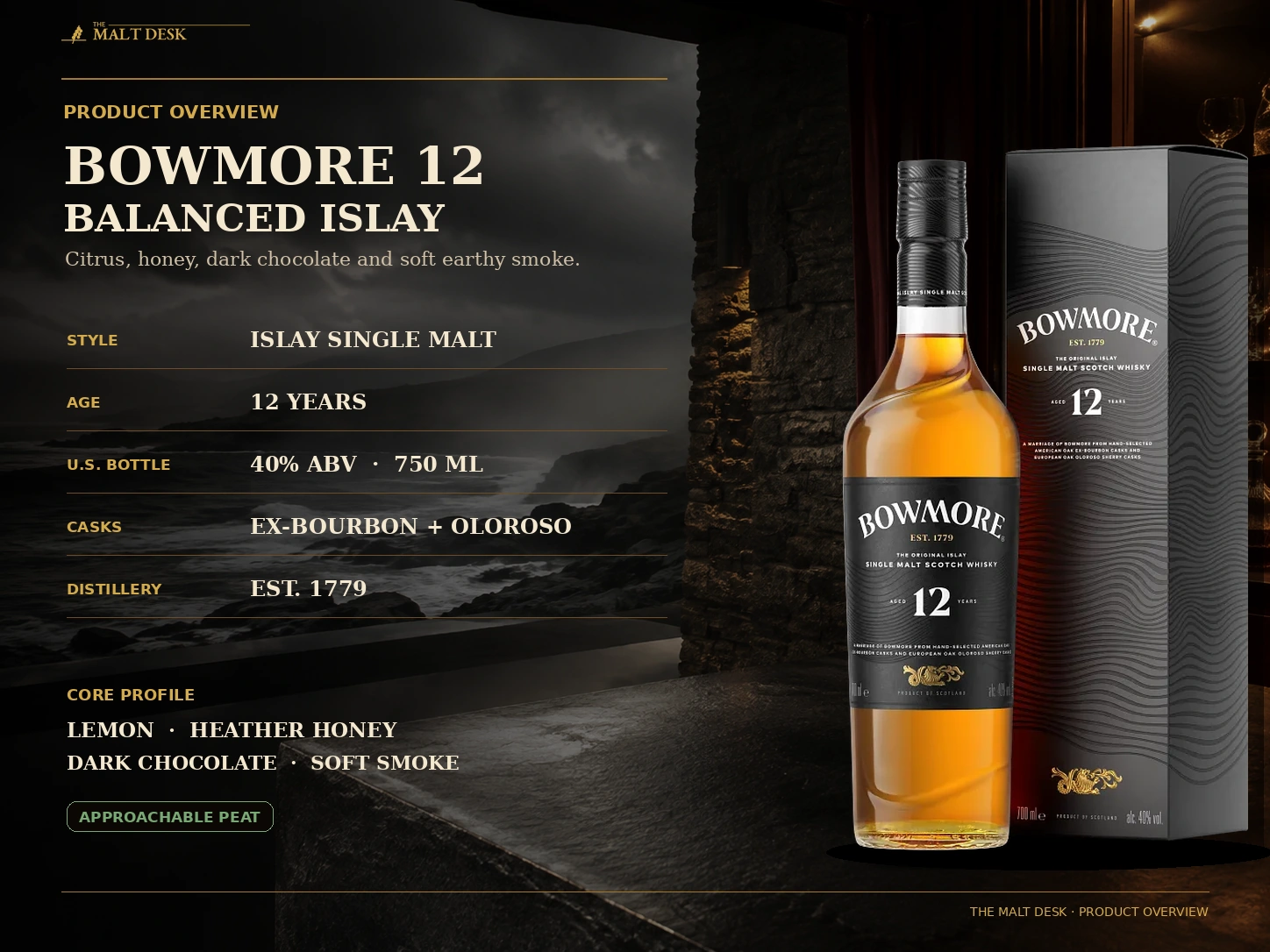
Bowmore 12 is an age-stated single malt Scotch from Islay. The standard expression combines a twelve-year minimum maturation with bourbon and sherry cask influences. Bowmore describes a style in which citrus, honey and fruit sit alongside earthy smoke.
Its place in the Islay category is best understood through the label and production details. The region identifies where it is made; the age identifies the youngest whisky in the bottle; neither supplies a universal quality score or predicts a reader’s preference for smoke.
Product information
| Detail | Reference bottling |
|---|---|
| Category | Islay single malt Scotch whisky |
| Distillery | Bowmore, Islay, Scotland |
| Age statement | 12 years |
| Reference strength | 40% ABV / 80 U.S. proof |
| Bottle sizes | Check the local label; 700ml and 750ml presentations differ |
| Cask information | American oak ex-bourbon and European oak Oloroso sherry casks |
What the casks tell you
Bowmore identifies both former bourbon casks and Oloroso sherry casks in the current core-range description. These terms describe cask history, while American and European oak describe the wood. They are related pieces of information, but not interchangeable labels.
The published description does not give a fixed percentage for each cask type or a separate number of years in each. The twelve-year statement therefore should not be split into an invented bourbon stage and sherry stage. A bottle can combine whisky from different casks while retaining one minimum age statement.
Cask descriptions also do not mean bourbon or sherry is poured into the finished Scotch. The influence comes from maturation in the wood. That distinction is useful when reading fruit and chocolate language in a flavor description: it does not indicate that those foods are added ingredients.
Published flavor notes
Bowmore’s aroma notes emphasize lemon and heather honey against soft, earthy smoke. Its palate description adds fruit and dark chocolate, while the finish returns to sweet smoke. These are the producer’s sensory reference points for the expression.
For readers learning the vocabulary, separate citrus from honey-like sweetness and both from smoke. Doing so makes it easier to explain a preference than using “smooth” for every impression. The whiskey flavor map provides a broader vocabulary.
A producer’s description of softer smoke is not a laboratory measure of peat intensity. It also does not establish that a new drinker will necessarily find the whisky mild. Individual sensitivity, glassware and serving temperature can affect how a smoky aroma is perceived.
Bowmore 12 and other smoky malts
Bowmore and the nearby Islay distilleries share a location, but their expressions should not be treated as interchangeable. The Laphroaig 10 guide discusses a producer profile with medicinal and seaweed associations. The Lagavulin 16 guide provides another age-stated Islay reference.
Talisker 10 is made on Skye rather than Islay. Its published pepper and maritime language offers a different comparison point. Comparing those descriptors is more useful than assuming that every island whisky has the same smoke character.
For the production background, read what peated whisky means. Peat terminology, bottling strength and age answer different questions; none alone establishes a complete flavor profile.
Understanding the 40% reference strength
Forty percent ABV means that alcohol accounts for 40% of the liquid’s volume. It is a measurable label fact, unlike descriptors such as light, dense or oily. The strength alone cannot prove a particular texture or establish that one whisky has a shorter finish than another.
Adding water lowers the concentration; adding ice changes both concentration and temperature as the ice melts. If exploring those effects, keep one unchanged reference sample and adjust the other gradually. There is no fixed dilution that guarantees the appearance of a particular fruit note. See how to drink whiskey for serving terminology.
Historical U.S. price context
The site’s August 28, 2026 notes recorded 750ml listings of $51.99 at Walmart, $63.99 at Total Wine and $64.99 at Total Beverage. These are historical references and have not been rechecked as current offers. The notes do not consistently identify the store location or final tax-inclusive cost.
Those figures illustrate a spread of $13.00 between the lowest and highest recorded listings. They do not justify a universal “buy below” threshold. Local distribution, available sizes and promotions can alter the comparison, and an old listing may no longer be available.
When comparing prices, first check that both bottles are Bowmore 12 rather than a different expression. Then compare volume and final cost. A 700ml bottle has less liquid than a 750ml bottle even when the age and ABV match. Broader category context is available in the whiskey budget guide.
Questions about Bowmore 12
Does twelve years mean every drop is exactly twelve years old?
The age statement specifies the youngest whisky. It is not an average and does not prevent older whisky from being included.
Does it contain sherry?
The cask description identifies Oloroso sherry casks used for maturation. It should not be read as a statement that sherry is added to the bottled whisky.
Is it suitable for someone new to peat?
The producer’s citrus, honey and softer-smoke description can help a reader decide whether the style sounds appealing. Beginner status alone does not predict a preference for smoky aromas.
Is the current packaging proof of a different recipe?
Packaging changes and liquid changes are separate matters. Compare the actual age, strength and producer specifications; a different box design alone does not establish a recipe change.
Sources
Bowmore: 12-Year Old product and core-range cask information. Scotch Whisky Association: Scotch categories and age statements. Historical prices: the site’s August 28, 2026 listing notes, not current verified offers.