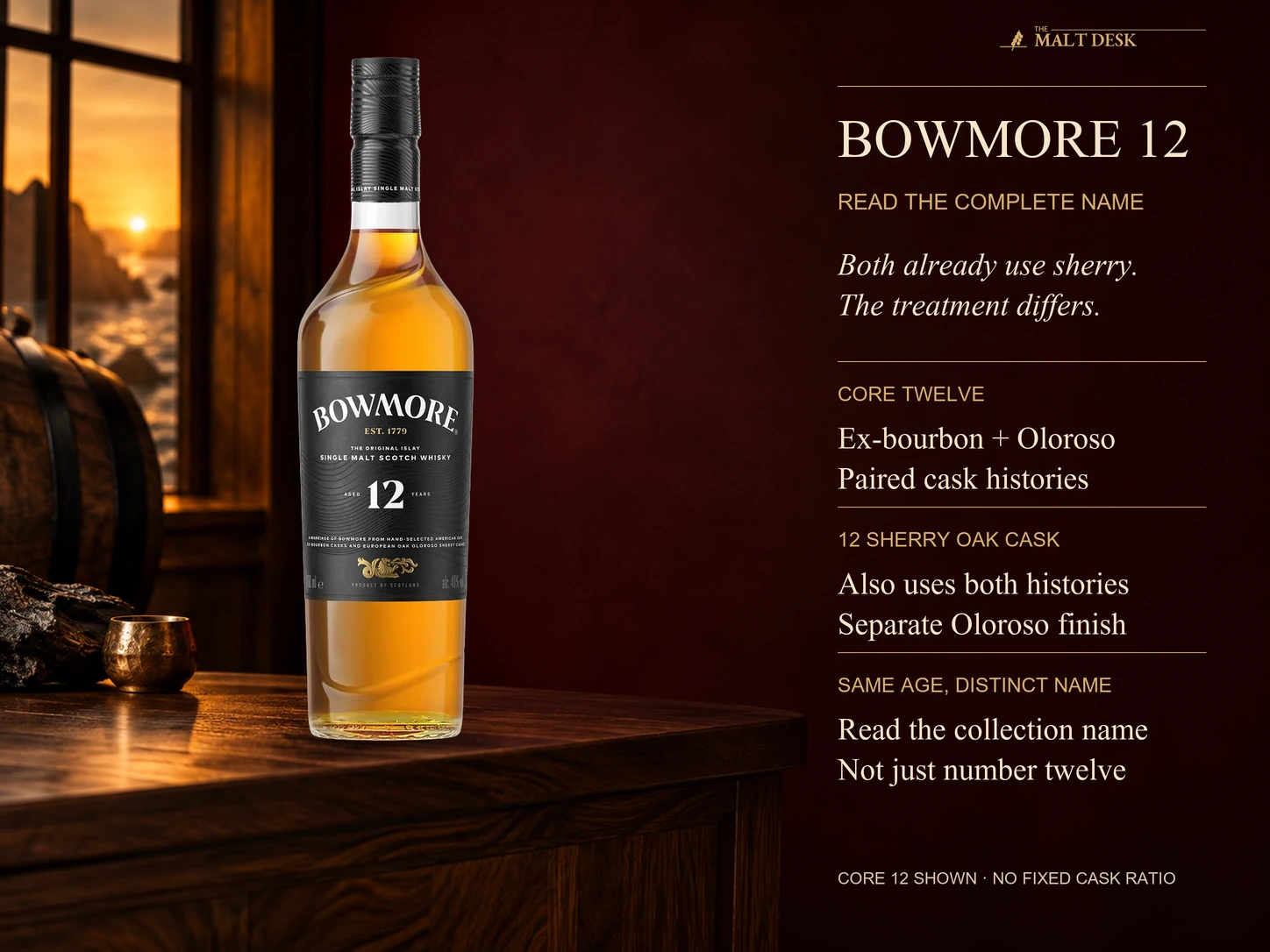
Bowmore 12 and Bowmore 12 Sherry Oak Cask are separately named expressions, even though both can bring Oloroso into their production accounts. The core twelve-year whisky already pairs ex-bourbon and Oloroso casks. The Sherry Oak name therefore does not divide the range into a sherry-free twelve and a sherried twelve.
The useful distinction is the treatment described for the complete expression. Sherry Oak Cask specifically adds an Oloroso finishing account, while the core page describes paired maturation histories. I would follow that difference before using a shortened ‘Bowmore 12’ listing to compare flavors or prices.
Bowmore 12 is an age-stated single malt Scotch from Islay. The standard expression combines a twelve-year minimum maturation with bourbon and sherry cask influences. Bowmore describes a style in which citrus, honey and fruit sit alongside earthy smoke.
Its place in the Islay category is best understood through the label and production details. The region identifies where it is made; the age identifies the youngest whisky in the bottle.
Product information
| Detail | Reference bottling |
|---|---|
| Category | Islay single malt Scotch whisky |
| Distillery | Bowmore, Islay, Scotland |
| Age statement | 12 years |
| Reference strength | 40% ABV / 80 U.S. proof |
| Bottle sizes | Check the local label; 700ml and 750ml presentations differ |
| Cask information | American oak ex-bourbon and European oak Oloroso sherry casks |
What the casks tell you
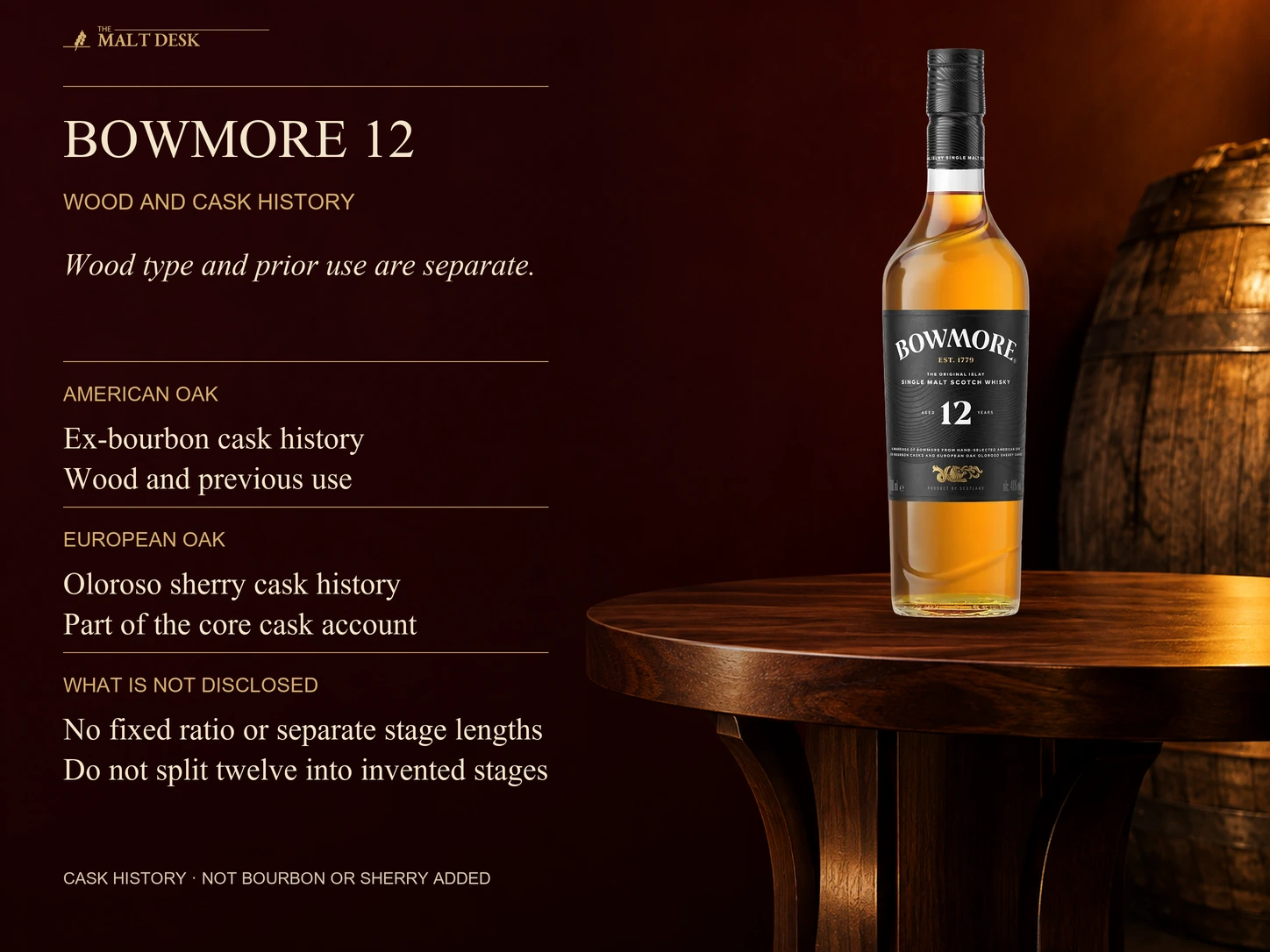
Bowmore identifies both former bourbon casks and Oloroso sherry casks in the current core-range description. These terms describe cask history, while American and European oak describe the wood. They are related pieces of information, but not interchangeable labels.
The published description does not give a fixed percentage for each cask type or a separate number of years in each. The twelve-year statement therefore should not be split into an invented bourbon stage and sherry stage. A bottle can combine whisky from different casks while retaining one minimum age statement.
Cask descriptions also do not mean bourbon or sherry is poured into the finished Scotch. The influence comes from maturation in the wood. That distinction is useful when reading fruit and chocolate language in a flavor description: it does not indicate that those foods are added ingredients.
Published flavor notes
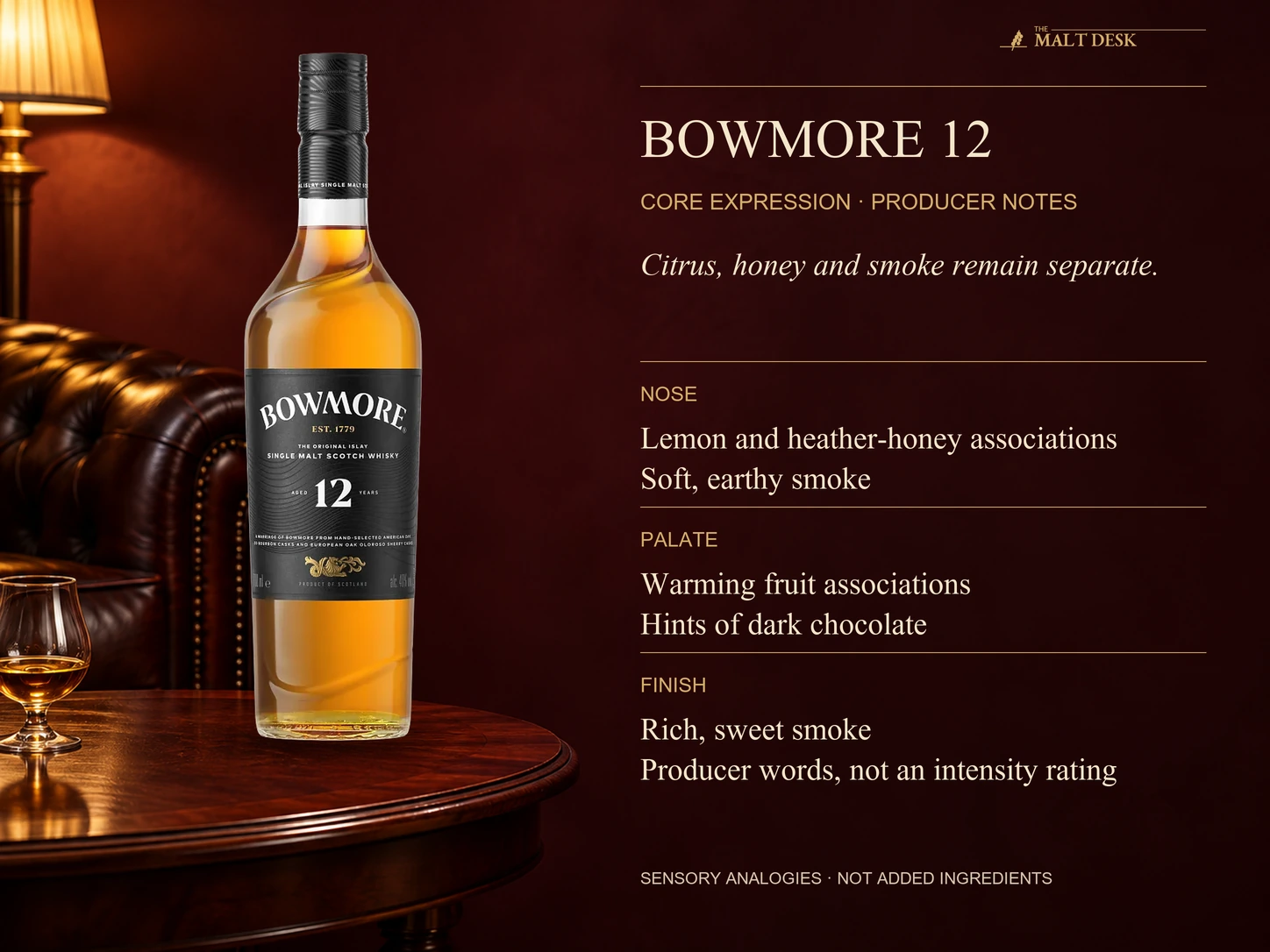
Bowmore’s aroma notes emphasize lemon and heather honey against soft, earthy smoke. Its palate description adds fruit and dark chocolate, while the finish returns to sweet smoke. These are the producer’s sensory reference points for the expression.
For readers learning the vocabulary, separate citrus from honey-like sweetness and both from smoke. Doing so makes it easier to explain a preference than using “smooth” for every impression. The whiskey flavor map provides a broader vocabulary.
It also does not establish that a new drinker will necessarily find the whisky mild. Individual sensitivity, glassware and serving temperature can affect how a smoky aroma is perceived.
Two Twelve-Year Expressions Already Share Sherry History
The current core Bowmore 12 page identifies American-oak ex-bourbon casks paired with European-oak Oloroso sherry casks. The separate Sherry Oak Cask page describes maturation in Oloroso and ex-bourbon casks followed by an Oloroso finish. This gives a concrete sequence difference in the published accounts, rather than a presence-versus-absence test for sherry.
| Full expression name | Published cask account | Useful inquiry |
|---|---|---|
| Bowmore 12, core | Ex-bourbon and Oloroso casks paired in the core-range account | The established citrus, honey and earthy-smoke profile |
| Bowmore 12 Sherry Oak Cask | Oloroso and ex-bourbon maturation, then Oloroso finish | A separately described finish and fruit/nut/spice direction |
Suntory’s 2024 announcement introduced the Sherry Oak collection alongside the existing range and described a new presentation across the portfolio. A redesigned black bottle is consequently not enough to identify the Sherry Oak expression. The collection name and full label matter more than the common design language.
Both twelve-year labels state a minimum age. The Sherry Oak finish is not a known extra period to add to the core’s twelve, and the public description does not disclose a fixed Oloroso percentage for either expression. Calling it ‘more sherry’ may be a reasonable question to investigate.
The core notes emphasize citrus and honey with smoke; the Sherry Oak page adds a red-fruit, nut and sweet-spice direction while retaining smoke. Those producer descriptions give the comparison a purpose. They cannot establish that one is universally sweeter or that an individual preference resulted solely from the final Oloroso stage.
A listing that names only Bowmore 12 leaves this distinction unresolved. Match the full collection name before deciding whether a higher local quote is for the same whisky, different packaging, or the separate Sherry Oak expression. Equal age numbers cannot make those three explanations equivalent.
Bowmore 12 and other smoky malts
Bowmore and the nearby Islay distilleries share a location, but their expressions should not be treated as interchangeable. The Laphroaig 10 guide discusses a producer profile with medicinal and seaweed associations. The Lagavulin 16 guide provides another age-stated Islay reference.
Talisker 10 is made on Skye rather than Islay. Its published pepper and maritime language offers a different comparison point. Comparing those descriptors is more useful than assuming that every island whisky has the same smoke character.
For the production background, read what peated whisky means. Peat terminology, bottling strength and age answer different questions; none alone establishes a complete flavor profile.
Understanding the 40% reference strength
Bowmore’s regional German collection page lists the twelve-year expression at 40% ABV and 70 cl. This is a regional reference, not a statement of every U.S. bottle size. Forty percent means alcohol accounts for 40% of the liquid’s volume.
Adding water lowers the concentration; adding ice changes both concentration and temperature as the ice melts. If exploring those effects, keep one unchanged reference sample and adjust the other gradually. There is no fixed dilution that guarantees the appearance of a particular fruit note. See how to drink whiskey for serving terminology.
Price and Label Comparisons
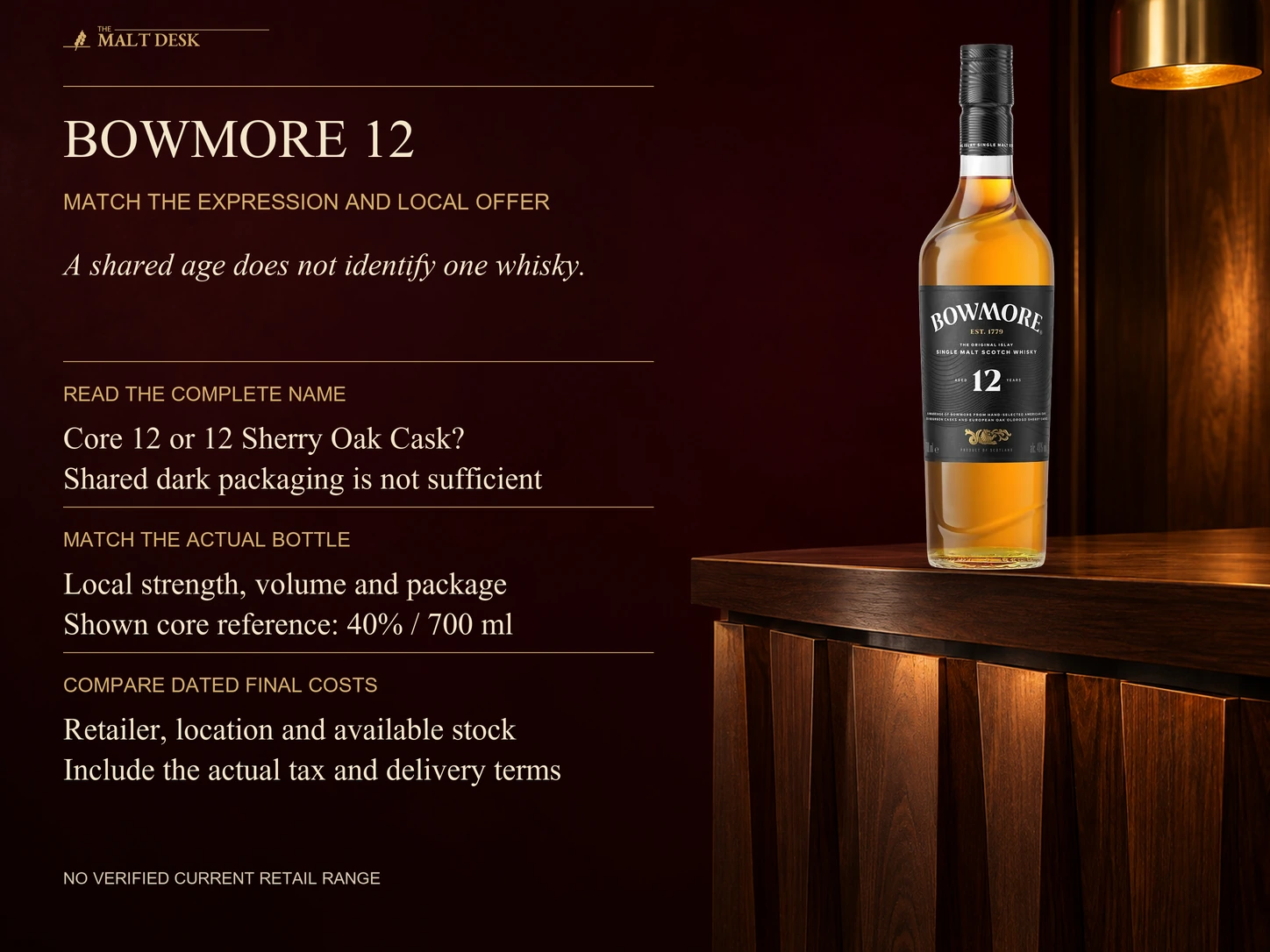
Keep Bowmore 12 separate from other Bowmore expressions and read the actual market strength and volume. Compare dated, in-stock local totals for equivalent bottles, including tax and delivery. The age statement does not establish a retailer price; no verified range is supplied here.
When comparing prices, first check that both bottles are Bowmore 12 rather than a different expression. Then compare volume and final cost. A 700ml bottle has less liquid than a 750ml bottle even when the age and ABV match. Broader category context is available in the whiskey budget guide.
In Brief
Bowmore 12 is an Islay single malt with a twelve-year minimum age. Its producer descriptions distinguish fruit, honey and smoke associations from the American/ex-bourbon and European/Oloroso cask account. Proportions and separate stage lengths remain undisclosed.
Distinguish the Two Bowmore Twelve-Year Programs
Start by matching core Bowmore 12 or the separately named 12 Sherry Oak Cask. Both production accounts involve sherry history, so compare their complete cask sequences and specific notes before choosing an expression. This is especially useful when a retailer shortens the product name: settle the exact twelve-year presentation before comparing the offer.
Questions about Bowmore 12
Does twelve years mean every drop is exactly twelve years old?
The age statement specifies the youngest whisky. It is not an average and does not prevent older whisky from being included.
Does it contain sherry?
The cask description identifies Oloroso sherry casks used for maturation. It should not be read as a statement that sherry is added to the bottled whisky.
Is it suitable for someone new to peat?
The producer’s citrus, honey and softer-smoke description can help a reader decide whether the style sounds appealing.
Is the current packaging proof of a different recipe?
Packaging changes and liquid changes are separate matters. Compare the actual age, strength and producer specifications; a different box design alone does not establish a recipe change.
Sources
Bowmore’s current 12 Year Old product and regional German collection pages, checked October 3, 2026; Scotch Whisky Association category and age guidance. The collection page supplies the regional 40%/70 cl reference. Producer sensory wording and core-range cask information do not disclose cask proportions or a current retail price.
Bowmore expression analysis checked October 7, 2026: core 12 and 12 Sherry Oak Cask have distinct names and disclosed treatment accounts. Neither Oloroso proportions nor finishing durations are inferred; shared packaging does not identify one liquid.