Bulleit Bourbon: Product and Grain Guide
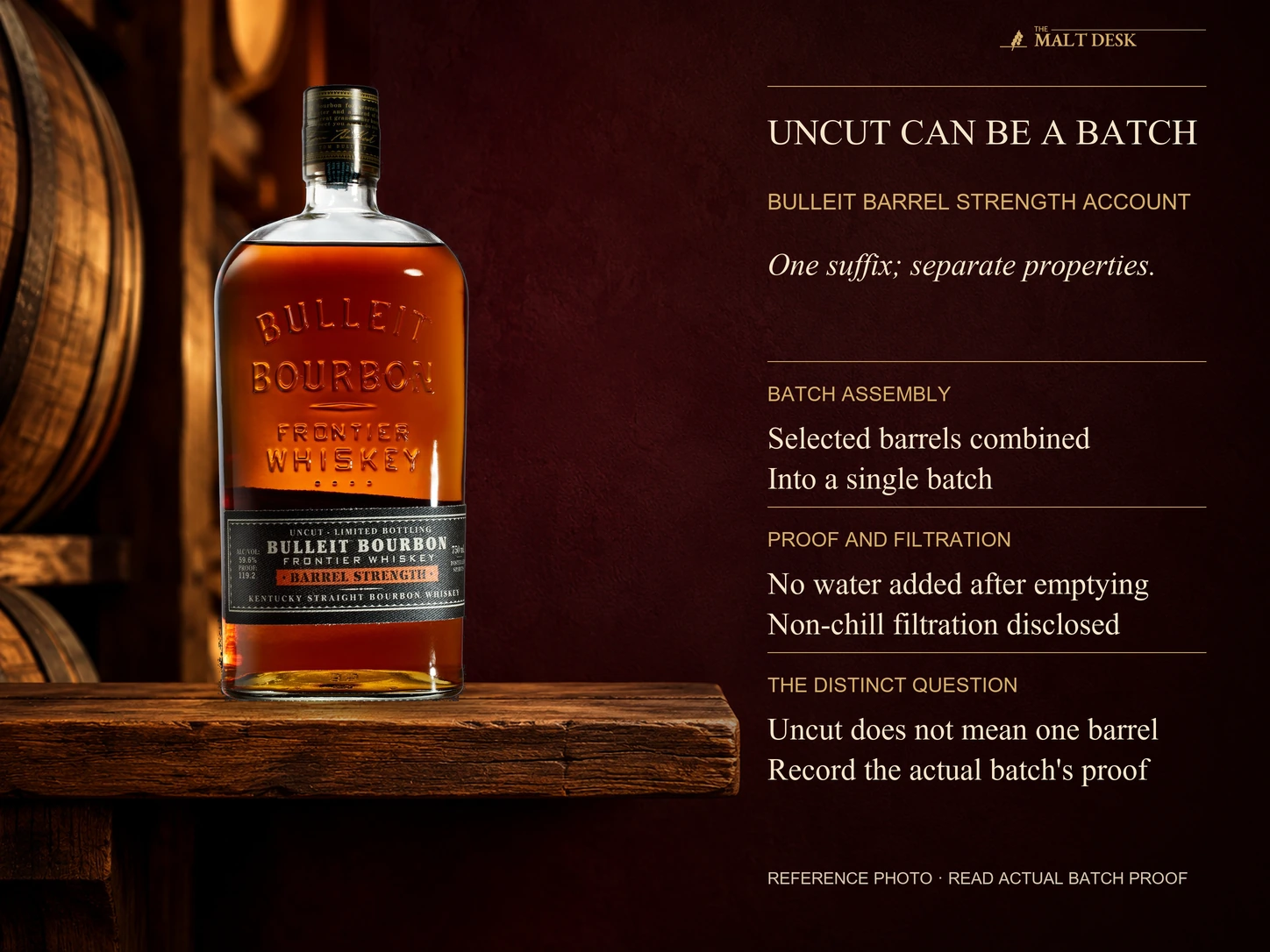
Bulleit’s Barrel Strength account connects two facts that are sometimes wrongly treated as opposites: no additional dilution water and whiskey combined from selected barrels into a batch. An uncut bourbon can therefore be a batch of multiple barrels. Barrel Strength does not, by itself, mean Single Barrel.
This matters beside standard 90-proof Bulleit Bourbon because the extra wording changes the bottling-strength question without necessarily changing the number of barrels to one. I would distinguish concentration, batch assembly and filtration before treating the suffix as one combined guarantee.
Standard Bulleit Bourbon is a Kentucky straight bourbon bottled at 45% ABV, or 90 proof. This informational guide explains its disclosed grain ingredients, the producer’s flavor descriptions, and how to distinguish it from Bulleit Rye and age-stated releases.
Disclosed Production Information
Bulleit identifies corn, rye, and malted barley and emphasizes a relatively high rye content in the bourbon. The product page consulted here does not provide exact grain percentages, so this guide does not turn an often-repeated mash-bill figure into a confirmed specification.
The standard bourbon is distinct from Bulleit 10 Year Bourbon. A ten-year age statement or a strength printed on the latter should not be assigned to the standard expression. Check the full label and market bottling when comparing references.
Bourbon and Rye Are Different Categories
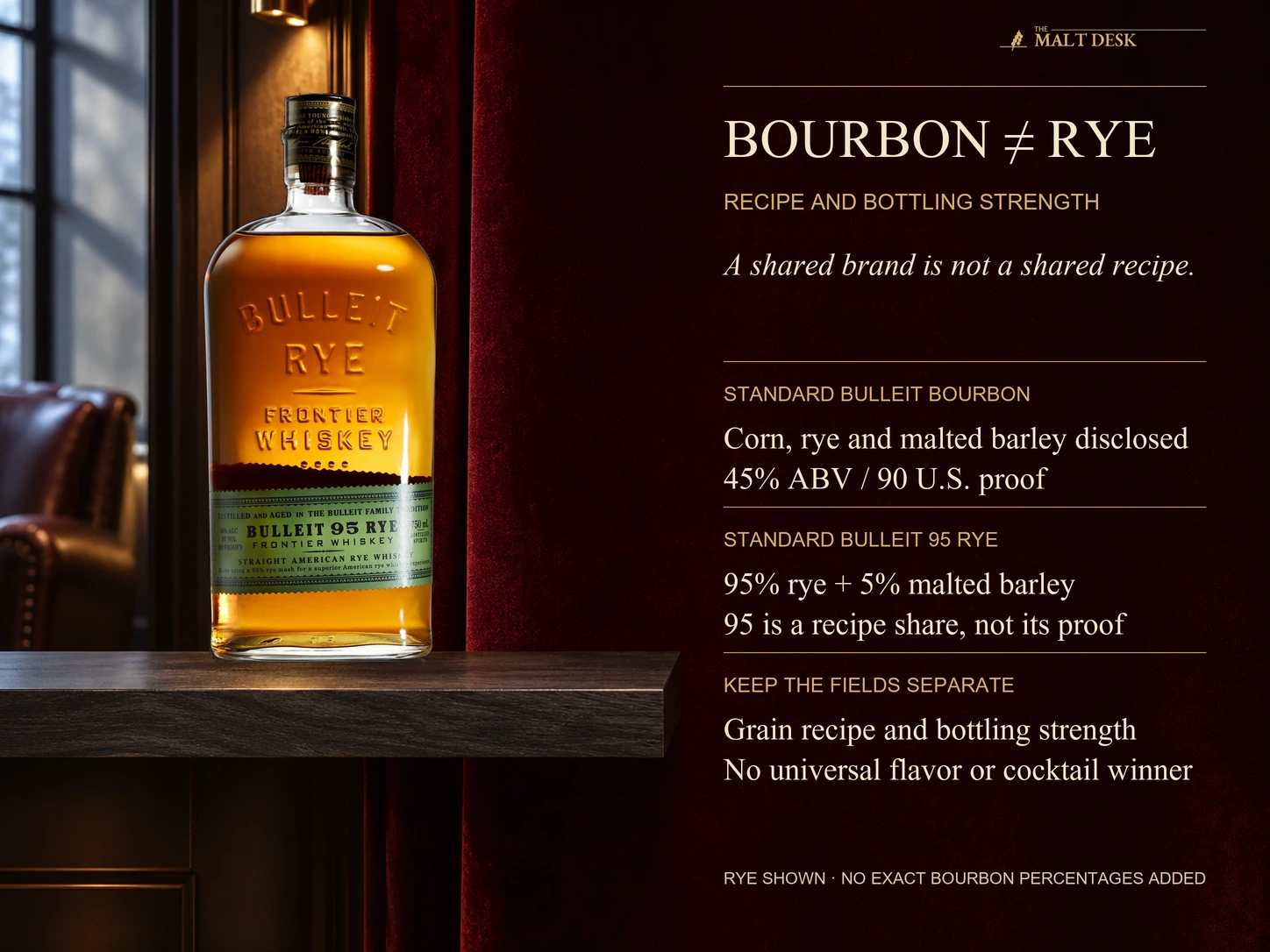
Bulleit describes its flagship Rye recipe as 95% rye and 5% malted barley in its official range material. That is a different recipe from the corn-containing bourbon; the common brand name does not make the two interchangeable.
The Bulleit Rye guide covers that expression, while bourbon versus rye explains the category terms. Recipe composition is a concrete distinction. A claim that one bottle is always sweeter or better in a specific cocktail requires a more narrowly defined comparison.
The Producer’s Flavor Descriptions
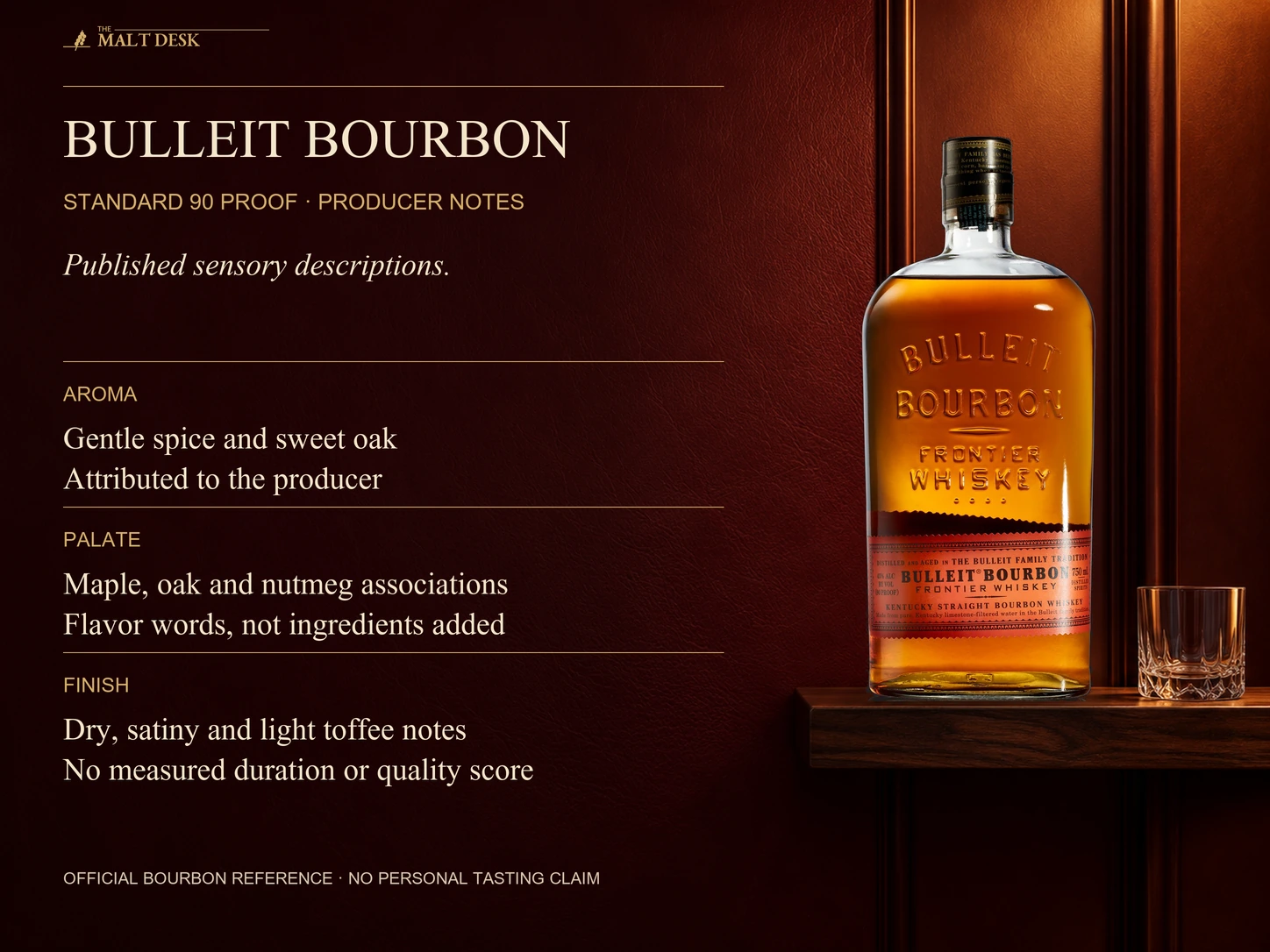
Bulleit’s bourbon notes associate the aroma with spice and oak, the palate with maple and nutmeg, and the finish with dryness and toffee.
The terms do not imply added maple syrup, toffee, or spice ingredients. Nor does a description such as smooth change the alcohol concentration. Flavor language provides a vocabulary for perception rather than a measurement of sweetness, finish length, or quality.
The Whiskey Flavor Map explains the main flavor families used in whiskey descriptions.
Price and Label Comparisons
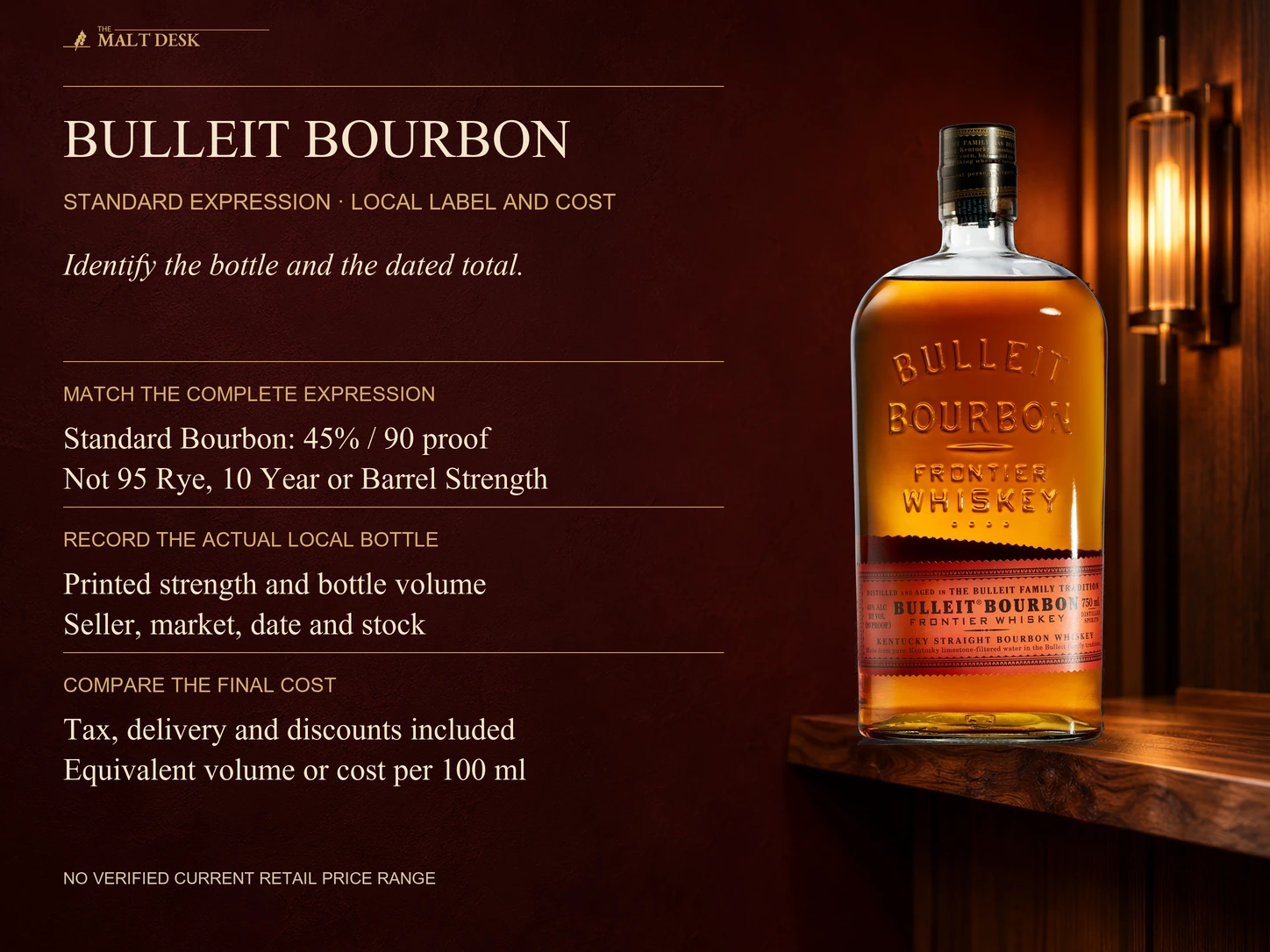
Match Bulleit Bourbon separately from Bulleit 95 Rye. The bourbon’s grain recipe and label strength are different fields from the rye percentage in the other product’s name. Record the exact expression, printed strength, volume and dated local total; no verified retail range is established here.
Uncut and Single Barrel Describe Different Decisions
Bulleit’s 2016 launch announcement says Barrel Strength varies in alcohol strength by batch and generally falls between 120 and 125 proof. The current U.S. product account at The Bar describes select barrels combined into a single batch, without additional water and without chill filtration. These disclosures separate batch construction from proof adjustment.
| Term or disclosure | Question it answers | Question it does not answer |
|---|---|---|
| Barrel Strength / no additional water | Whether dilution water was added in the disclosed bottling account | Whether only one barrel supplied the liquid |
| Select barrels combined into a batch | How the disclosed expression is assembled | One exact fixed proof for every batch |
| Non-chill-filtered | A disclosed filtration choice | Age, one-barrel origin or a guaranteed taste advantage |
| Standard Bulleit at 90 proof | The flagship bottling concentration | The exact strength of a Barrel Strength batch |
For a numerical illustration, equal amounts from hypothetical 60% and 64% barrels would combine to approximately 62% ABV, or 124 proof, before any adjustments. No dilution water is needed for the resulting batch strength to differ from either individual barrel. This simple equal-volume model ignores small mixing-volume effects and is not a Bulleit batch reconstruction.
A single barrel can also have its strength reduced before bottling unless a separate statement rules that out. Thus one barrel and no added water are independent properties. Reading one as the other loses the distinction that Bulleit’s positive multi-barrel account makes explicit.
The generally 120–125-proof description is a range, not a label value for a particular offer. A 120-proof bottle is 60% ABV; a 125-proof bottle is 62.5%. Record the printed number for the actual batch rather than assigning the top of the range to every Barrel Strength bottle or copying standard Bulleit’s 45%.
The current account also identifies a shared high-rye mash-bill identity with the standard bourbon. That connection does not provide exact grain percentages missing from the main product page, and it does not make diluted Barrel Strength a recreated standard bottling. Barrel selection and the final production histories remain part of the expressions.
Cocktails and Serving Conditions
A bourbon Old Fashioned and a rye Manhattan are examples of different recipe structures, not mandatory assignments for these two bottles. Changing sugar, bitters, vermouth, temperature, or dilution can change a mixture as much as changing the whiskey.
Neat means no added water or ice. Ice cools the drink and adds water as it melts; this does not remove the original alcohol. The serving guide provides terminology without guaranteeing that a fixed resting time reveals a particular flavor.
How to Compare Nearby Bourbons
The Woodford Reserve, Maker’s Mark, Wild Turkey 101, and Buffalo Trace guides provide other expression-specific reference points. Compare strength, disclosed grains, age information, and attributed notes separately from price.
A higher proof establishes a strength difference, while wheat or rye in a recipe establishes a production difference.
In Brief
Bulleit Bourbon is a Kentucky straight bourbon. Its producer-disclosed grain details, proof and published notes describe the expression; they do not establish whether it suits every cocktail or preference.
Choose Bulleit by Batch Treatment and Barrel Identity
Keep standard Bulleit Bourbon as the reference expression. When exploring Barrel Strength, record the named batch and strength; when a single-barrel identity matters, look for that explicit designation. This separates dilution treatment from barrel count and gives the next bottle a clear purpose before comparing proof and price.
Frequently Asked Questions
What is its strength?
The standard bourbon product page lists 45% ABV, equivalent to 90 U.S. proof.
Are the bourbon’s exact grain percentages confirmed here?
No. This guide uses the grain ingredients disclosed on the consulted product page without adding an unverified percentage.
Is Bulleit Bourbon better than Bulleit Rye?
The products differ in recipe and category.
Does this guide establish a current price?
No. Compare equivalent dated local offers, including the printed bottle volume, strength, availability, tax and delivery.
Sources
Bulleit’s current Bourbon product page and official Rye range material, checked October 4, 2026; U.S. federal bourbon identity rules for the corn-based category distinction. The Bourbon product text does not disclose exact grain percentages. The 95% rye recipe belongs to the separate Rye expression; no current retailer price is established.
Bottling analysis checked October 7, 2026: Bulleit’s Barrel Strength account explicitly describes a selected-barrel batch. The 60/64-to-62% calculation is hypothetical and approximate; published general proof ranges do not replace an actual batch label.