Four Roses Small Batch: Recipe and Label Guide
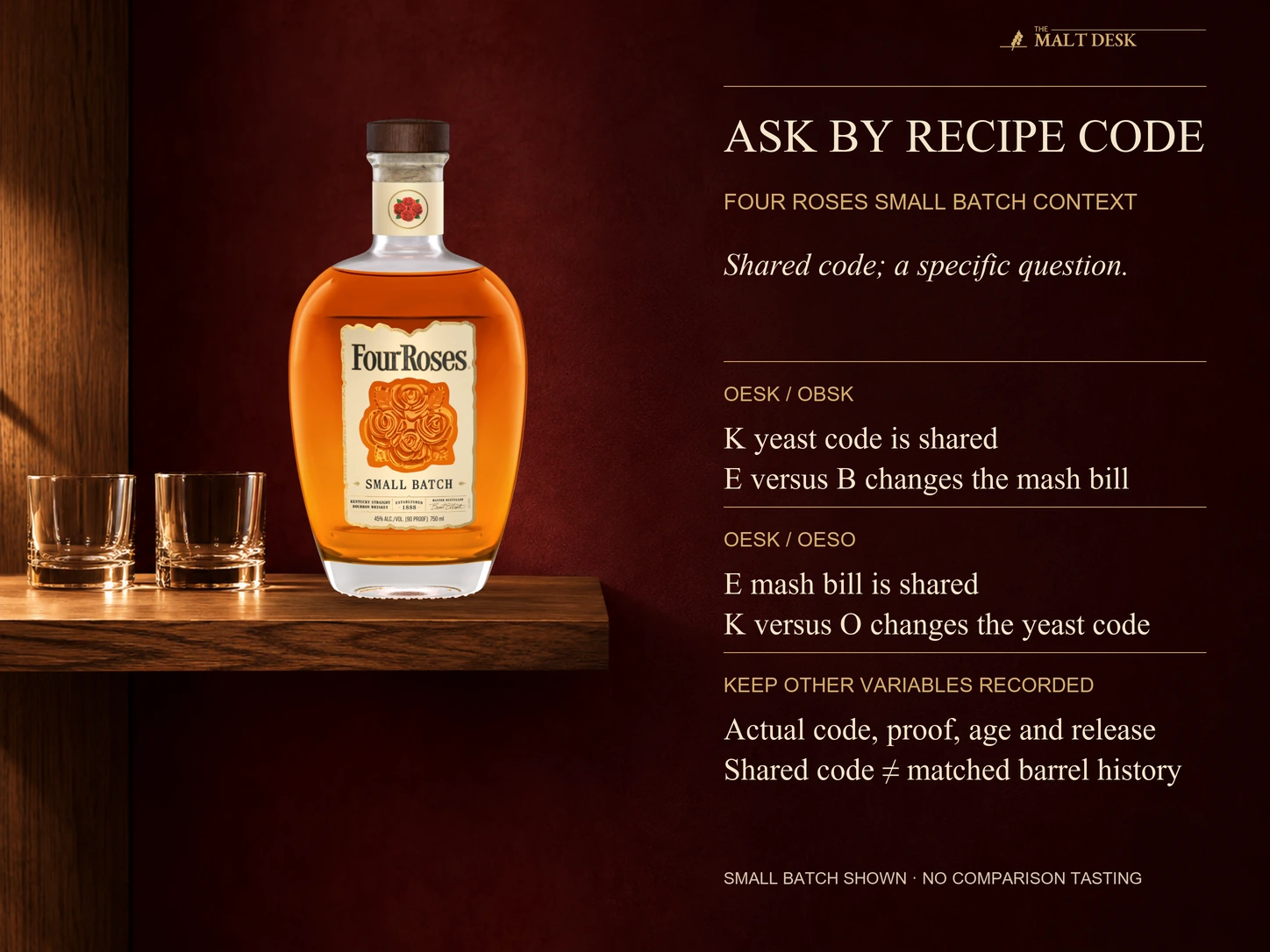
Four Roses Small Batch names four component recipes, which raises a more useful next question than whether four must be better than one: can a reader examine one of those recipes separately? The producer’s expanded Single Barrel Collection makes that possible for specific codes. OESK and OESO appeared in its 2025 collection, and OBSK appears in the subsequent collection; all three codes are also used in standard Small Batch.
The opportunity is to investigate a named ingredient in the blending design, rather than compare two bottles merely carrying the Four Roses name. It comes with a crucial limitation: a single barrel of that recipe is not a sample drawn from the actual Small Batch being examined. The code identifies a production recipe, while age, strength and the particular barrel remain separate variables.
Four Roses Small Batch combines four of the distillery’s recipes at 90 proof, or 45% ABV. This guide decodes the recipe identifiers, separates current product references from the producer’s historical blending account, and explains how to compare equivalent local bottles.
The Four Recipes
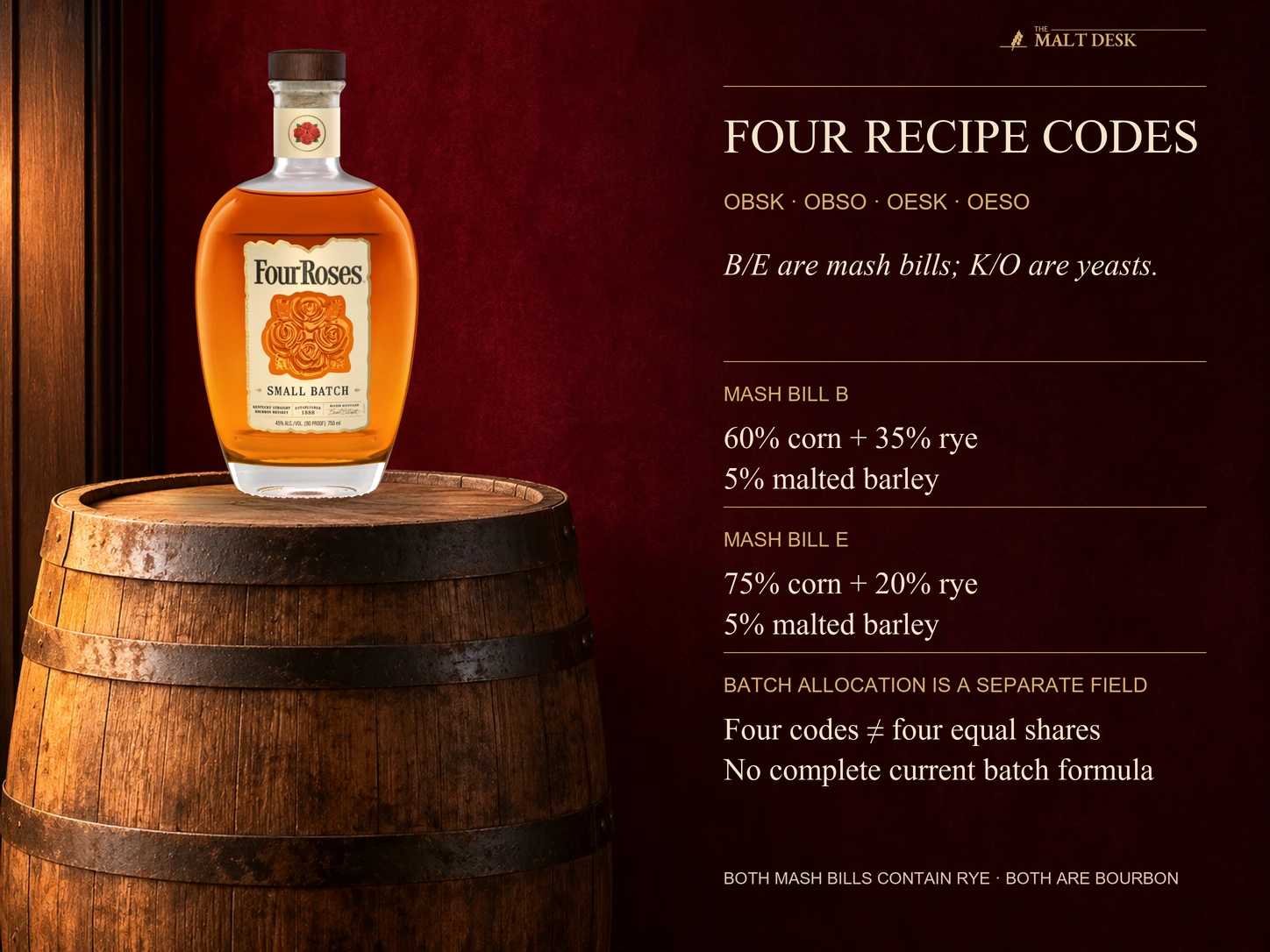
The producer lists OBSK, OBSO, OESK, and OESO for standard Small Batch. Four Roses’ production system combines two mash bills with five yeast strains to create ten recipes, so the four used here represent a subset of that system.
The B and E identifiers distinguish mash bills, while K and O distinguish yeast strains. Four Roses associates these component recipes with spice, fruit, and vanilla.
| Recipe | Mash bill | Yeast |
|---|---|---|
| OBSK | B | K |
| OBSO | B | O |
| OESK | E | K |
| OESO | E | O |
Mash bill B contains 60% corn, 35% rye and 5% malted barley; E contains 75% corn, 20% rye and 5% malted barley. Both therefore contain rye. The distinction is the recipe proportion, not bourbon versus rye whiskey.
Each code combines a mash bill with a yeast strain, rather than identifying a fourth grain or a maturation year. The producer’s August 6, 2019 account describes equal B/E and K/O balances, with an average batch around 250 barrels and details varying by batch. This is a dated production account, not a current guarantee of every batch’s barrel count or four equal component shares. The current product page confirms the four recipe codes without giving a complete batch formula.
A Component Recipe Can Be Available Separately Without Being a Controlled Experiment
The familiar flagship Single Barrel is OBSV. Its V yeast code is absent from standard Small Batch’s OBSK, OBSO, OESK and OESO list, so an unspecified “Small Batch versus Single Barrel” comparison may introduce a yeast recipe that was never one of these four components. Record the code, not just the Single Barrel name. The collection rotates, and a producer product page does not establish local inventory or availability of a particular annual release.
| Expression or named release | Connection to standard Small Batch | Producer reference |
|---|---|---|
| Small Batch | Contains OBSK, OBSO, OESK and OESO | 90 proof; 6–7 years |
| Single Barrel OESK | Shares the E mash bill and K yeast recipe of one component | 100 proof; 7–9 years |
| Single Barrel OESO | Shares the E mash bill and O yeast recipe of one component | 100 proof; 7–9 years |
| Single Barrel OBSK | Shares the B mash bill and K yeast recipe of one component | 100 proof; 7–9 years |
| Flagship Single Barrel OBSV | V is not one of standard Small Batch’s two yeast codes | 100 proof; 7–9 years |
An OESK-versus-OBSK pair holds the K code in common while changing E to B. An OESK-versus-OESO pair holds E in common while changing K to O. Those questions focus the comparison on a named production difference. Record each individual barrel’s selection and maturation history alongside the recipe code and proof. A perceived difference could have more than one cause.
Small Batch versus a named component introduces another difference: 90 versus 100 proof. Under the simple volume-additive approximation, 27 ml of 50% Single Barrel plus 3 ml water makes a 30 ml serving at 45%, matching the concentration of 30 ml Small Batch. This proposed preparation removes that one numerical gap; it cannot recreate the Small Batch barrel selection, maturation range or component proportions.
Age, Strength, and Similar Names
The official Small Batch page identifies 90 proof and six-to-seven-year maturation. Check the bottle label for market-specific details.
Small Batch Select is a different expression, as is Single Barrel. Do not carry over another expression’s strength, filtration claim, or recipe composition merely because the Four Roses name appears on both. The full product name matters when comparing specifications or a retailer listing.
Published Flavor Descriptions
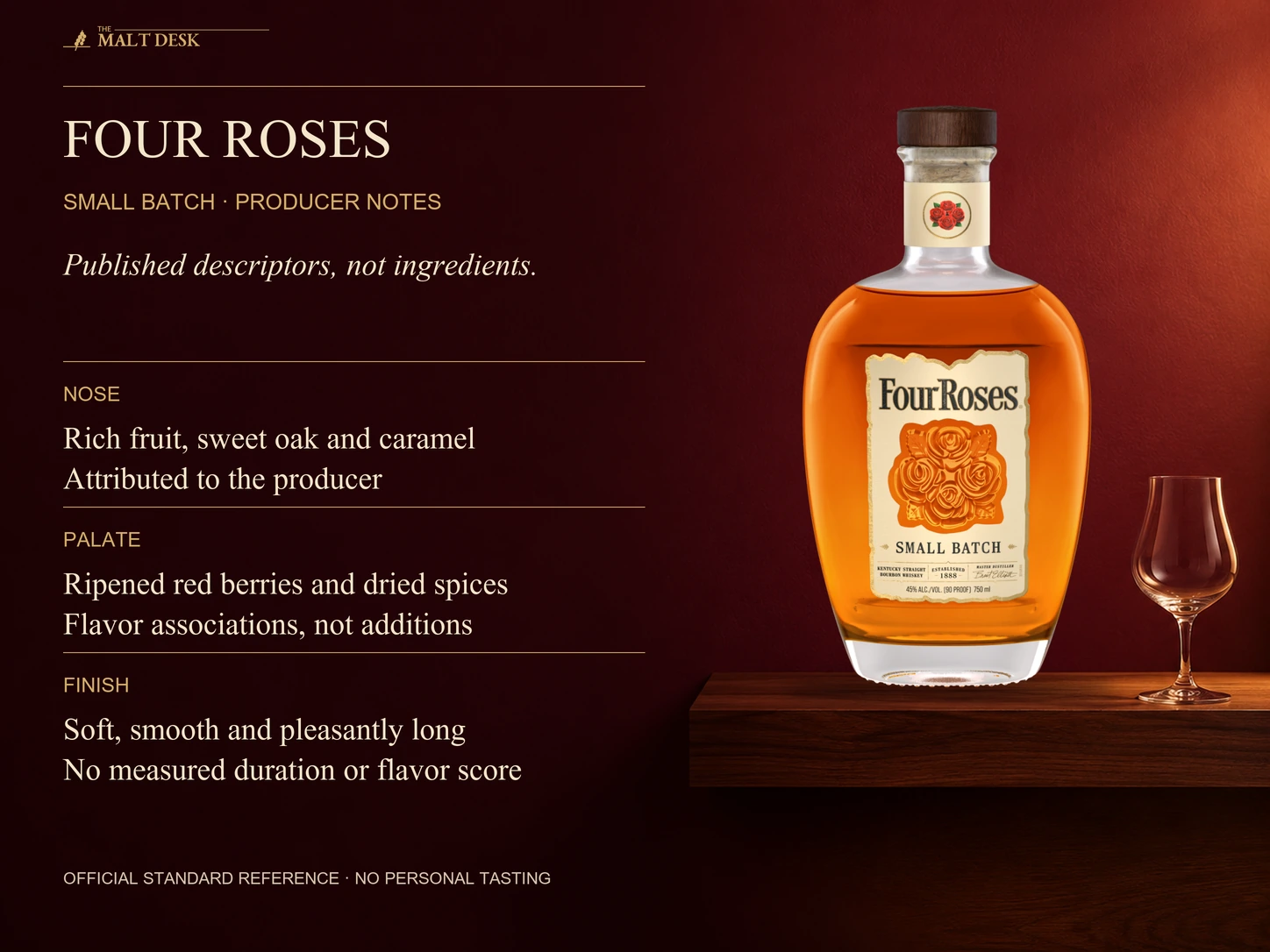
The producer describes fruit, oak, and caramel on the nose; berries and spice on the palate; and a soft, extended finish.
A term such as berry is a flavor association, not evidence that berries are an ingredient. Individual perception and serving conditions can differ even when a label specification remains the same.
The Whiskey Flavor Map explains descriptive categories.
Price and Label Comparisons
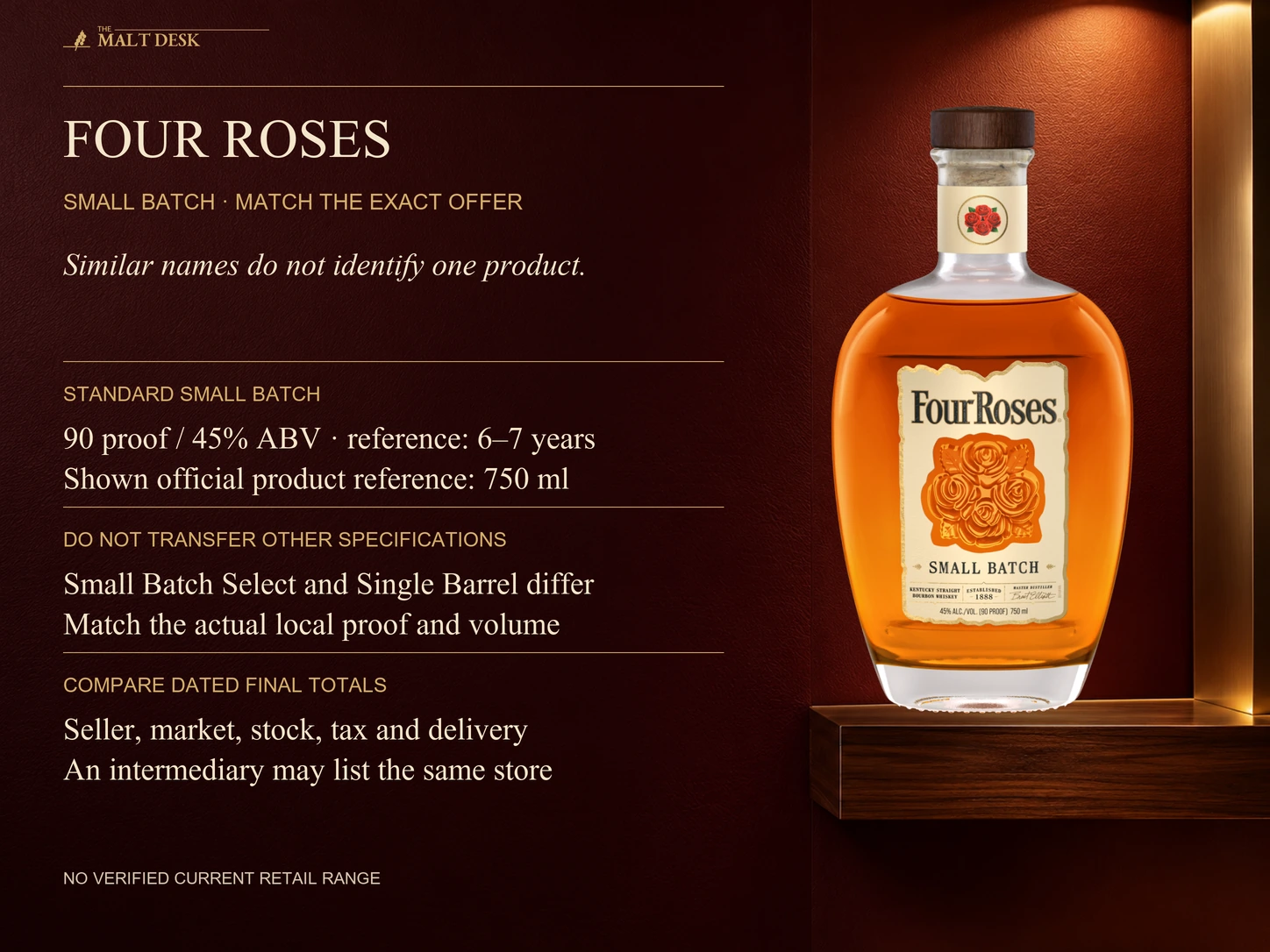
Match Four Roses Small Batch separately from Small Batch Select and Single Barrel. The recipe codes in this guide belong to the standard Small Batch account and do not identify every Four Roses release. Record the actual proof, volume and dated local total; no verified retail range is established here.
An intermediary listing and a retailer’s own listing may refer to the same store and do not necessarily constitute independent market observations. Delivery charges, taxes, promotions, and local inventory can also change the comparison.
Serving and Comparison
Neat, water-added, and ice-cooled servings change temperature and concentration. A cocktail also changes the ingredient mixture.
The serving guide explains the terms. For production context, see bourbon versus rye. A rye-containing bourbon recipe should not be confused with the rye-whiskey category.
Related Bourbons
For a direct comparison, read Buffalo Trace vs Woodford Reserve vs Four Roses Small Batch. It brings the three products into one reference rather than requiring a comparison across separate profiles.
The Woodford Reserve, Maker’s Mark, Wild Turkey 101, and Buffalo Trace guides provide other expression-level reference points.
In Brief
Four Roses Small Batch’s current producer page identifies four recipes, 90 proof and 6–7 years of maturation. The B/E grain formulas and K/O yeast distinctions explain production choices.
Use the Four Roses Recipe Code to Plan the Next Comparison
Start with Small Batch’s four-recipe list, then choose an individually available recipe code when that component interests you. Record the Single Barrel release’s own age, proof and selection details alongside the shared code. This creates a focused next step from the blend to a named recipe while keeping each finished expression clearly identified.
Frequently Asked Questions
Which recipes are used?
The producer lists OBSK, OBSO, OESK, and OESO for standard Small Batch.
Is Small Batch the same as Small Batch Select?
No. The producer lists standard Small Batch at 90 proof (45% ABV), while Small Batch Select is 104 proof (52% ABV). Similar names do not make their specifications interchangeable.
Is it better than Wild Turkey 101?
The expressions differ in strength and recipe; preference depends on the flavor and serving style you enjoy.
Does this guide establish a current price?
No. Match the standard Small Batch expression, actual label and dated local offer conditions. An intermediary offer may refer to the same store as a direct listing.
Sources
Four Roses’ current Small Batch, Our Recipes and Our Process pages, checked October 4, 2026; The Story of Small Batch, published August 6, 2019. Current proof, maturation reference, recipe codes and mash bills are separated from the historical equal-balance and average-batch account. No current retailer price is established.
Additional recipe-comparison sources: Four Roses’ Single Barrel Collection announcement and current range and named OESK, OESO and OBSK product pages, checked October 7, 2026. Annual collection identity, component code, age reference and proof are kept separate; the dilution example is proposed arithmetic.