A Talisker, Bowmore or Lagavulin preference can be real while still depending partly on the setting in which the whisky was encountered. Comparing a seaside bar memory with a quiet home pour also compares environments. The three label profiles below are more useful when those conditions are held steady than when memories from different occasions are treated as a single tasting panel.
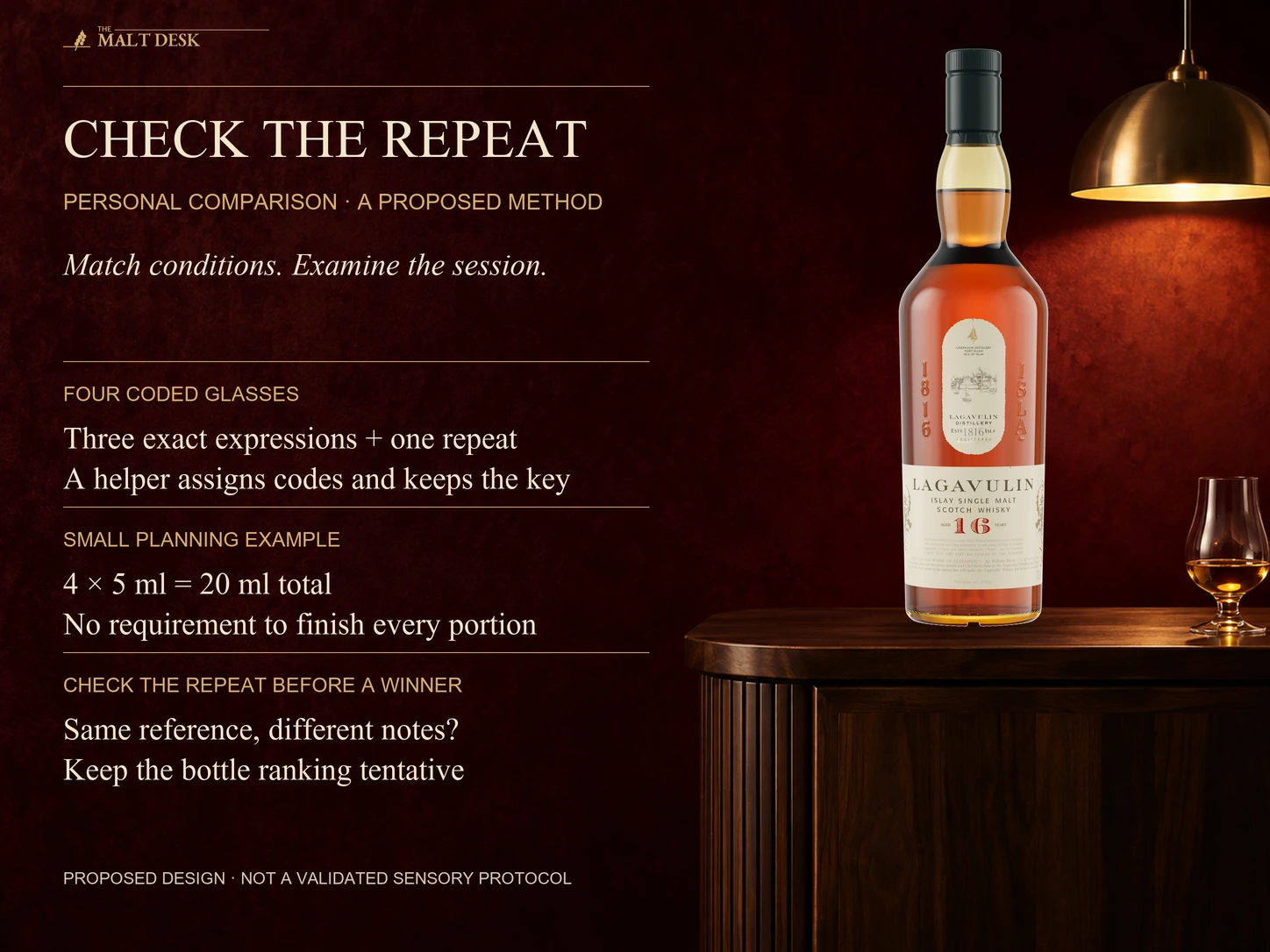
A practical check is to repeat one of the same whiskies under a second unknown code within a small comparison. If that identical reference produces noticeably different notes, the exercise has revealed uncertainty in the session itself. That is useful information before assigning every perceived difference to the three bottles.
Talisker 10, Bowmore 12 and Lagavulin 16 show three different approaches to smoky single malt Scotch. Talisker comes from Skye; Bowmore and Lagavulin are made on Islay. The age statements and bottling strengths differ, but neither number establishes which whisky a reader will prefer.
The producer descriptions offer a useful starting point: pepper and maritime smoke for Talisker, lemon and honey alongside earthy smoke for Bowmore, and peat, iodine and seaweed for Lagavulin. This comparison separates those published descriptions from measurable label information.
Label information compared
| Expression | Origin | Age statement | Reference ABV |
|---|---|---|---|
| Talisker 10 | Isle of Skye | 10 years | 45.8% |
| Bowmore 12 | Islay | 12 years | 40% |
| Lagavulin 16 | Islay | 16 years | 43% |
The age on a Scotch label refers to the youngest whisky in the bottle. It is not an average age, and time spent in a sealed retail bottle does not increase it. The figures above refer to the standard expressions; special editions and market-specific labels need their own checks.
What the producer notes emphasize
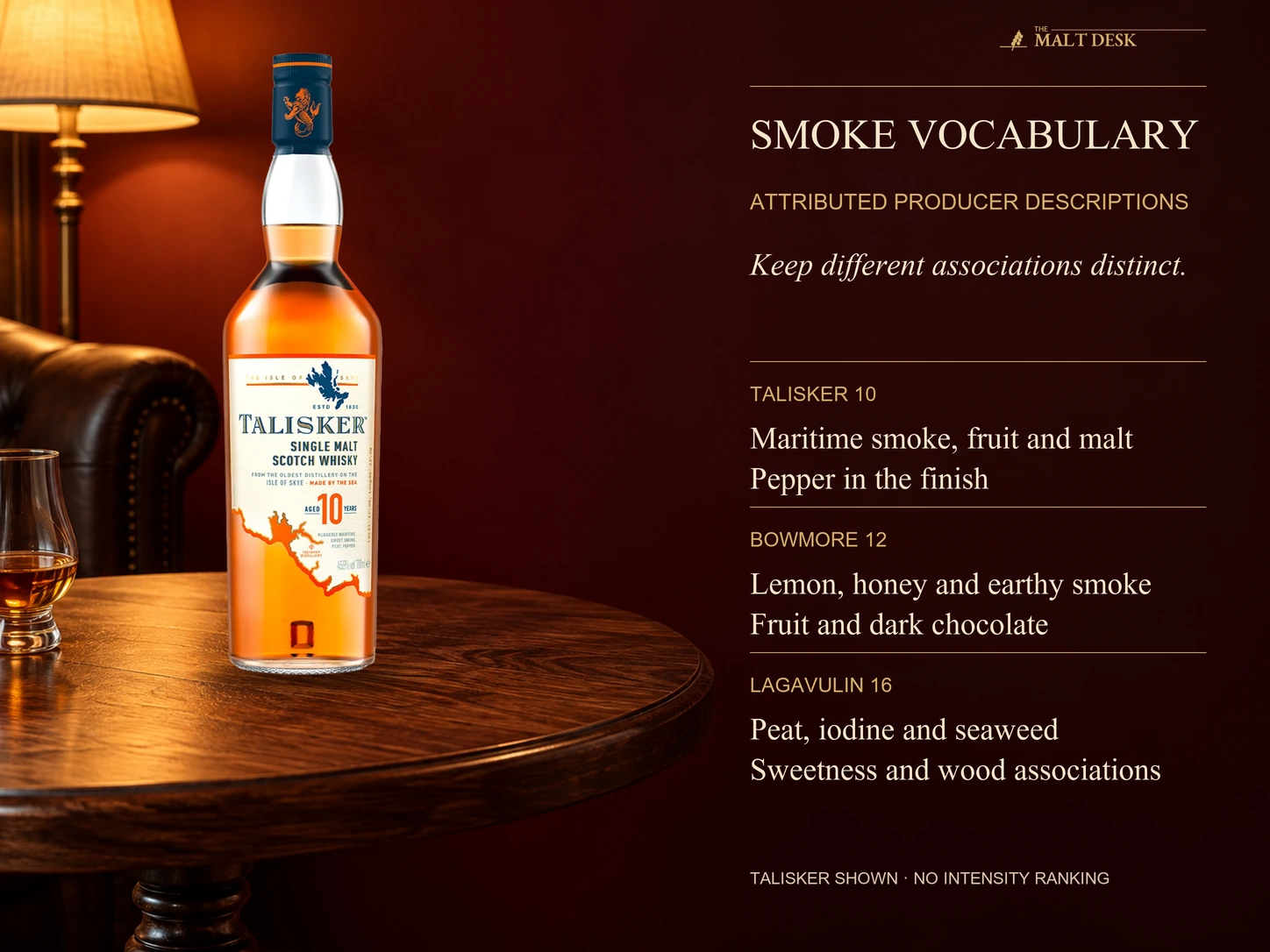
Talisker 10: the official Malts description combines peat and maritime aromas with fruit, malt and a peppery finish. Its production information identifies double distillation and at least ten years in American oak casks. See the Talisker 10 guide for the individual expression.
Bowmore 12: Bowmore’s published notes pair citrus and honey with earthy smoke, followed by fruit and chocolate. The brand identifies American oak ex-bourbon and European oak Oloroso sherry casks. The Bowmore 12 guide explains its cask and label information.
Lagavulin 16: the official Malts page describes peat, iodine, seaweed, sweetness and wood, with a long smoky finish. It confirms oak maturation for at least sixteen years and 43% ABV. The Lagavulin 16 guide covers the standard bottling.
Choosing a Smoke Style
Smoke is not a single sensation. A description may refer to an earthy aroma, a medicinal association, dry ash or a sweet smoky finish. Separating those terms makes the different smoke profiles easier to compare.
Producer notes are not a standardized blind panel. Bowmore’s description of softer smoke and Lagavulin’s emphasis on intense peat suggest different intended styles. The peated whisky guide explains why production terminology and perceived intensity are different questions.
For finish and texture, keep the producer’s vocabulary attached to the named expression. In your own notes, describe the sensations that remain and record the serving conditions so later comparisons have a consistent reference.
Proof, dilution and fair comparison
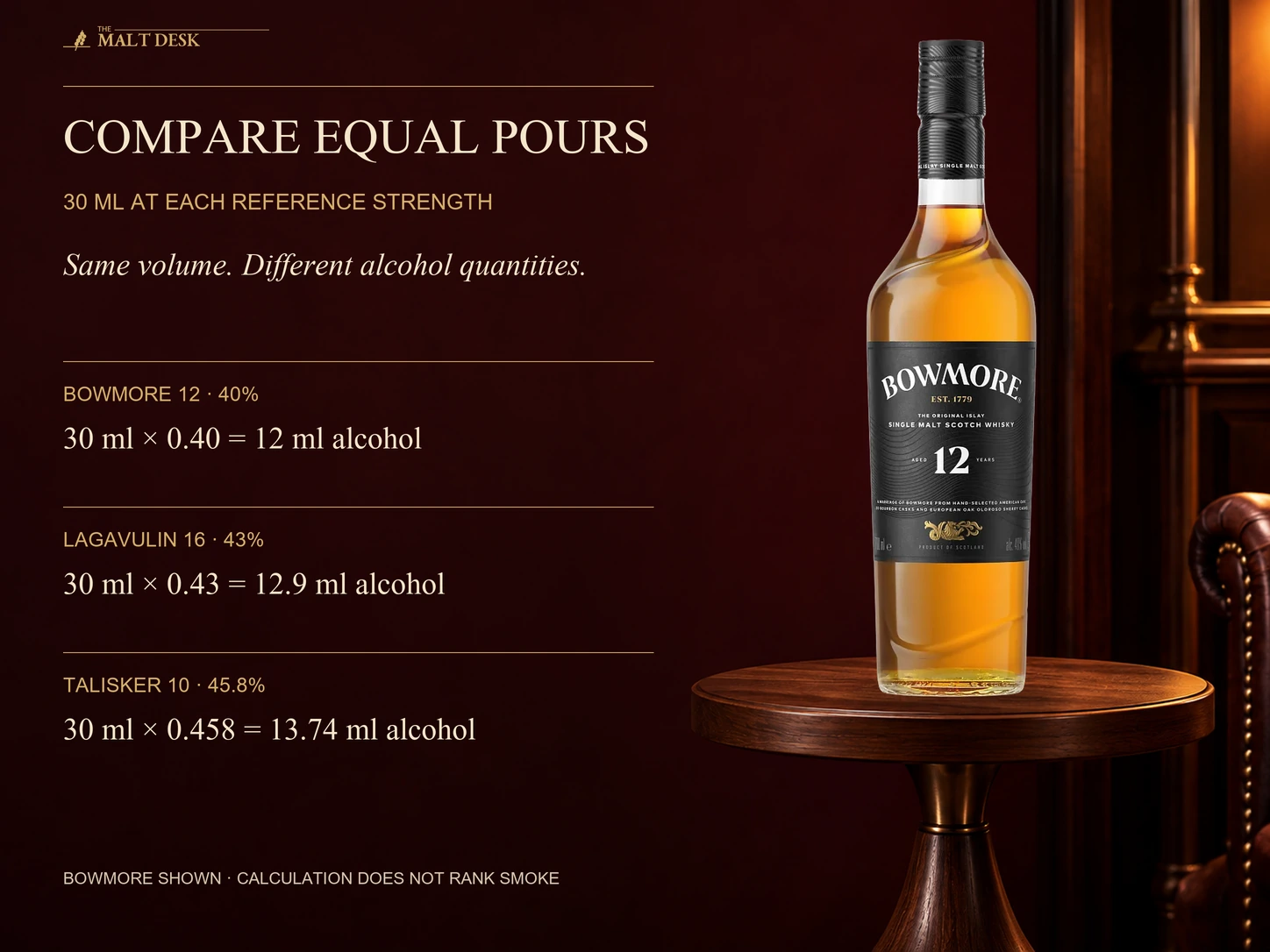
Talisker has the highest reference ABV here. At an equal serving volume, the higher-ABV expression contributes more alcohol. Record the starting strength and pour size before comparing the same serving recipe.
For a structured comparison, use the same type of glass, similar serving temperatures and equal initial measures. Record impressions before adding anything. Water can then be added in small measured steps. Equal additions of water do not produce equal final strengths when the starting ABVs differ.
Ice adds a second variable because it chills while melting. If the aim is to understand dilution, room-temperature water is easier to control. For practical serving terminology, see how to drink whiskey and the flavor map.
Equivalent Bottles and Local Cost
The earlier retailer amounts lack consistent records of location, tax, delivery and offer conditions, so this guide does not use them as a current or verified historical market range. Identify the standard age expression, printed bottle volume and actual strength before comparing dated local totals.
For equal 30 ml measures at the reference strengths, Bowmore contains 12 ml pure alcohol, Lagavulin 12.9 ml and Talisker 13.74 ml. These calculations separate quantity from smoke vocabulary.
Compare equivalent bottle sizes and the final local cost. A 700ml label beside a 750ml label can make a shelf-price comparison misleading. Age, ABV and cask information explain product differences, but personal preference still determines whether a premium is useful.
Include a Repeated Reference in the Three-Way Comparison
Velasco and colleagues’ 2013 whisky study tested audiovisual conditions in a small laboratory group and multisensory rooms in a 441-person event. Ratings of grassiness, sweetness and woody aftertaste varied with the context. The event also had an order limitation acknowledged by its authors. It did not compare Talisker, Bowmore and Lagavulin or establish a correction factor for their smoke; it shows why setting deserves a place in a comparison record.
My proposed home check uses four coded glasses: one for each of these three exact expressions and a second glass repeating one of them. A helper can assign the codes and retain the key. For an illustrative 5ml per glass, the four portions total 20ml; this is a planning example, not a requirement to finish every portion or a validated sensory protocol.
| Before revealing codes | Why record it separately |
|---|---|
| Aroma description in your own words | Keeps producer vocabulary from supplying every observation |
| Perceived smoke and pepper as separate impressions | Prevents a pepper sensation from becoming a peat score |
| Liking | An intense feature can be liked or disliked independently |
| Glass order, setting and any additions | Identifies differences beyond the bottle |
| Agreement between the duplicate references | Shows how consistent the session was for one identical whisky |
Use matched glasses, measures, temperature and lighting, and avoid changing music or ambient scents between the samples. If another comparison is wanted on a separate occasion, change the order rather than always beginning with Bowmore’s lowest reference strength. This is a way to examine order dependence.
After revealing the codes, compare the duplicate descriptions before writing a winner. A large discrepancy is a reason to keep the bottle ranking tentative and revisit conditions. Close agreement provides useful repeatability for that reference in that session, but it does not prove the three-bottle comparison is free of bias or that the result represents other drinkers.
Keep the native strengths for a question about the bottles as sold: Talisker 45.8%, Bowmore’s 40% reference and Lagavulin 43%. Matching concentration with measured water would be a different question, and would still compare complete expressions. The repeated reference tests session consistency; it does not isolate age, island or cask history.
Questions to use when comparing the three
Start with the descriptors that interest you: citrus and honey with smoke, pepper and maritime notes, or peat and medicinal associations. Then check the exact expression, size and strength. This order avoids assuming that an older age statement or a higher price must represent the next step in a fixed quality ladder.
For someone new to smoky whisky, familiarity with the terminology is more useful than a claim that one bottle is universally suitable for beginners. If comparing with other Islay styles, the Ardbeg 10 and Laphroaig 10 guides provide additional production and flavor references.
In Brief
Talisker 10, Bowmore 12 and Lagavulin 16 are single malts from different regions and bottled at different strengths. Their published notes describe distinct smoke profiles; neither age nor a single peat number establishes a universal winner.
Choose the Smoky Malt Under Comparable Conditions
Use the producer notes to shortlist the smoke direction that interests you, then compare the expressions in a consistent setting. Include a repeated reference and record glass, temperature and dilution to see whether the preference holds. Keep a seaside-bar memory as part of the occasion, while using the repeatable comparison to decide which bottle suits the intended home serve.
Common questions
Is Talisker an Islay whisky?
No. Talisker is made on the Isle of Skye. Bowmore and Lagavulin are on Islay. An island location alone does not make a whisky an Islay whisky.
Is Lagavulin 16 automatically better because it is older?
No. The age statement establishes a minimum maturation period.
Which has the highest bottling strength?
Talisker 10 at 45.8% ABV, compared with 43% for Lagavulin 16 and 40% for the reference Bowmore 12 bottling.
Sources
Current Bowmore 12 product and regional-strength information; Diageo Malts Talisker 10 and Lagavulin 16 descriptions; Talisker’s official regional strength reference; Scotch Whisky Association age and regional guidance, checked October 4, 2026. Equal-pour calculations are arithmetic at stated reference strengths.
Comparison method note: the four-glass repeated-reference exercise is The Malt Desk’s proposed practical design. The 5ml planning example totals 20ml.